
화학합성농약과 유기농업자재에 대한 가중평균사충율 기반 토마토뿔나방 살충효과 평가

초록
토마토뿔나방은 전세계적으로 가지과 작물에 심각한 피해를 일으키는 해충으로서 국내에서는 2024년 토마토 재배지에서 발생하였다. 방제 약제 선발을 위해 28종의 농자재(화학합성농약 16종, 유기농업자재 12종)를 대상으로 엽침지법을 기반으로 약효 스크리닝을 수행하였다. 약효 평가 결과 spinosad, chlorfenapyr, indoxacarb, broflanilide, diamide계성분의 약제가 약 80% 이상의 가중평균사충율을 나타내었다. 약효 반응 정보는 계통간에는 통계적인 유의성이 없었으나(P = 0.169 ), 농자재 유형별로 화학합성농약이 유기농업자재 보다 통계적으로 유의하게 약효가 높은 것으로 나타났다(P < 0.001). 이상의 결과는 토마토 재배 농가에서 발생한 토마토뿔나방 관리에 중요한 정보를 제시할 것으로 판단된다.
Abstract
The tomato pinworm (Phthorimaea absoluta) is a significant pest that causes severe damage to solanaceous crops globally. In Korea, it was first detected in tomato cultivation areas in 2024. In this study, an efficacy screening of 28 agricultural materials (16 synthetic pesticides and 12 organic agricultural materials) was conducted using a leaf-dipping bioassay method. The results revealed that products containing broflanilide, chlorfenapyr, chlorantraniliprole, cyantraniliprole, and spinosad exhibited a weighted mean mortality rate of over 80%. Synthetic pesticides demonstrated significantly higher efficacy than organic agricultural materials (P < 0.001) although there was no statistically significant difference in efficacy between strains (P = 0.169). These findings provide critical management information for P. absoluta outbreaks in tomato crops in Korea.
Keywords:
Bioassay, Insecticidal efficacy, Insecticide, Phthorimaea absoluta, Weighted mean mortality키워드:
토마토뿔나방, 생물검정, 살충효과, 살충제, 가중평균사충율서 론
토마토뿔나방은 생물지리학적으로 서부 신열대구(중앙아메리카, 안데스 산맥 지역, 태평양 연안 열대우림 지역) 토착종으로서 생장점, 엽육조직, 열매 등을 직접 가해하여 토마토를 포함한 가지과 채소 생산에 심각한 피해를 일으키는 해충이다(Guedes and Picanço, 2012; Biondi et al., 2018). 1950년 이후부터 남아메리카에 속한 국가의 토마토 생산에 심각한 피해를 일으켰으나, 2006년 스페인(Urbaneja et al., 2007) 침입 후 아프리카(Son et al., 2017), 중동(Shaltiel-Harpaz et al., 2016), 아시아(Campos et al., 2017)로 확산하였다. 중국(Zhang et al., 2021)과 일본(Sakai and Sakamaki, 2025)에서도 2017년과 2022년도에 각각 발생이 보고되었다. 국내에는 2024년 4월 1일 전북 김제 지역 토마토 재배지에서 발생하였으며, 특히, 친환경 토마토 재배단지 중심으로 피해가 확산되었다(Lee et al., 2024).
토마토뿔나방의 방제는 주로 화학합성농약과 유기농업자재 등이 활용되고 있다. 1960년에서 1990년대까지는 유기인계, 피레스로이드계, cartap, abamectin, indoxacarb 그리고 키틴 합성 저해제 등이 사용되었다. 2000년대에는 chlorfenapyr, spinosyn 그리고 diamide계 살충제가 방제에 사용되고 있다. 친환경 유기농 토마토 재배지의 경우, azadirachtin, spinosyn, Bt계열의 저독성 유기농업자재등이 사용되고 있다(Biondi et al., 2018).
토마토뿔나방 방제를 위한 화학합성농약의 남용은 약제 저항성 개체군 발달을 촉진시켰다(Guedes and Siqueira, 2012). 앞에서 언급한 화학합성농약에 대해선 전 세계적으로 이미 저항성 개체군 발달이 일어난 것으로 보고되었다. Abamectin, cartap, methamidophos약제는 남미계통에, 피레스로이드계 약제는 유럽계통에, 또한 inodoxacarb와 spinosad는 공통적으로 남미와 유럽계통에 해당 약제 저항성을 지닌 것을 확인되었다(Biondi et al., 2018). 다이아마이드계 약제는 브라질(Campos et al., 2015)과 유럽계통(Roditakis et al., 2015)에 저항성 개체군이 발달한 것을 확인되었고, 터키 계통은 피레스로이드계 약제와 indoxacarb에 대해 저항성 형질을 지닌 것으로 확인하였다(İnak et al., 2021). 중국 신장위그루와 운난성에서 채집한 계통은 5종의 약제(chlorantraniliprole, emamectin benzoate, chlorfenapyr, spinosad, indoxacarb)에 대해서 저항성 수준 평가 결과, 감수성 계통 대비 저항성비가 20배 높은 것으로 확인하였다(Li et al., 2022).
침입 해충의 효과적인 관리를 위해 상용화 된 화학합성농약과 유기농업자재에 대한 약효 스크리닝이 우선적으로 필요하다. 본 연구는 2024년 토마토 친환경 재배 농가에서 채집한 토마토뿔나방 2개 지역 집단을 대상으로 화학합성농약 16종과 유기농업자재12종을 대상으로 약효 평가를 수행하였다.
재료 및 방법
대상 계통 및 사육 방법
실험에 사용한 토마토뿔나방은 2024년 보성과 논산의 시설 토마토 재배지에서 채집하여(Table 1), 곤충 사육케이지(360 × 360 × 610 mm)에 가지(아시아흑장, 아시아종묘, 대한민국)를 공급하며 누대 사육하였다. 가지 재배는 72구 트레이에 상토(비전바이오, NH농우바이오, 수원)에 파종 후 본엽 2-3매 전개 시 포트(외경 150 mm, 높이 135 mm)에 정식하였다. 60일이 지나면 비료(20-20-20, Masterblend, 미국)를 1,000배 희석하여 관주하였으며, 생장 발달을 유지시켰다. 토마토뿔나방 유충 사육은 사육케이지에 기주식물 2개당 성충 약 100마리를 4일 간격으로 접종하여 산란을 유도하였으며, 생물검정에 사용할 대상 유충의 령기를 일정하게 하였다. 기주 식물에 접종 후 10-15일 사이의 2-3령 유충을 약효평가에 사용하였다. 사육 조건은 온도 25 ± 22oC, 습도 50 ± 7%, 광주기 16:8에서 수행하였다.

Strains used in this study
Agromaterials used in this study
시험대상 농자재 및 약효평가 방법
토마토뿔나방 보성과 논산 계통을 대상으로 화학합성농약 16종과 유기농업자재 12종에 대해 엽침지법을 적용하여 약효 평가를 수행하였다. 가지의 엽절편(지름 90 mm)을 해당 약제의 추천 약량에 30초 동안 침지한 후 30분 동안 후드 안에서 음건하였다. 대조군으로는 동일한 방법으로 가지 엽절편을 물에 침지 후 음건하였다. Insect breeding dish (120 × 80 mm, SPL Life Sciences, 포천, 경기도)에 1% 아가(Agar) 30 mL를 넣고 굳힌 후, 약액에 음건된 엽절편의 뒷면이 보이도록 치상하였다. 2-3령 토마토뿔나방을 처리구당 10마리씩 접종하였으며, 24시간 간격으로 96시간 동안 사충율을 관찰하였다. 사충 판별 기준은 붓으로 토마토뿔나방 애벌레를 자극하였을 때 2-3초 안에 위아래 혹은 양옆으로 움직이지 못하는 개체를 죽은 개체로 간주하였다. 해당 계통에 대한 각 약제별 실험은 3반복으로 수행하였으며, 약제 처리 후 온도 25 ± 2oC, 습도 45 ± 9% 조건의 실내에서 이루어졌다.
가중평균사충율을 이용한 약효 평가
32종 농자재에 대해 점박이응애(Kwon et al., 2022), 목화 진딧물(Kim et al., 2023), 가루이류(Kwon et al., 2024)의 약효 평가에 적용되었던 가중평균사충율을 적용하였다. 96 시간 동안 24, 48, 72, 96시간 사충율을 산출한 후 각 시간대 별 사충율 차이값을 가중치(w)로 하고 해당 시간의 사충율값과 곱하였다. 그리고 가중치와 사충율 곱의 합계를 가중치의 합계로 나누어 4일동안의 사충 속도가 반영된 가중평균사충율(x̄)을 산출하였다.
− xᵢ: 해당 시간 사충율
− wᵢ: 각 시간대 별 사충율 값의 차이
통계분석
본 연구에 수행된 통계 분석은 R software를 활용하였다(R Core Team, 2024). 약제간 통계적 유의성 비교는 ANOVA 분석을 활용하였으며 사후 분석은 Tukey's HSD방법을 적용하였다. 계통 간 약효 비교는 t-test를 이용하였으며, 화학합성농약과 유기농업자재 간의 약효 차이에 대한 유의성 검정은 Mann-Whitney U test를 수행하였다(McKnight and Najab, 2010).
결과 및 고찰
28종 농자재(16종 화학합성농약, 12종 유기농업자재)를 대상으로 엽침지법을 이용하여 논산과 보성에서 채집한 집단을 대상으로 약효 평가를 수행하였다. 논산 계통은 6종 화학합성농약(P_Test06, P_Test12, P_Test13, P_Test14, P_Test15, P_Test16)에 약 80%이상 가중평균사충율을 나타내었다(F29,60 = 18.8, P < 0.001) (Fig. 1A, Supplementary Figs. 1 & 2). 보성 계통의 경우, 6종 화학합성농약(P_Test06, P_Test09, P_Test13, P_Test14, P_Test15, P_Test16)에 대해 약 80%이상 가중평균사충율을 나타내었다(F29,60 = 21.1, P < 0.001) (Fig. 1B, Supplementary Figs. 1 & 2).
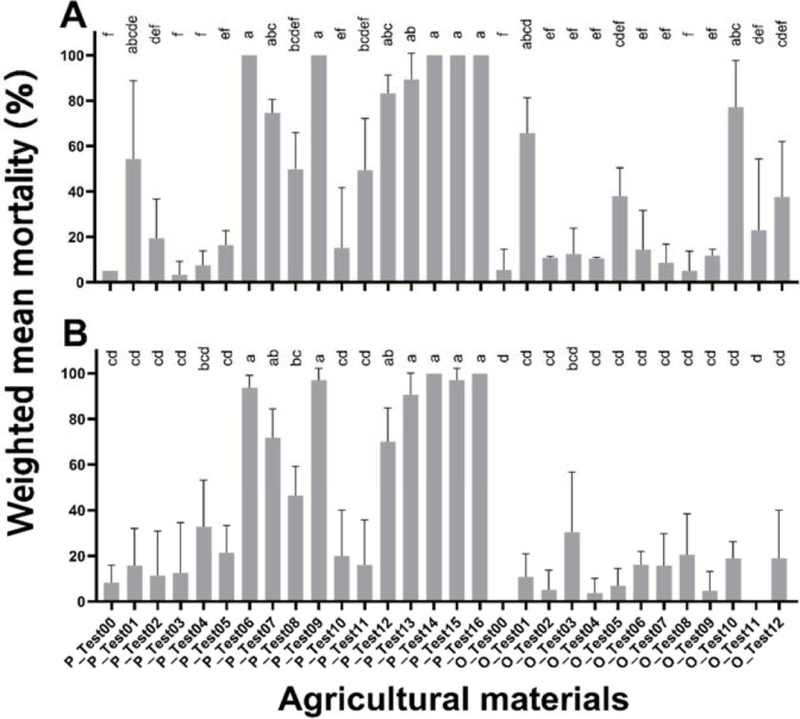
Weighted mean mortality by NS (A) and BS (B) strains, respectively, against 28 agromaterials composed with 16 synthetic pesticides and 12 organic agromaterials. Small alphabetical character means the significant difference by ANOVA (P < 0.05), respectively.
80% 가중평균사충율을 나타내는 약제들은 주로 화학합성농약에 포함되며 유효성분이 spinosad, chlorfenapyr, indoxacarb, chlorantraniliprole, cynantraniliprole, broflanilide, chlorfenapyr + fluxametamide이었고, 대상 작용기작은 5, 13, 22, 28, 30에 해당하였다(Table 1). 해당 약제들은 국내 침입 집단 토마토뿔나방에 대해 기주 식물에 대한 약해를 고려하여 우선적인 방제대상 약제로 적합할 것으로 판단된다. 본 약효 평가에 서는 상기 약제들이 효과적인 것으로 나타났으나, 국외에서는 이미 spinosad, chlorfenapyr, diamide계(chlorantraniliprole, cynantraniliprole) 등의 약제에 대해 저항성 개체군이 발달된 것으로 보고되었다(Biondi et al., 2018). 약효가 우수한 약제는 우선적으로 방제에 적용하되, 지속적인 약효 모니터링을 통해 저항성 발달 상황을 고려하여 적용할 필요가 있다.
지역 계통 간 가중평균사충율 비교에서 논산과 보성 계통이 평균적으로 42.9 ± 38%와 35.2 ± 36.7%의 약효를 각각 보였는데, 통계적 유의성이 나타나지 않았다(P = 0.169) (Fig. 2A). 이러한 특성은 본 실험에 사용한 계통이 약제 반응 기준으로 지역적으로 분화되지 않았음을 의미한다. 추가적으로 지역 계통의 집단 수가 늘어나면, 침입 집단의 약제에 대한 변화 양상을 이해하는데 도움이 될 것이다.
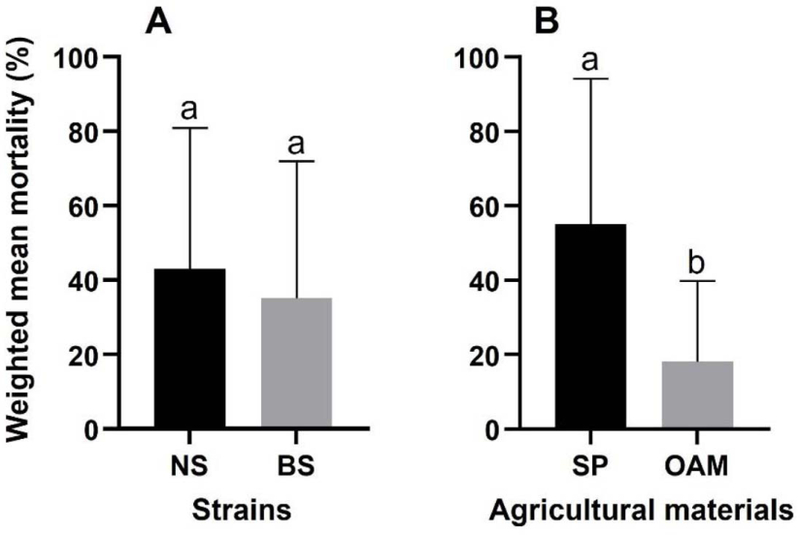
Comparisons of weighted mean mortality by strains (A) and agromaterial types (B). SP and OAM represent the abbreviation of ‘synthetic pesticides’ and ‘organic agricultural materials’, respectively. Small alphabetical character means the significant difference by t-test and Mann-Whitney U test (P < 0.05), respectively.
본 연구에 사용한 농자재는 화학합성농약과 유기농업자재로 구성되어 있는데, 농자재 유형별 가중평균사충율의 평균 비교에서 각각 55.1 ± 39.1%와 18.1 ± 21.8%로서, 화학합성 농약의 효과가 통계적으로 높게 나타났다(P < 0.001) (Fig. 2B). 유기농업자재에서 논산 계통에 대해 O_Test01과 O_Test10이 약 60% 이상의 약효를 보였으나 나머지 농자재의 약효는 높지 않았다. 보성계통에 대해서는 전체적으로 유기농업 자재에 대한 효과가 낮게 나타났다. 2024년 토마토뿔나방은 유기농업재배 농가에 피해가 심했는데(Lee et al., 2024), 친환경 토마토 생산을 지원하기 위해 친환경 유기농자재 발굴 연구가 국가수준에서 진행되어야 할 것이다.
IRAC에서는 토마토뿔나방에 엽침지법을 기반으로 cell unit(Bio-Serve) 내에 약액에 침지된 엽절편을 치상하고, unit당 1 마리의 토마토뿔나방 L2유충(4-5 mm)을 접종시킨 후 사충율을 관찰하였다(Insecticide Resistance Action Committee, 2012). 반면에 본 연구에서는 다양한 약제에 대한 신속한 약효 스크리닝에 초점을 맞추어, 90 mm 가지 절편상에 10마리 유충을 접종하여 사충율을 관찰한 것으로, 관찰 시간을 단축시켜 약효 평가를 용이하게 한 장점이 있다. 기주식물을 가지로 선정한 이유는 야외 계통 증식이 용이하였고, 관찰 기간 동안 무처리구의 애벌레의 생장과 발육을 가능하게 하였기 때문이다. 향후, 기주식물에 따른 약효 반응을 비교할 필요가 있다.
특정 약제에 대한 약효 평가는 관찰 시점에 따라 사충율이 변하므로 기준점을 선정하는데 어려움이 있다. 가중평균 사충율은 가중산술평균을 기준으로 하되, 가중치를 관찰 시간대별 차이값을 부여하여 속효성일수록 가산점을 부여하는 특징이 있다. 또한, 관찰 시점 별 사충율의 특성이 종합적으로 반영된 지수이므로 약효 특성을 이해하는데 도움이 된다(Kwon et al., 2022). 향후, 가중평균사충율의 약효 결과와 포장 약효 평가 실험에서의 상관성 검증을 통해 본 연구 결과에서 나온 선정 약제가 포장 적용성이 우수함을 추가적으로 실험하여 증명할 필요가 있다.
정리하면, 본 조사를 통해 침입 해충 토마토뿔나방에 대한 화학합성농약과 유기농업자재에 대한 약효 평가 결과는 우수 약제 발굴을 통해 국내 발생 해충군의 초기 관리에 기여할 것이다. 이는 토마토의 안정적인 생산에 기여하여 농업인의 소득 유지 및 증대에 도움을 줄 것이다.
Acknowledgments
본 연구는 농림축산식품부의 재원으로 농림식품기술기획평가원의 핵심농자재 국산화기술개발사업(321054-05)의 지원을 받아 수행되었음.
이해상충관계
저자는 이해상충관계가 없음을 선언합니다.
References
-
Biondi A, Guedes RNC, Wan F-H, Desneux N, 2018. Ecology, worldwide spread, and management of the invasive South American tomato pinworm, Tuta absoluta: Past, present, and future. Ann. Rev. Entomol. 7(63):239-258.
[https://doi.org/10.1146/annurev-ento-031616-034933]

-
Campos MR, Biondi A, Adiga A, Guedes RN, Desneux N, 2017. From the Western Palaearctic region to beyond: Tuta absoluta 10 years after invading Europe. J. Pest Sci. 90:787-796.
[https://doi.org/10.1007/s10340-017-0867-7]
- Campos MR, Silva TB, Silva WM, Silva JE, Siqueira HA, 2015. Susceptibility of Tuta absoluta (Lepidoptera: Gelechiidae) Brazilian populations to ryanodine receptor modulators. Pest Manag. Sci. 71(4):537-544.
-
Guedes R, Picanço M, 2012. The tomato borer Tuta absoluta in South America: pest status, management and insecticide resistance. EPPO Bulletin 42(2):211-216.
[https://doi.org/10.1111/epp.2557]
- Guedes R, Siqueira H, 2012. The tomato borer Tuta absoluta: insecticide resistance and control failure. CABI Reviews (2012):1-7.
- İnak E, Øzdemir E, Atış AE, Randa Zelyüt F, İnak A, et al., 2021. Population structure and insecticide resistance status of Tuta absoluta populations from Turkey. Pest Manag. Sci. 77(10):4741-4748.
- Insecticide Resistance Action Committee (2012). IRAC Susceptibility Test Method 022. Retrieved from https://irac-online.org/methods/tuta-absoluta-larvae/
-
Kim MH, Im JS, Ahn YK, Kwon HY, Park Y, et al., 2023. Insecticidal efficacy monitoring of agricultural materials against Aphis gossypii populations collected at agricultural and forestry area. Korean. J. Pestic. Sci 27(2):75-84. (In Korean)
[https://doi.org/10.7585/kjps.2023.27.2.75]
-
Kwon DH, Gwak GY, Kim IH, Ahn YG, Hong KH, 2022. Selection techniques of agrochemical materials by multi array leaf dipping bioassay method for the precision management of two-spotted spider mite (Tetranychus urticae) in fruit vegetables. Korean. J. Pestic. Sci 26(4):258-272. (In Korean)
[https://doi.org/10.7585/kjps.2022.26.4.258]
-
Kwon DH, Jeon YS, Kwon MJ, Yoo GR, Park JH, et al., 2024. Insecticidal efficacy evaluation against agricultural materials in two whitefly species collected at fruit vegetables. Korean J. Pest. Sci. 28(2):103-112. (In Korean)
[https://doi.org/10.7585/kjps.2024.28.2.103]
-
Kwon DH, Kwack GY, Won SM, Kim MH, Choi HJ, et al., 2021. Establishment of classification system of major ingredients in organic agricultural materials associated with insect pest control. Korean. J. Pestic. Sci. 25(4):287-304. (In Korean)
[https://doi.org/10.7585/kjps.2021.25.4.287]
-
Lee MH, Jeong D, Lee G-S, Paik C, 2024. First report of Phthorimaea absoluta (Lepidoptera: Gelechiidae) in Korea. J. Integr. Pest Manag. 15(1):36.
[https://doi.org/10.1093/jipm/pmae028]
- Li X-W, Ma L, Lu Y-B, 2022. Susceptibility of Xinjiang and Yunnan populations of Tuta absoluta (Lepidoptera: Gelechiidae) to six insecticides and its relationship with detoxification enzyme activities. Acta Entomol. Sin. 65(8):1010-1017.
- Mcknight PE, Najab J, 2010. Mann‐Whitney U Test. CEPS: 1-1.
- R Core Team. (2024). R: A language and environment for statistical computing. In. Retrieved from https://www.R-project.org/
- Roditakis E, Vasakis E, Grispou M, Stavrakaki M, Nauen R, et al., 2015. First report of Tuta absoluta resistance to diamide insecticides. J. Pest Sci. 88(1):9-16.
- Sakai D, Sakamaki Y, 2025. Discrimination of larvae of the tomato leaf miner, Tuta absoluta, from other gelechiid larvae attacking solanaceous plants in Japan (Lepidoptera: Gelechiidae). Lepidoptera Sci. 76(1):31-41.
-
Shaltiel-Harpaz L, Gerling D, Graph S, Kedoshim H, Azolay L, et al., 2016. Control of the tomato leafminer, Tuta absoluta (Lepidoptera: Gelechiidae), in open-field tomatoes by indigenous natural enemies occurring in Israel. J. Econ. Entomol. 109(1):120-131.
[https://doi.org/10.1093/jee/tov309]
-
Son D, Bonzi S, Somda, I, Bawin T, Boukraa S, et al., 2017. First record of Tuta absoluta (Meyrick, 1917) (Lepidoptera: Gelechiidae) in Burkina Faso. Afr. Entomol. 25(1):259-263.
[https://doi.org/10.4001/003.025.0259]
- Urbaneja A, Vercher R, Navarro-Llopis V, Porcuna Coto JL, García-Marí F, 2007. La polilla del tomate, ‘Tuta absoluta’. Phytoma Esp. (194):16-23.
-
Zhang Gf, Xian Xq, Zhang Yb, Liu Wx, Liu H, et al., 2021. Outbreak of the South American tomato leafminer, Tuta absoluta, in the Chinese mainland: Geographic and potential host range expansion. Pest Manag. Sci. 77(12):5475-5488.
[https://doi.org/10.1002/ps.6588]
Appendix
Appendix
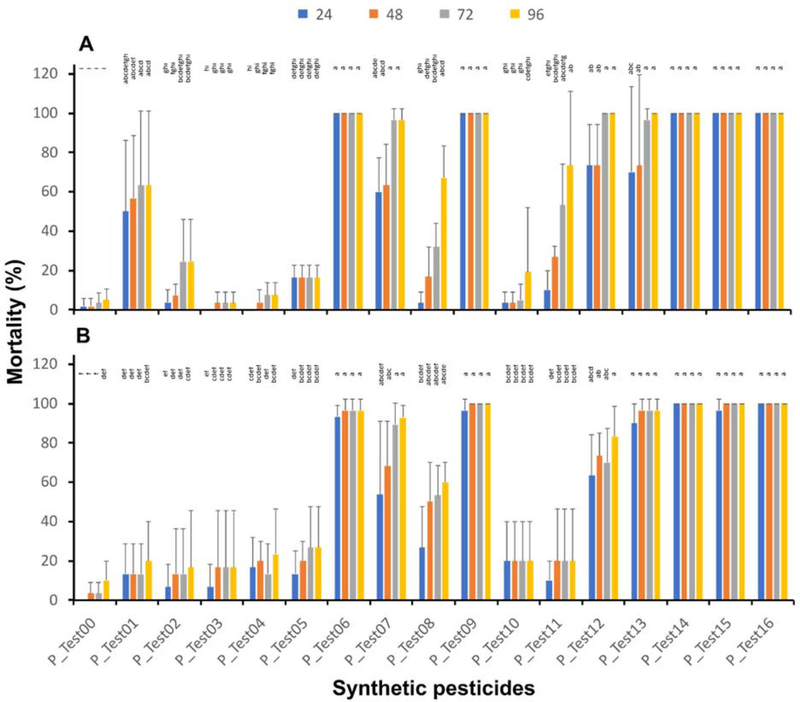
Mortality from 24 to 96 hours after treatment with 16 synthetic pesticides in the NS (A) and BS (B) strains. Error bars indicate standard deviations. Small alphabetical character means the significant difference (P < 0.05) by ANOVA with LSD post hoc test.
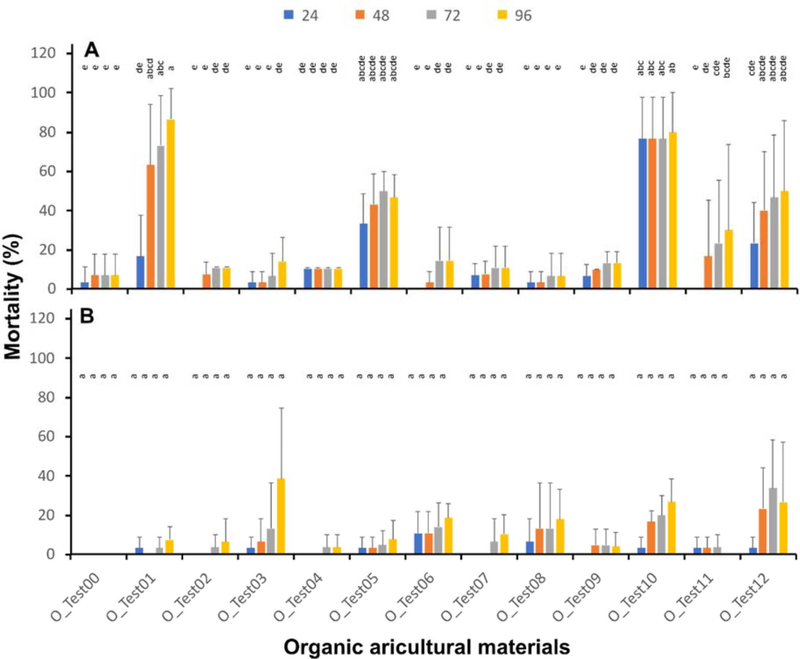
Mortality from 24 to 96 hours after treatment with 12 organic agricultural materials in the NS (A) and BS (B) strains. Error bars indicate standard deviations. Small alphabetical character means the significant difference (P < 0.05) by ANOVA with LSD post hoc test.
Deok Ho Kwon: Experiment design, Data analysis, Writing, Draft review, https://orcid.org/0000-0003-2162-4771
Gi Ryeol Yu: Bioassay
Haeri Jeon: Rearing, Bioassay
Yein Lim: Bioassay
Eunyoung Yang: Draft review
Yul Gyun Ahn: Draft review