우엉 중 살충제 Tebufenozide의 경시적 잔류량과 식이 섭취 노출 위해 평가
 ; Kyeong-Yeol Oh1
; Sang-Woo Kang1, 2
; Jin-Seong Kim1, 3
; Kwang-Min Kim1
; Jin-Hyo Kim1, *
; Kyeong-Yeol Oh1
; Sang-Woo Kang1, 2
; Jin-Seong Kim1, 3
; Kwang-Min Kim1
; Jin-Hyo Kim1, *
초록
도둑나방 방제에 사용될 수 있는 tebufenozide의 우엉 중 잔류물 소실과 식이 위해성을 평가하기 위해, tebufenozide 8% 수화제를 7일 간격 2회 경엽 살포하였다. 약제 살포 후 우엉의 뿌리에서는 불검출 되어 잔류소실과 식이섭취 위해평가가 요구되지 않았으나, 우엉 잎에서는 2회 살포 후 초기 잔류량이 8.63 mg kg−1이었으며, 경시적 잔류 반감기는 2.57일로 나타났다. 우엉잎의 초기 잔류량은 동일 수준으로 경엽처리된 아로니아 열매의 잔류농도 보다 약 3배 높았으며, 이는 우엉잎의 단위 무게당 면적비가 높아 나타난 결과로 판단되었다. 국내에 등록된 MRL을 활용한 tebufenozide의 TMDI는 전연령 평균 노출량이 6.20 × 10⁻³ mg day−1로 ADI의 31.0%였다. 특히, 1−2세 집단에서 가장 높은 노출량 (52.2% ADI)이 예측되었다. 또한, 극단적 식이섭취 집단인 식품별 상위 5% 집단에 대한 TMDI 노출평가에서 시금치, 상추 및 양배추가 ADI의 20%를 초과하는 식품으로 확인되었다.
Abstract
To evaluate the residue dissipation of tebufenozide in burdock, 8% wettable tebufenozide powder was applied, and the residue dissipation in the leaves and the roots was analyzed. Tebufenozide was not detected in the roots, whereas the initial residue was 8.63 mg kg⁻¹ in the leaves, and the dissipation half-life was 2.57 days. The initial residue in burdock leaves was approximately three times higher than that observed in treated aronia berries, which was attributed to the high surface area-to-weight ratio of burdock leaves. Based on the maximum residue limits (MRLs) registered in Korea, the theoretical maximum daily intake (TMDI) of tebufenozide was estimated to be 6.20 × 10⁻³ mg day−1, corresponding to 31.0% of the acceptable daily intake (ADI) for the overall population. The 1-2-year-old age group was estimated to have the highest exposure, reaching 52.2% of the ADI. Furthermore, the TMDI for spinach, lettuce, and cabbage exceeded 20% of the ADI in each high food consumer (95th percentile) group.
Keywords:
Burdock, Dissipation time, Percentage of acceptable daily intake, Residual safety, Tebufenozide키워드:
우엉, 잔류반감기, 초기잔류량, 식이섭취노출량, 테부페노자이드서 론
우엉(Arctium lappa L.)은 재배 면적이 1,000 ha 미만인 국화과의 소면적 재배 작물 중 하나로 잎은 쌈채소로 섭취하며, 뿌리는 밑반찬으로 사용되는 작물이다. 우엉의 생육은 파종 후 유묘기 생육이 느리고, 이 시기에 지상부와 지제부가 동시에 노출되는 생육 특성이 있고, 이로 인해 토양 표면에서 활동하는 해충에 의한 피해가 종종 발생하지만(Dousti, 2010; Münzbergová and Skuhrovec, 2020; RDA, 2026; Weintraub et al., 2017), 이들 해충 방제를 위해 등록된 약제는 많지 않다(KCPA, 2026; Lee et al., 2003; Lee et al., 2009).
밤나방과의 도둑나방(Mamestra brassicae) 유충 등은 경작지 토양에 서식하며, 연 2회 발생하는 해충으로 국내에서는 1회 성충이 주로 6월에, 2회 성충이 8월에 출현하는 것으로 알려져 있다(Devetak et al., 2014; Güçlü et al., 2006; Gwon et al., 2005). 도둑나방의 유충기간은 약 40-80일에 이르며, 이들 유충은 주로 야간에 작물의 지제부를 절단하는 습성을 가지고 있어, 발생 초기 발견이 어렵고 단기간 내 집단 피해를 유발한다(Guo et al., 2020; Gwon et al., 2005; Rodingpuia and Lalthanzara, 2021). 이러한 나비목 해충의 생태적 특성과 우엉 경작 피해 양상을 고려할 때, 나비목 유충을 표적으로 하는 살충제의 품목 검토가 필요하다.
Tebufenozide는 디아실하이드라진계 살충제로 나비목 유충의 탈피호르몬 수용체(Ecdysone) 기능을 활성화하는 작용기작(IRAC Group 18)이 알려진 약제이다. 국내에서는 이화명나방, 혹명나방, 잎말이나방, 파밤나방, 열대거세미나방, 흰띠명나방, 도둑나방, 뒷날개흰밤나방, 사과굴나방 등 나방류의 유충 방제에 등록되어 널리 쓰이고 있다(IRAC, 2026; RDA, 2026; Retnakaran et al., 2001; Retnakaran et al., 2003). 특히, tebufenozide는 방제 수요가 많은 벼, 무, 배추, 고구마, 땅콩, 시금치 등 다양한 작물에 대해 약효를 인증 받고 품목별 안전사용기준이 등록되어 있으나, 우엉에 대해서는 안전사용기준이 등록되어 있지 않다(KCPA, 2026). 따라서 본 연구에서는 우엉 가식부에 대한 tebufenozide의 안전사용기준 등록을 위해 포장 잔류시험을 수행하여 가식부의 초기 잔류량과 잔류 변화를 평가하고, tebufenozide에 대한 식이섭취 노출량을 이론적 최대 일일섭취량(Theoretical maximum daily intake, TMDI)을 토대로 평가하였다.
재료 및 방법
표준품 및 시약
Tebufenozide 분석용 표준품은 Sigma-Aldrich® PESTANALTM (St. Louis, Missouri, USA)에서 구입하여 사용하였으며, 시험대상 성분의 이화학적 특성은 Table 1과 같다. Acetonitrile (ACN)과 methanol (MeOH), distilled water (DW)는 Burdick & JacksonTM (Honeywell International Inc., Mo, NJ, USA)의 high-performance liquid chromatography (HPLC) grade를 사용하였고, ammonium formate (Kanto Chemical Co., Inc., Tokyo, Japan)와 formic acid (Merck KGaA, Darmstadt, Germany)는 순도 >98%를 사용하였다. 우엉 중 tebufenozide의 추출은 Phenomenex Inc. (Torrance, CA, USA)의 QuEChERS extraction kit (4 g magnesium sulfate anhydrous anhydrous, 1 g sodium chloride, 1 g sodium citrate tribasic dihydrate 및 0.5 g sodium citrate dibasic sesquihydrate)를 사용하였고, 추출 시료의 정제를 위한 dispersive-solid phase extraction (d-SPE)는 primary-secondary amine (PSA) 25 mg과 C18 25 mg 및 MgSO4 150 mg으로 구성된 Agilent Technologies, Inc. (Santa Clara, CA, USA)의 d-SPE kit를 사용하였다.

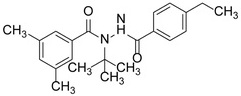
Information on the physicochemical properties and structure of tebufenozide
시험포장 및 약제 처리
시험에 사용된 우엉 품종은 유천이상(KyoungShin Seeds Co., Ltd., Uiseong, Korea)을 사용하였으며, 경상남도 진주시에서 노지 재배하며, 4-6월에 시험하였다. 시험포장은 반복구마다 12.5 m2 의면적으로 3반복배치하였고, 각시험구별 완충지를 조성하였다. 잔류시험은 tebufenozide 8% 수화제 (Kyung Nong Co., Ltd., Seoul, Korea)를 1,000배 희석하여 전동식 분무기를 통해 수확 전 7일 간격 2회 경엽 살포 후 일시 수확하였다. 1회 살포당 유효성분 살포 약량은 0.118-0.132 kg a.i. ha-1 이었다. 분석용 시료는 반복구당 우엉 잎 1.0 kg 이상, 우엉 뿌리 2.0 kg 이상을 수확하였으며, 수확한 시료는 냉장상태로 실험실로 옮긴 후 우엉 잎은 변질된 잎을 제거하였고, 뿌리는 흐르는 물로 흙을 제거한 뒤 드라이아이스와 함께 균질화하고, 잔류분석 전까지 -20oC에서 보관하였다.
시료 추출 및 정제
균질화 된 시료 10 g에 ACN 10 mL를 가한 후 QuEChERS extraction kit를 첨가하고 1분간 vortex (G-560, Scientific Industries, Inc., Bohemia, NY, USA)하였다. 이후 30분간 200 rpm에서 상하 진탕 한 후 15분간 초음파 추출(Powersonic 410, Hwashin Tech Co., Ltd., Seoul, Korea) 한 뒤, 4,000 rpm에서 10분간 원심분리(Labogene 1580R, LabogenTM, Bio-Medical Science Co., Ltd., Seoul, Korea) 하였다. 추출 상등액 1 mL를 d-SPE kit가 든 e-tube에 취한 후 vortex하고, 0.22 μm syringe filter (PTFE, Biofact Co., Ltd., Daejeon, Korea)로 여과한 뒤 추출 시료 0.1 mL를 ACN 0.9 mL와 섞어 10배 희석한 후 기기분석 하였다.
분석 기기 및 기기 분석
정량 분석은 LC-MS/MS (LC-MS 8050 Triple Quadrupole, Shimadzu Co., Kyoto, Japan)을 사용하였으며, 물질 분리는 Kinetex® Phenyl-Hexyl (2.1 × 100 mm, 2.6 μm, Phenomenex, Torrance, CA, USA)을 사용하였고, 상세 조건은 Table 2에 명시하였다.
The instrumental condition of LC-MS/MS for quantitative analysis of tebufenozide in Burdock
정량 분석법 검증
표준 검량선은 tebufenozide 표준품을 이용하여 1,000 mg L−1 stock solution을 제조한 뒤 우엉 잎과 뿌리의 무처리 추출물을 이용해 0.001−0.05 mg L−1의 범위 matrix-matched standard를 조제하고 이를 활용하여 작성하였다. 우엉 잎과 뿌리 중 tebufenozide 잔류분석에 사용된 검량선의 직선성(R2)은 0.9986−0.9999로 정량분석에 적합하였고, 우엉 잎과 뿌리에서의 정량한계는 모두 0.01 mg kg−1이었다. 우엉에서 분석 대상 성분의 회수율은 0.01 mg kg−1과 0.1 mg kg−1에서 3반복 수행하였고, 잎과 뿌리에서 모두 96.9−105.2% 범위에서 확인되었으며, 변이계수(Coefficient of variation, CV)는 1.7−2.8%이었다
작물 잔류 반감기
작물 잔류 반감기는 최종 약제 처리 후 경과일수에 따른 잔류량 변화를 아래의 식 (1)에 적용하여 산출하였고, 작물 잔류 반감기(dissipation time, DT50)는 식 (2)를 사용하여 산출하였다(Kim et al., 2025; Lee et al., 2022; Lee et al., 2024).
| (1) |
| (2) |
농산물의 무게와 표면적 산출
시료의 무게는 전자저울(BL220H, Shimadzu Co., Kyoto, Japan)을 사용하여 측정하였다. 표면적 측정을 위해 시료와 측정자를 함께 촬영가능한 높이에 카메라를 고정하고, 수확한 우엉 잎을 대상으로 무작위로 8반복을 선정하여 촬영하였다. 촬영된 이미지는 ImageJ 프로그램(National Institutes of Health, USA)을 이용하여 개체별 면적을 산출하였다. 우엉 잎은 앞과 뒷면을 모두 고려하기 위해 측정된 면적에 2를 곱하여 총 표면적을 계산하였으며, 아로니아는 개체별 지름을 측정한 후 구의 표면적 계산식에 따라 산출하였다.
식이섭취 잔류 위해성 평가
Tebufenozide의 잔류 위해성 평가를 위한 TMDI는 식품의약품안전처(Ministry of Food and Drug Safety, MFDS)의 잔류물질정보에 등록되어 있는 최대잔류허용량(Maximum residue limit, MRL)과 2023년 국민영양통계 자료를 활용하였으며, 전연령 평균 식이 섭취량과 평균 체중(62.6 kg)을 식 (3)에 사용하여 산출하였다(KHIDI 2026; Kang et al., 2024; Kim et al., 2021). 국민건강영양통계에 제시된 식이섭취량은 신선식품 섭취량만 사용하였으며, 가공식품의 섭취량은 반영하지 않았다. 산출된 TMDI는 MFDS에서 제시한 일일섭취허용량(acceptable daily intake, ADI) 0.02 mg kgb.w.−1 day−1을 사용하여 Eq. 4를 통해 %ADI를 산출하였다(Chun and Kang, 2003; MFDS, 2026). 식품섭취량 및 연령집단 차이에 따른 TMDI 평가는 국민영양통계에서 분류된 연령집단(1−2세 집단, 3−5세 집단, 6−11세 집단, 12−18세 집단, 19−29세 집단, 30−49세 집단, 50−64세 집단 그리고 65세 이상)과 식품별 극단적 식이섭취량을 나타내는 집단(95th과 99th percentile) 정보를 사용하여 노출평가를 실시하였다.
| (3) |
| (4) |
결과 및 고찰
우엉 잎과 뿌리에서의 tebufenozide 잔류량
우엉 잎에서는 최종 약제 살포 2시간 경과 후 초기 잔류량이 8.63 ± 0.36 mg kg−1 이었고, 14일 경과 후 잔류량은 0.73 ± 0.12 mg kg−1이었다. 우엉 뿌리에서는 최종 약제 살포 당일부터 모두 정량한계(0.01 mg kg−1) 미만으로 불검출되었다(Table 3).
Time-course residues concentration and the DT50 of tebufenozide in burdock
최종 약액 살포 후 경과 시간에 따른 tebufenozide의 잔류 농도는 Fig. 1과 같이 경시적 잔류 감소를 확인할 수 있었다. 최종 약액 살포 14일 경과 후 잔류농도는 초기 잔류농도의 8.46% 수준으로 감소하였다. 회귀분석을 통해 산출한 경시적 잔류 반감기는 2.57일로 나타났다. 이러한 잔류 소실은 비대생장에 따른 희석 효과와 대사적 요인에 의한 분해가 주요 인자로 고려 될 수 있다(Lee et al., 2024; Lee et al., 2025; Oh et al., 2023). 반면, 우엉 뿌리에서는 약제 처리일부터 최종 수확일까지 처리 약제가 모두 불검출 되었으며, 이는 경엽 처리된 비침투성 tebufenozide가 잎에서 뿌리로 체내 이행이 제한되어 나타난 결과로 추정된다(FAO, 2026).
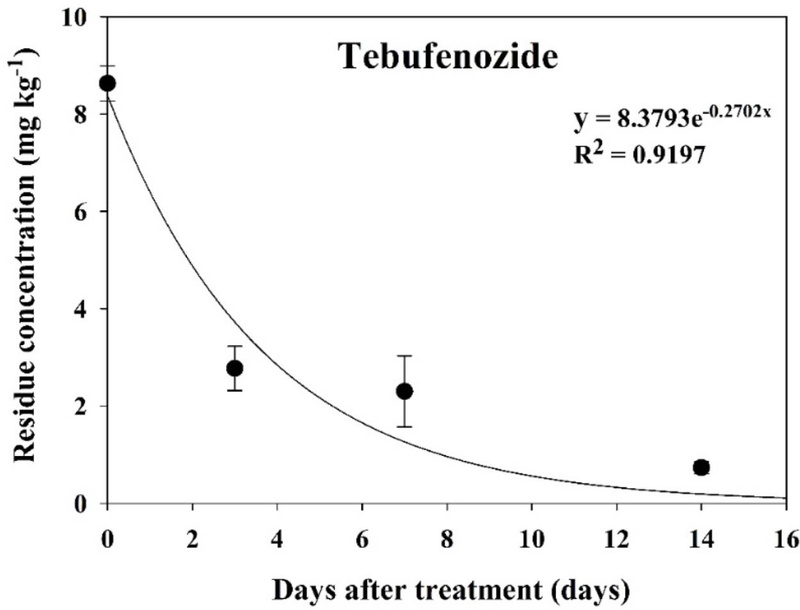
Residue dissipation of tebufenozide in burdock leaves.
초기 잔류 수준은 작물의 형태적 특성과 재배 환경 등 복합적인 요인의 영향을 받는 것으로 알려져 있다(Jin et al., 2018; Kim et al. 2025; Oh et al., 2022). 우엉 잎의 초기 잔류량 8.63 mg kg−1은 아로니아 열매에서 보고된 동일성분 약제의 초기 잔류량 2.86 mg kg−1에 비해 3배 가량 높은 것으로 확인되며, 이는 비표면적의 차이에 의한 것으로 추정된다. 이에 따라, 본 연구에서는 우엉 잎과 아로니아 열매의 비표면적을 비교하여, 이러한 초기 잔류농도 차이의 원인을 보다 분명히 하고자 하였다. 우엉 잎의 비표면적은 27.8 cm2 g−1으로 아로니아 열매(5.47 cm2 g−1)에 비해 약 5배 넓은 것이 확인되었다(Table 4). 하지만, 아로니아 시험에서 사용된 살포약액의 추정농도(100 mg L−1)가 우엉 잔류 시험에 사용된 살포액의 추정농도(80 mg L−1)보다 1.25배 높았던 점을 반영하면, 아로니아 열매의 단위면적당 약제 부착량(0.52 μg cm−2)이 우엉 잎(0.31 μg cm−2) 보다 약 30% 가량 더 많은 것으로 나타난다. 이러한 차이를 아로니아 잔류시험에 사용된 액상수화제와 우엉 잔류시험에 사용된 수화제의 제형적 특성차이로 인한 작물 부착량 차이로 판단할 수 있으나, 시험 전반에 걸친 반복 시험구의 오차 등을 고려하면, 제형에 의한 차이가 초기 부착량에 유의적 영향을 미친 것으로 단정할 수는 없었다.
Specific surface area and the attached residue amount on the burdock leaf and aronia berry
TMDI에 의한 tebufenozide의 노출 수준 평가
현재 tebufenozide는 국내에서 가지를 포함한 56개 작물에 대해 MRL이 설정 되어있다(MFDS, 2026). 이를 기반으로 2023년 기준 1세 이상 전 연령층의 평균 체중(62.6 kg)과 MRL 설정 작물의 평균 식이섭취량을 사용하여 TMDI를 산출한 결과, 6.20 × 10⁻³ mg kgb.w.−1 day−1으로 ADI 대비 31.0%이었다(Table 5).
TMDI and %ADI of tebufenozide based on average food consumption for the general population
또한 연령별 집단의 식이섭취량을 기준으로 %ADI를 산출한 결과, 1−2세 집단에서 가장 높은 52.2%로 예측되었으며, 이어서 50−64세 집단, 65세 이상 집단 순으로 높은 경향을 보였고, 19−29세 집단에서 가장 낮은 값이 산출되었다(Fig. 2).
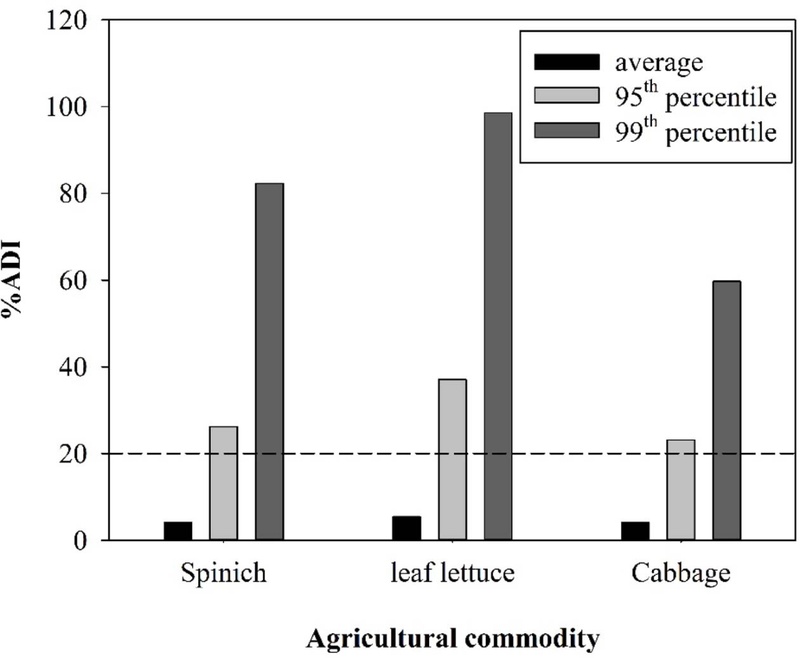
TMDI contribution to ADI by age group.
국민영양통계에 보고된 식품별 식이섭취 상위 집단(95th, 99th percentile)의 식품 섭취량을 반영하여 식품별 TMDI에 의한 %ADI 기여도를 분석한 결과, 시금치, 상추 및 양배추의 상위 5% 식품섭취군은 개별 식품 섭취만으로도 각각 ADI의 20%를 초과하였다. 특히 상추를 극단적으로 섭취하는 상위 1% 섭취 집단의 TMDI는 ADI의 98.6%로 매우 높았다(Fig. 3). 따라서, 시금치, 상추, 양배추 등 극단적 섭취자의 경우 식이섭취 노출량이 ADI를 초과할 가능성이 있음을 시사한다. 이와 달리, 우엉 잎은 국민영양통계에 집계되는 주요 식품군이 아니며, tebufenozide의 소실 양상과 낮은 섭취 수준을 종합적으로 고려할 때, 우엉 잎과 뿌리에 대한 잔류허용기준의 신규 설정은 가능할 것으로 판단된다.
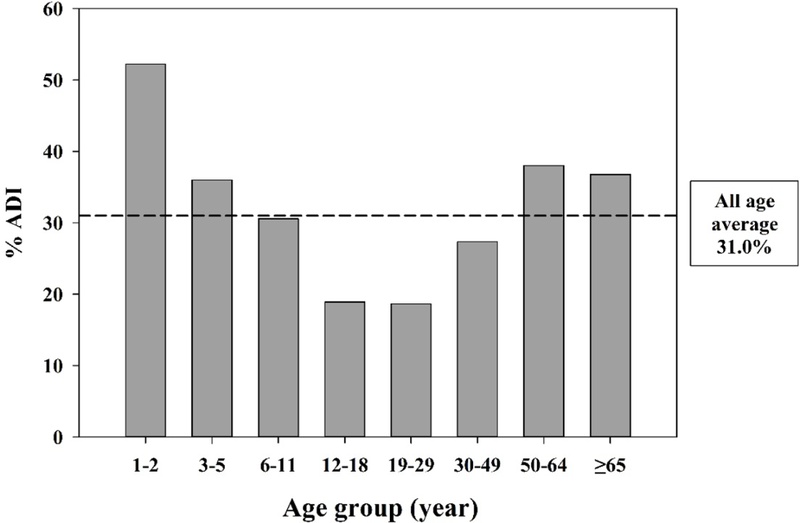
TMDI contribution to the ADI of tebufenozide in the heavy food diet group (average, 95th percentile, and 99th percentile).
Acknowledgments
본 연구는 농촌진흥청 연구사업 (RS-2024-00394889, RS-2024-00352111)의 지원에 의해 수행되었으며, 이에 감사드립니다.
이해상충관계
저자는 이해상충관계가 없음을 선언합니다.
REFERENCES
-
Chun OK, Kang HG, 2003. Estimation of risks of pesticide exposure, by food intake, to Koreans. Food Chem. Toxicol. 41(8):1063-1076.
[https://doi.org/10.1016/S0278-6915(03)00044-9]

-
Devetak M, Bohinc T, Kač M, Trdan S, 2014. Seasonal dynamics of the cabbage armyworm (Mamestra brassicae [L.]) and the bright-line brown-eyes moth (Mamestra oleracea [L.]) in Slovenia. Hortic. Sci. 41(2):80-88.
[https://doi.org/10.17221/209/2013-HORTSCI]
- Dousti A, 2010. Annotated List of Agromyzidae (Diptera) from Iran, with Four New Records. J. Entomol. Res. Soc. 12(3):1-61302.
- Food and Agriculture Organization (FAO), 2026. 4.22 Tebufenozide (196) (T,R)*. https://www.fao.org/4/w3727e/w3727e0s.htm, (Accessed Feb. 24. 2026). (In Korean)
-
Guo JL, Li XK, Shen XJ, Wang ML, Wu KM, 2020. Flight Performance of Mamestra brassicae (Lepidoptera: Noctuidae) Under Different Biotic and Abiotic Conditions, J. Insect Sci. 20(1):2.
[https://doi.org/10.1093/jisesa/iez126]
- Gwon M, Gwon H-J, Lee S-H, 2005. Temperature-dependant development and seasonal occurrence of Cabbage armyworm (Mamestra brassicae L.) at Highland Chinese cabbage fields. Korean J. Appl. Entomol. 44(3):225-230. (In Korean)
- Güçlü Ş, Hayat R, Gültekin L, Tozlu G, 2006. Some biological observations on Mamestra brassicae (Linnaeus, 1758) (Lepidoptera: Noctuidae), an important cabbage pest in Erzurum, Turkey. Atatürk Üniv. Ziraat Fak. Derg. 37(1):17-20.
- Inscecticide Resistance Action committee (IRAC), 2025. Mode of action. https://irac-online.org/mode-of-action/classification-online/, (Accessed Dec. 13. 2025). (In Korean)
-
Jin MJ, Park HK, Jeong HR, Lee JW, Jo SH, et al., 2018. Residual characteristics and safety assessments of the fungicide fenhexamid in some minor crops. Korean J. Pestic. Sci. 22(4):363-369. (In Korea)
[https://doi.org/10.7585/kjps.2018.22.4.363]
-
Kang SW, Kim KM, Lee S, Kim SC, Hong SM, Kim JH, 2024. Dietary exposure assessment of mineral and trihalomethane in the major Korean seaweeds. J. Appl. Biol. Chem. 67:26. (In Korean)
[https://doi.org/10.3839/jabc.2024.026]
-
Kim KM, Park SH, Lee DY, Lee JW, Oh KY, et al., 2025. Dissipation of pencycuron in greenhouse soil and its bioconcentration factor for estimation of the residue in spinach. Appl. Biol. Chem. 68:62. (In Korean)
[https://doi.org/10.1186/s13765-025-01040-7]
-
Kim KM, Kim JS, Oh KY, Ullah W, Kim JH, 2025 Assessment of dietary exposure to picoxystrobin, pydiflumetofen, and pyraclostrobin with residual dissipation in leaf mustard (Brassica juncea). Korean. J. Pestic. Sci. 29(1):1-8. (In Korea)
[https://doi.org/10.7585/kjps.2025.29.1.1]
-
Kim YJ, Song JW, Choi SG, Kim JH, 2021. Residual characteristics of fungicides azoxystrobin, fluxapyroxad, and penthiopyrad on Peucedanum japonicum Thunb. Korean. J. Pestic. Sci. 25(4):415-424. (In Korean)
[https://doi.org/10.7585/kjps.2021.25.4.415]
- Korea Crop Protection Association (KCPA), 2025. Agrochemical use guide book. https://www.koreacpa.org/ko/use-book/, (Accessed Dec. 11. 2025). (In Korean)
- Korea Health Industry Development Institute (KHIDI), 2026. National Nutrition Statistics. https://www.khidi.or.kr/kps/dhraStat/result10?menuId=MENU01663&year=2023, (Accessed Jan. 15. 2026) (In Korean)
-
Lee DY, Bae JY, Song YH, Oh KY, Kim YJ, et al., 2022. Residual dissipation pattern and residual safety assessment of dichlorvos and valifenalate in Chinese chives (Allium tuberosum R.) under greenhouse condition. Korean J. Pestic. Sci. 26(1):34-42. (In Korean)
[https://doi.org/10.7585/kjps.2022.26.1.34]
- Lee JH, Im JH, Jeong JD, Seo DH, 2003. Major Characteristics of Burdock (Arctium lappa L.) Native to Yeong-Nam Region. Korean J. Plant Res. 16(1):12-16. (In Korean)
-
Lee JW, Kim JS, Park JH, Noh H-H, Oh MS, et al., 2024. Investigation of residue dissipation of fluxapyroxad and its metabolites in Chinese cabbage and spring scallion using different application methods. Plants 13(17):2448. (In Korean)
[https://doi.org/10.3390/plants13172448]
-
Lee JW, Kim JS, Park JH, Noh HH, Oh MS et al., 2025. Characterization of residue dissipation of hexaconazole in Chinese cabbage and spring scallion. Appl. Biol. Chem. 68(1):23. (In Korean)
[https://doi.org/10.1186/s13765-025-00995-x]
- Lee MY, Shin SL, Park SH, Kim NR, Chang Y-D, et al., 2009. Development of Optimal Cultivation Conditions and Analysis of Antioxidant Activities of Arctium lappa Sprout Vegetables. Korean J. Plant Res. 22(4):304-311. (In Korean)
- Ministry of Food and Drug Safety (MFDS), 2026. Pesticides and Veterinary Drugs Information. https://www.foodsafetykorea.go.kr/residue/prd/mrls/list.do?menuKey=1&subMenuKey=161, . (Accessed Jan. 22. 2026) (In Korean)
-
Münzbergová Z, Skuhrovec J, 2020. Data on Herbivore Performance and Plant Herbivore Damage Identify the Same Plant Traits as the Key Drivers of Plant-Herbivore Interaction. Insects. 11(12):865.
[https://doi.org/10.3390/insects11120865]
-
Oh KY, Lee DY, Seo SJ, Kang SW, Kim JS, et al., 2023. Evaluations of residual dissipation and dietary exposure safety of Miticidal Bifenazate and Cyeno-pyrafen as suspension concentration treated on burdock (Arctium lappa L.). Korean J. Pestic Sci. 27(2):120-129. (In Korean)
[https://doi.org/10.7585/kjps.2023.27.2.120]
-
Oh KY, Lee DY, Song TB, Kim YJ, Kim JH, 2022. Residual Dissipation Pattern and the Safety Assessment of Tebufenozide and Teflubenzuron on Black Chokeberry (Aronia melanocarpa). Korean J. Pestic Sci. 26(2):95-102. (In Korean)
[https://doi.org/10.7585/kjps.2022.26.2.95]
-
Retnakaran A, Gelbic I, Sundaram M, Tomkins W, Ladd T, et al., 2001. Mode of action of the ecdysone agonist tebufenozide (RH-5992), and an exclusion mechanism to explain resistance to it. Pest Manag. Sci. 57(10):951-957.
[https://doi.org/10.1002/ps.377]
-
Retnakaran A, Krell P, Feng Q, Arif B, 2003. Ecdysone agonists: mechanism and importance in controlling insect pests of agriculture and forestry. Arch. Insect Biochem. Physiol. 54(4):187-99.
[https://doi.org/10.1002/arch.10116]
-
Rodingpuia C, Lalthanzara H, 2021. An insight into black cutworm (Agrotis ipsilon): A glimpse on globally important crop pest. Sci. Vis. 21(2):36-42.
[https://doi.org/10.33493/scivis.21.02.02]
- Rural Development Administration (RDA), 2025. Pesticide Safety Information System. https://psis.rda.go.kr/psis/index.ps, (Accessed Dec. 19. 2025). (In Korean)
- Rural Development Administration (RDA), 2026. brassicae. https://www.nongsaro.go.kr/portal/ps/pss/pssa/hlsctSearchDtl.ps?pageIndex=1&pageSize=10&&hlsctCode=H00000416&menuId=PS00202, (Accessed Jan. 22. 2026). (In korean)
-
Weintraub P, Scheffer S, Visser D, Valladares G, Corrêa A, et al., 2017. The Invasive Liriomyza huidobrensis (Diptera: Agromyzidae): Understanding Its Pest Status and Management Globally. J. Insect Sci. 28:1-27.
[https://doi.org/10.1093/jisesa/iew121]
Jin-Hyo Kim, Department of Agricultural Chemistry, Division of Applied Life Science, Institute of Agriculture and Life Science (IALS), Gyeongsang National University, Professor, Study design, writing paper and supervision, https://orcid.org/0000-0002-0341-7085
Sang-Woo Kang, Agricultural Technology Center, Sancheong-Gun, Republic of Korea, Researcher, Field experiment, http://orcid.org/0000-0001-8965-8340
Jin-Seong Kim, R&D Division, Kyung Nong Co., Ltd., Icheon, Republic of Korea, Researcher, Field experiment, https://orcid.org/0000-0001-5154-2561
Kyeong-Yeol Oh, Department of Agricultural Chemistry, Division of Applied Life Science, Institute of Agriculture and Life Science (IALS), Gyeongsang National University, Ph.D. student, Experimental design and analysis, https://orcid.org/0000-0002-1699-4164
So-Hyeon Park Department of Agricultural Chemistry, Division of Applied Life Science, Institute of Agriculture and Life Science (IALS), Gyeongsang National University, Master student, Data analysis, https://orcid.org/0009-0007-6138-5900
Kwang-Min Kim, Department of Agricultural Chemistry, Division of Applied Life Science, Institute of Agriculture and Life Science (IALS), Gyeongsang National University, Master student, Field experiment, https://orcid.org/0009-0009-9891-0048