
Selection of Effective Antibiotics and in vitro Monitoring of Sensitivity in Xanthomonas campestris pv. campestris Isolated from Highland Kimchi Cabbage (Brassica rapa subsp. pekinensis) in Korea

Abstract
Black rot, caused by Xanthomonas campestris pv. campestris (Xcc), is a major threat to highland Kimchi cabbage in Korea. Due to a lack of registered pesticides, antibiotics labeled for other cruciferous diseases are often used, raising concerns about resistance. This study evaluated the susceptibility of 11 Xcc strains (8 field isolates and 3 reference strains) to five antibiotics. Oxytetracycline (OTC) and oxolinic acid (OA) exhibited the greatest antibacterial efficacy, displaying a steep dose-dependent inhibition profile starting from 10 ppm. In contrast, kasugamycin (KAS) and validamycin A (VA) exhibited significantly lower activity, particularly within the field application range (50–300 ppm). These findings suggest a decline in the field efficacy of KAS and VA and highlight the urgent need to register OTC and OA for effective Xcc management in Korea.
Keywords:
Black rot disease, Brassicaceae, Oxolinic acid, OxytetracyclineIntroduction
In Korea, Kimchi cabbage (Brassica rapa L. subsp. pekinensis) is one of the most essential strategic crops in the national diet (Lee and Heo, 2018). Highland summer cabbage is typically sown from May to late July and harvested between July and early October. Due to the difficulty of cultivating cabbage in lowland areas during the high-temperature summer season, production is concentrated in cool highland regions at altitudes exceeding 600 meters (Lee et al., 2024; National Institute of Highland Agriculture (NIHA), 2000). Currently, Gangwon Province, the primary production hub, accounts for over 90% of the total national supply of highland cabbage. However, rising temperatures driven by climate change have made stable cultivation increasingly challenging, leading to a consistent downward trend in the total cultivated area (Korea Rural Economic Institute (KREI), 2014; Lee et al., 2016).
Under these changing climatic conditions, the incidence of bacterial diseases in highland regions has significantly increased. Traditionally, bacterial soft rot (caused by Pecto- bacterium carotovorum) has been considered the most damaging bacterial disease in Kimchi cabbage cultivation (Chung et al., 2003). To mitigate the damage caused by this pathogen, various chemical control strategies have been implemented, with antibiotic-based pesticides such as streptomycin, validamycin, and oxolinic acid being widely and repeatedly applied (Chung et al., 2003).
Recently, however, black rot, caused by Xanthomonas campestris pv. campestris (Xcc) has emerged as an equally critical threat to the production stability of highland Kimchi cabbage (Lee et al., 2023b). Arguably the most destructive disease affecting cruciferous crops worldwide, black rot was first reported by H. Garman in 1889 (Garman, 1890) in Kentucky, USA. Since its discovery, it has spread to every continent where cruciferous crops are grown, causing significant yield losses ranging from 10% to over 50% in conducive environments (Williams, 1980). The pathogen is primarily seed-borne and can rapidly disseminate through irrigation water, wind-driven rain, and farm machinery (Cook et al., 1952). The infection typically begins when Xcc enters the plant through hydathodes at the leaf margins, leading to the formation of characteristic V-shaped chlorotic to necrotic lesions. As the bacteria colonize the xylem, they cause systemic blackening of the vascular tissues, which impairs water and nutrient transport, ultimately resulting in stunted growth or plant death (Garman, 1890; Vicente and Holub, 2013). In Korea, high humidity and moderate temperatures during the summer months in the highland regions of Gangwon Province create an ideal environment for Xcc outbreaks. Given the high economic value of cruciferous crops and the increasing prevalence of the disease, understanding the antibiotic sensitivity of Xcc is critical for developing effective management strategies.
Currently, no chemical agents are specifically registered for the control of black rot in Kimchi cabbage in Korea; instead, pesticides containing active ingredients such as oxolinic acid, kasugamycin and validamycin are only registered for bacterial soft rot in Kimchi cabbage or black rot in cabbage (Brassica oleracea var. capitata). Consequently, the intensive and prolonged use of these aforementioned antibiotics—often applied to manage other registered diseases—has raised significant concerns regarding the emergence of antibiotic-resistant strains of Xcc. This escalating resistance could lead to severe control failures of black rot in the field. Therefore, it is crucial to monitor the current status of antibiotic resistance in Xcc populations and evaluate the efficacy of alternative control agents. This study aims to test the susceptibility of Xcc strains isolated from Korean highland Kimchi cabbage to various antibiotics and to provide fundamental data for selecting effective pesticides by evaluating their antibiotic resistance status.
Materials and Methods
Collection and isolation of pathogens
To obtain Xcc isolates for this study, diseased Kimchi cabbage or cabbage (B. oleracea var. capitata) samples exhibiting typical black rot symptoms (Fig. 1A-D) were collected from major cultivation areas in Korea. A total of eight isolates were secured: six were collected from highland Kimchi cabbage fields in Gangwon Province, the primary production hub. To ensure a diverse representation of both geographical regions and host plants, two additional isolates were included: one from Kimchi cabbage in Haenam (not a highland area), Jeollanam-do, and another from cabbage in Jeju Island. Additionally, three reference strains of Xcc (KACC 19133, 19134, and 19136) were obtained from the Korean Agricultural Culture Collection (KACC) at the National Institute of Agricultural Sciences (Table 1). All isolates and reference strains were maintained on yeast dextrose calcium carbonate agar (YDC, Duchefa Biochemie, Netherlands) and stored under identical conditions to ensure experimental consistency.
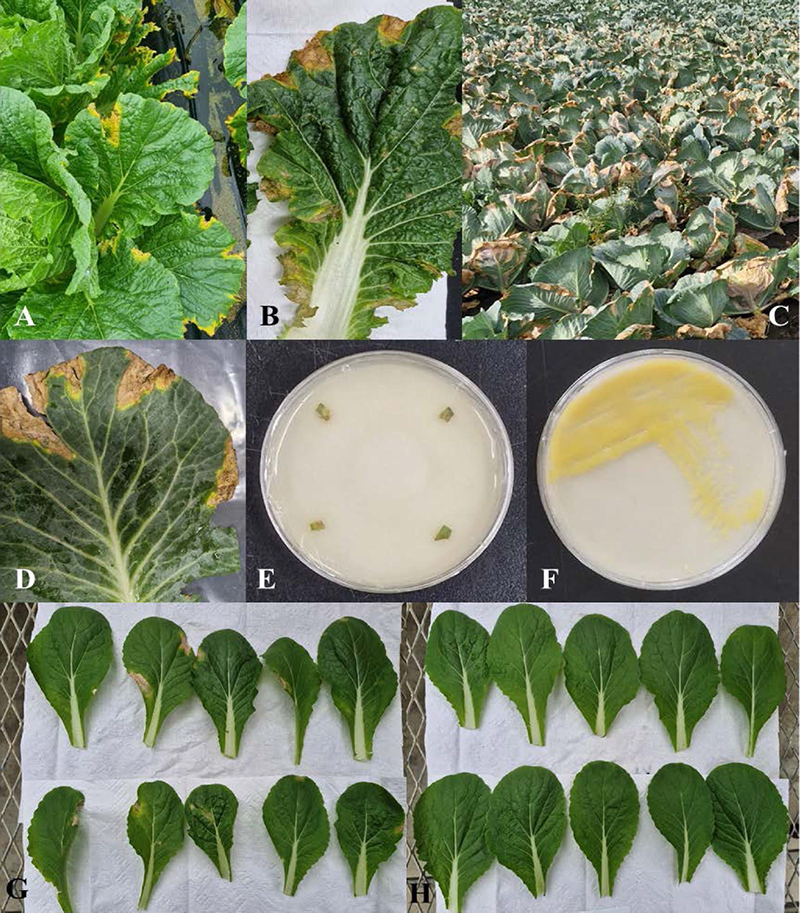
Black rot symptoms and isolated bacterial strains. (A) Field symptoms of black rot on Kimchi cabbage; (B) Symptoms on a naturally infected Kimchi cabbage leaf; (C) Field symptoms of black rot on cabbage; (D) Symptoms on a naturally infected cabbage leaf; (E) Leaf tissue sections with symptoms placed on yeast dextrose calcium carbonate (YDC) agar medium; (F) Pure culture of Xanthomonas campestris pv. campestris (Xcc) on YDC agar after 2 days of incubation, displaying characteristic yellow, convex, and mucoid colonies; (G) Symptoms appearing on Xcc-inoculated Kimchi cabbage leaves in a greenhouse; (H) Control group (D.W. inoculated).

Information of Xcc strains used in this study.
The diseased leaf tissues were cut into approximately 5 × 5 mm pieces using sterilized scissors. For surface sterilization, the leaf segments were immersed in 1% sodium hypochlorite (NaOCl) for 1 min, followed by 70% ethanol (EtOH) for 2 min, and then rinsed three times with sterilized distilled water (Lee et al., 2023a). The sterilized segments were placed onto YDC agar medium (Fig. 1E) and incubated at 28°C. Once bacterial colonies emerged from the lesions, single colonies were selected and subcultured onto fresh YDC medium using the streaking method to obtain pure cultures.
Molecular identification
To identify the bacterial strains, direct colony PCR was performed without a genomic DNA extraction step. A small amount of each pure bacterial colony was picked and added directly to the PCR master mix (DiaStarTM Direct Multiplex PCR Kit, SolGent Co., Ltd., Korea) as a template DNA. The 16S rDNA region was amplified using the universal bacterial primers 27F and 1492R (Lane, 1991). The resulting PCR products were purified and sequenced (SolGent Co., Ltd., Korea), and the DNA sequences were compared with those in the National Center for Biotechnology Information (NCBI) GenBank database using BLAST. Bacterial identification was further confirmed by constructing a neighbor-joining phylogenetic tree with MEGA 7.0 software (Kumar et al., 2016) alongside reference type strains.
To ensure the taxonomic accuracy, PCR amplification was initially performed using the Xcc-specific primer pair, Xcc-53-F and Xcc-53-R (Rubel et al., 2019a). Additionally, to determine the physiological race of the 11 Xcc strains, PCR amplification was performed using specific primers for determining Race 1 to Race 7 (Afrin et al., 2019; Afrin et al., 2018; Afrin et al., 2020; Kim et al., 2023b; Rubel et al., 2019b; Rubel et al., 2017).
Pathogenicity test
To verify the virulence of the eleven Xcc strains, a pathogenicity test was conducted in a greenhouse using the Kimchi cabbage cultivar ‘Chungwang’, which is the most widely cultivated variety in the highland regions of Gangwon Province. Seeds were sown in plastic pots (3.63 × 3.63 × 6 inches; Stuewe and Sons, Inc., USA) filled with sterilized potting soil (NH nongwoobio, Korea), which had been autoclaved at 121°C for 15 minutes twice and subsequently dried. The plants were then grown for three weeks. Inoculation was performed on three-week-old seedlings using the foliar spray method with bacterial suspensions adjusted to 1 × 10⁸ CFU/mL. Uninoculated seedlings sprayed with sterilized distilled water served as negative controls. Three seedlings were inoculated with each strain, and a total of 36 seedlings, including the control group, were used in the test. To facilitate infection, the inoculated plants were subjected to a humidity treatment by covering them with a vinyl tent to maintain high relative humidity for 48 hours. After the treatment, the plants were maintained under standard greenhouse conditions. Disease development was assessed a week after inoculation by observing typical black rot symptoms, such as V-shaped chlorotic or necrotic lesions on the leaf margins. The entire experiment was performed in duplicate to ensure the reproducibility of the results.
Antibiotic susceptibility assay
The eleven Xcc strains (eight field isolates and three KACC reference strains) were inoculated into Luria-Bertani (LB) broth and incubated in a shaking incubator at 28°C for 7 days. Following incubation, the bacterial concentration of each culture was adjusted to approximately 1 × 10⁸ CFU/mL to ensure consistent inoculum density for the subsequent assays.
Five antibiotics were selected based on the active ingredients of pesticides currently registered for controlling black rot in cabbage or bacterial soft rot in Kimchi cabbage in Korea (Chung et al., 2003; Lee et al., 2023a): oxolinic acid (OA), kasugamycin (KAS), validamycin A (VA), oxytetracycline (OTC), and streptomycin (STR). Each antibiotic was prepared at five different concentrations: 0 (as a negative control), 1, 10, 100, and 1,000 ppm, to evaluate the dose-dependent response and sensitivity levels of Xcc strains.
The susceptibility test was performed using the paper disc diffusion method. Two hundred microliters (200 μL) of each bacterial suspension were uniformly spread onto LB agar plates. Three sterilized filter paper discs (8 mm diameter; Advantec, Japan) were placed onto the surface of each inoculated plate. Then, 50 μL of each antibiotic solution at the specified concentrations were applied to the respective discs.
For control group, dimethyl sulfoxide (DMSO) was used for OA and OTC, while sterile distilled water was used for the other antibiotics (STR, VA, and KAS) to account for potential solvent effects. All plates were incubated at 28°C in the dark, and the efficacy of the antibiotics was determined by measuring the diameter of the inhibition zones (clear zones) formed around the discs. To ensure statistical reliability, each treatment was performed in triplicate (three discs per concentration).
Results and Discussion
Identification of Xcc isolates
Bacterial strains were successfully isolated from the symptomatic leaf tissues on YDC, yielding characteristic yellow, mucoid, and convex colonies (Fig. 1F). Based on 16S rDNA sequence analysis, all eight field isolates were identified as Xanthomonas campestris pv. campestris with 98–100% sequence identity to the reference strains in the NCBI database. In the neighbor-joining phylogenetic tree, the eight field isolates clustered into a single monophyletic clade along with the Xcc type strains (ATCC 33913 and LMG 568) and KACC reference strains (KACC 19133, 19134, and 19136) (Fig. 2). Furthermore, all 11 strains (including 8 field isolates and 3 reference strains) successfully yielded the expected 930 bp specific amplicon (Fig. 3A), confirming their identity as Xcc.
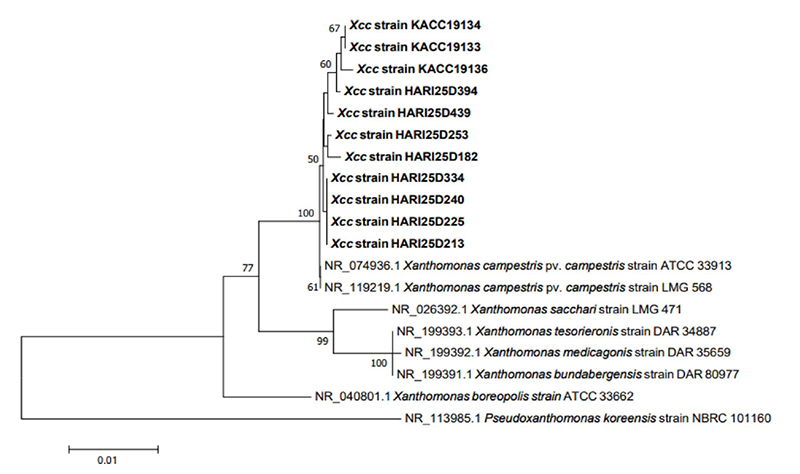
Neighbor-joining phylogenetic tree based on an alignment of 16S rDNA sequence showing the relationship between the field isolated and reference strains of Xanthomonas campestris pv. campestris. Pseudoxanthomonas koreensis was used as an outgroup. Numbers on branches indicate bootstrap values (1,000 replicates). Xcc strains used in this study are in bold. All DNA sequences used as references originated from type strains.
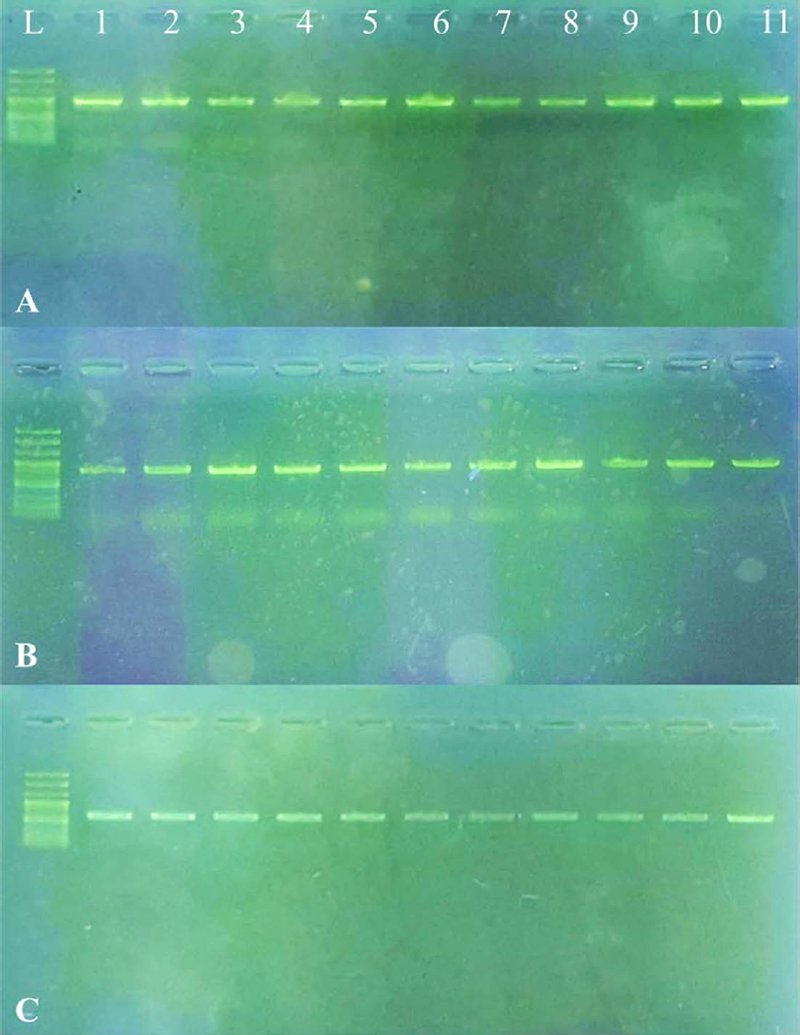
PCR-based species identification and race determination of Xanthomonas campestris pv. campestris (Xcc) strains using specific molecular markers. (A) Species-specific identification of Xcc using the Xcc-53-F/R primer pair, yielding the expected 930 bp amplicon across all strains. (B) Race 7-specific marker (30-7-1F-1R) amplification showing a diagnostic 800 bp fragment. (C) Race 7-specific marker (Race 7-5F-5R) amplification showing a diagnostic 700 bp fragment. Lanes: L, 100 bp DNA ladder; 1, HARI25D182; 2, HARI25D213; 3, HARI25D225; 4, HARI25D240; 5, HARI25D253; 6, HARI25D334; 7, HARI25D394; 8, HARI25D439; 9, KACC19133; 10, KACC19134; 11, KACC19136. Lanes 1–8 represent field isolates from highland regions, and lanes 9–11 represent KACC reference strains.
Notably, none of the 11 Xcc strains yielded any positive or specific amplicons with the primers designated for Race 1 through Race 6. In contrast, when tested with the Race 7-specific markers, all 11 strains consistently amplified a 800 bp fragment with the primer 30-7-1F and 1R (Fig. 3B) and a 700 bp fragment with the primer Race 7-5F and 5R (Fig. 3C). Based on these distinctive and cross-verified band profiles, all tested strains were identified as Race 7 (Table 1).
Pathogenicity test
All tested Xcc strains successfully induced typical black rot symptoms, including V-shaped yellow lesions starting from the leaf margins and darkening of the veins. These symptoms were clearly observed in the inoculated groups (Fig. 1G), whereas the control group (inoculated with sterile distilled water) remained healthy without any visible symptoms (Fig. 1H). This confirms that all 11 strains are the causal agents of black rot in the collected regions. Although all strains were pathogenic, there were noticeable variations in the rate of disease progression and symptom severity among them (Table 1). Based on the disease severity, certain strains exhibited more aggressive colonization, leading to rapid chlorosis and necrosis within a shorter period. Re-isolation of the pathogen from the affected areas resulted in the isolation of Xcc in all cases, satisfying Koch's postulates. The test was repeated twice, and the same result was obtained both times.
Globally, races 1 and 4 of Xcc are recognized as the most destructive and prevalent races affecting Brassica crops (Vicente and Holub, 2013). However, in the present study, all Xcc strains were identified as race 7. Although there were variations in disease severity during field observations and pathogenicity tests, all isolates consistently induced typical black rot symptoms. Notably, the KACC strains used in this study had also been previously characterized as race 7 (Kim et al., 2023b), further supporting our findings. These results strongly suggest that the occurrence of black rot in Korean Kimchi cabbage is closely associated with race 7, rather than the globally dominant races 1 or 4. This regional dominance underscores the importance of focusing on race 7 for establishing effective management strategies and selecting appropriate chemical controls in Korea.
Antibiotic susceptibility assay
The visual confirmation of the antibiotic efficacy against the Xcc isolates is presented in Fig. 4. As shown in the representative images of strain HARI25D182, the clear zones surrounding the discs of OTC (Fig. 4B) and OA (Fig. 4A) were markedly larger than those of other antibiotics. In contrast, the inhibition zones for KAS (Fig. 4D) and VA (Fig. 4E) were minimal, visually verifying their limited inhibitory activity at the tested concentration.
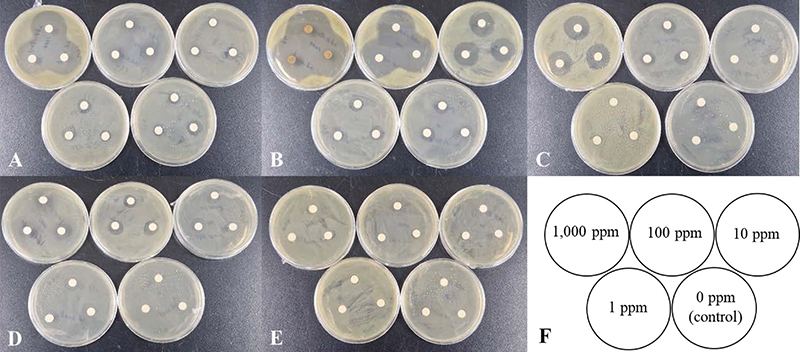
Representative images of the paper disc diffusion assay for Xanthomonas campestris pv. campestris (Xcc) strain HARI25D182 against five agricultural antibiotics. (A) oxolinic acid (OA); (B) oxytetracycline (OTC); (C) streptomycin (STR); (D) kasugamycin (KAS); (E) validamycin A (VA); (F) Schematic diagram of antibiotic concentrations on each plate: Five paper discs were arranged in a specific pattern where the concentrations decrease in a clockwise direction starting from the top-left: 1,000, 100, 10, 0 (negative control), and 1 ppm.
The in vitro susceptibility of 11 Xcc strains to five antibiotics showed a clear dose-dependent response (Table 2, Fig. 5). Among the tested antibiotics, OTC exhibited the highest antibacterial activity, with a mean inhibition zone of 40.95 mm at 1,000 ppm, followed by OA (37.79 mm). Notably, both OTC and OA displayed significantly enhanced activity starting from 10 ppm, forming distinctively steep inhibition curves. This rapid increase indicates their superior efficacy against Xcc even at relatively lower concentrations, making them potential candidates for managing field outbreaks. It is noteworthy that the control groups for OTC and OA, which used DMSO as a solvent, showed basal inhibition zones of approximately 15 mm, suggesting a slight inhibitory effect of the solvent itself (Basch and Gadebusch, 1968), which should be considered when evaluating susceptibility.
Comparative efficacy of five antibiotics against 11 Xcc strains
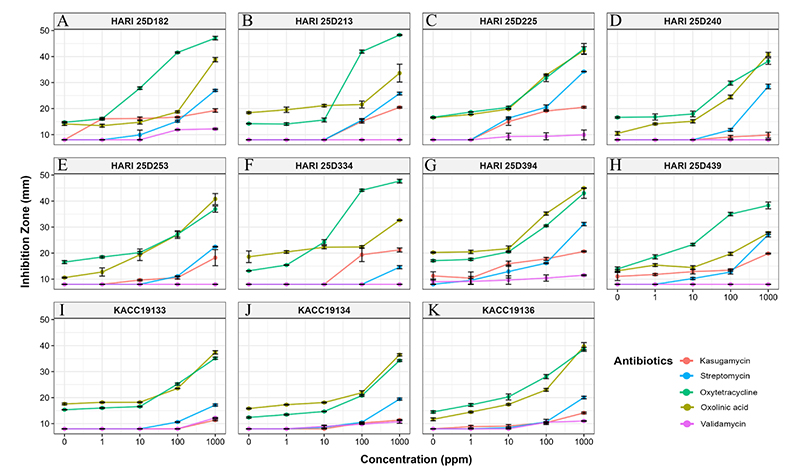
Comparison of antibiotic susceptibility curves for 11 Xcc strains. The x-axis represents antibiotic concentrations (0, 1, 10, 100, and 1,000 ppm) on a logarithmic scale, and the y-axis indicates the diameter of the inhibition zone (mm). (A) HARI25D182; (B) HARI25D213; (C) HARI25D225; (D) HARI25D240; (E) HARI25D253; (F) HARI25D334; (G) HARI25D394; (H) HARI25D439; (I) KACC19133, (J) KACC19134, (K) KACC19136. Error bars represent the standard error of the mean.
In contrast, the individual graphs in Fig. 5 revealed significant variations in sensitivity among the strains that were not as apparent in the overall mean values. The most prominent variation was observed with STR. While STR generally showed a moderate upward trend, strains HARI25D225 (Fig. 5C) and KACC19136 (Fig. 5K) were highly sensitive, whereas HARI25D334 (Fig. 5F) exhibited a much smaller inhibition zone (15.17 mm at 1,000 ppm), representing a more than twofold difference. This variation is consistent with previous reports on the emergence of STR-resistant Xcc in Korean Kimchi cabbage production areas (Lee et al., 2023a), suggesting that certain populations may have developed resistance due to long-term, intensive use of STR in the field. Although STR can be an effective antibiotic for preventing black rot in Kimchi cabbage (Liu et al., 2022), the substantial variation in STR sensitivity among the Xcc strains observed in this study suggests a potential risk of efficacy decline. This underscores the necessity of diversifying antibiotic treatments by introducing potent alternatives such as OTC and OA.
Regarding KAS and VA, both antibiotics maintained a relatively low slope in their response curves, with significant increases observed only in the high-concentration range (100–1,000 ppm). Specifically, certain strains such as HARI25D213 (Fig. 5B) showed almost horizontal lines in the low-concentration range (1–10 ppm), indicating a lack of initial response. This plateauing highlights the risk of sub-lethal dosing, which could potentially accelerate the selection of resistant sub-populations in the environment. Recent studies on phytopathogenic bacteria have suggested that long-term exposure to commonly used antibiotics like STR can exert selective pressure, favoring sub-populations with broad-spectrum defensive traits that lead to decreased susceptibility to alternative agents like KAS and VA (Sundin and Wang, 2018). This trend aligns with reports that P. carotovorum, another major bacterial pathogen in Kimchi cabbage, has already exhibited reduced sensitivity or resistance to VA and other agricultural antibiotics in Kore (Kim et al., 2023a). The plateauing curves of VA in our results (Fig. 5) likely reflect this trend of decreased susceptibility among field-collected Xcc strains.
Furthermore, a comparative analysis between the KACC reference strains (isolated in 2013) and the field isolates (collected in 2025) showed notable shifts in sensitivity. While the 2013 strains exhibited relatively uniform and high susceptibility—with STR inhibition zones ranging from 28.71 to 31.58 mm at 1,000 ppm—the 2025 field isolates showed a much broader range of susceptibility, spanning from 15.17 to 34.22 mm for STR. Specifically, the significant reduction in the inhibition zone of isolate 25D334 (15.17 mm) compared to KACC 19136 (31.58 mm) suggests that Xcc populations have undergone a shift toward reduced sensitivity over the past 12 years. Similarly, for KAS, while KACC strains maintained consistent efficacy (20.45–21.45 mm), some field isolates demonstrated diminished initial responses at lower concentrations. These findings underscore the necessity of using contemporary field isolates to reflect the current resistance status in agricultural ecosystems accurately.
Conclusion
While all tested antibiotics exhibited dose-dependent inhibitory effects, their efficacy varied significantly. Commercial pesticide formulations in Korea incorporating these five antibiotics as their primary active ingredients typically require effective field application concentrations ranging from 50 to 300 ppm according to the Pesticide Safety Information System (https://psis.rda.go.kr/psis/). Within this specific range, however, KAS and VA demonstrated considerably lower antibacterial activity compared to OTC, OA, and STR. In particular, the lack of initial response in certain strains at lower concentrations suggests a potential decline in field control efficiency for these agents. Currently, there are no pesticides officially registered for the management of Kimchi cabbage black rot caused by Xcc in Korea. Therefore, it is imperative to prioritize the registration of OTC- or OA-based pesticides, which showed consistent and potent inhibitory effects against all tested strains. However, to prevent the emergence of antibiotic-resistant Xcc populations, these agents should be integrated into a rotation-based management strategy with other chemical classes, such as copper-based compounds (La Torre et al., 2018) or biological control agents (Liu et al., 2022). Furthermore, the findings of this study provide critical baseline data for selecting effective antibiotics and establishing integrated pest management strategies. Continuous monitoring of antibiotic sensitivity in field isolates is essential to ensure the long-term sustainability of black rot control in highland Kimchi cabbage cultivation.
Acknowledgments
This work was carried out with the support of “Research Program for Agriculture Science and Technology Development (ProjectNo. PJ01764602)”, Rural Development Administration, Republic of Korea. We would like to thank the Korean Agricultural Culture Collection (KACC) for providing Xcc type strains.
Conflict of Interest
The authors declare that they have no conflict of interest.
References
-
Afrin KS, Rahim MA, Jung HJ, Park JI, Kim HT, Nou IS, 2019. Development of molecular marker through genome realignment for specific detection of Xanthomonas campestris pv. campestris race 5, a pathogen of black rot disease. J. Microbiol. Biotechnol. 29(5):785-793.
[https://doi.org/10.4014/jmb.1901.01050]

-
Afrin KS, Rahim MA, Rubel MH, Natarajan S, Song JY, Kim HT, Park JI, Nou IS, 2018. Development of race-specific molecular marker for Xanthomonas campestris pv. campestris race 3, the causal agent of black rot of crucifers. Can. J. Plant Sci. 98(5):1119-1125.
[https://doi.org/10.1139/cjps-2018-0035]
-
Afrin KS, Rahim MA, Rubel MH, Park JI, Jung HJ, Kim HT, Nou IS, 2020. Development of PCR-based molecular marker for detection of Xanthomonas campestris pv. campestris Race 6, the causative agent of black rot of Brassicas. Plant Pathol. J. 36(5):418-427.
[https://doi.org/10.5423/PPJ.OA.06.2020.0103]
-
Basch H, Gadebusch HH, 1968. In vitro antimicrobial activity of dimethylsulfoxide. Applied microbiology 16(12):1953-1954.
[https://doi.org/10.1128/am.16.12.1953-1954.1968]
- Chung EK, Zhang XZ, Rog YY, Kim BS, 2003. Screening of effective control agents against bacterial soft rot on Chinese Cabbage in Alpine Area Korean J. Pestic. Sci. 7(1): 32-37.
- Cook AA, Walker JC, Larson RH, 1952. Studies on the disease cycle of black rot of crucifers. Phytopathology 42(3):162-167.
- Garman H. 1890. A bacterial disease of cabbage. In Kentucky Agric. Exp. Stn. Rep. 3 (pp. 43-46).
-
Kim JY, Baek KH, Lee SY, 2023a. Evaluation of Resistance of Phytopathogenic Bacteria to Agricultural Antibiotics Res. Plant Dis. 29(2):168-173.
[https://doi.org/10.5423/RPD.2023.29.2.168]
-
Kim YH, Mao S, Sahu N, Somaddar U, Kim HT, Watanabe M, Park JI, 2023b. Molecular marker development for the rapid differentiation of black rot causing Xanthomonas campestris pv. campestris race 7. Plant Pathol. J. 39(5):494-503.
[https://doi.org/10.5423/PPJ.OA.07.2023.0102]
- Korea Rural Economic Institute (KREI). (2014). Factors and prospects for changes in vegetable area in highland areas. krei.re.kr
-
Kumar S, Stecher G, Tamura K, 2016. MEGA7: molecular evolutionary genetics analysis version 7.0 for bigger datasets. Mol. Biol. Evol. 33(7):1870-1874.
[https://doi.org/10.1093/molbev/msw054]
- La Torre A, Iovino V, Caradonia F, 2018. Copper in plant protection: Current situation and prospects. Phytopathol. Mediterr. 57(2):201-236.
- Lane DJ. 1991. 16S/23S rRNA sequencing. In Nucleic acid techniques in bacterial systematics (pp. 115-175). Wiley.
-
Lee MH, Ko HR, Lee YH, Hong SK, Choi HW, 2023a. Investigation of Streptomycin Resistance of Pectobacterium spp. and Xanthomonas campestris pv. campestris Isolated from Kimchi Cabbage in Korea. Korean J. Pestic. Sci. 27(4):303-310.
[https://doi.org/10.7585/kjps.2023.27.4.303]
-
Lee SG, Kim SK, Lee HJ, Choi CS, Park ST, 2016. Impacts of climate change on the growth, morphological and physiological responses, and yield of Kimchi cabbage leaves. Hortic. Environ. Biotechnol. 57(5):470-477.
[https://doi.org/10.1007/s13580-016-1163-9]
-
Lee SH, Baek SH, Lee JW, Jang YA, Seo TC, Moon JH, Jang SH, 2024. Production of kimchi cabbage (Brassica rapa subsp. pekinensis) under high temperature stress conditions: A Review. Korean J. Breed. Sci. 56(3):237-256.
[https://doi.org/10.9787/KJBS.2024.56.3.237]
- Lee SH, Heo IH, 2018. Impact of climate on yield of highland Chinese cabbage in Gangwon province, South Korea. J. Korean Geogr. Soc. 53(3):265-282.
-
Lee SM, Lee JJ, Choi YH, Kim H, Choi GJ, 2023b. Resistance Characteristics of Chinese Cabbage Cultivars to Black Rot. Res. Plant Dis. 29(2):158-167.
[https://doi.org/10.5423/RPD.2023.29.2.158]
-
Liu Z, Wang H, Wang J, Lv J, Xie B, Luo S, Wang S, Zhang B, Li Z, Yue Z, 2022. Physical, chemical, and biological control of black rot of brassicaceae vegetables: A review. Front. Microbiol. 13:1023826.
[https://doi.org/10.3389/fmicb.2022.1023826]
- National Institute of Highland Agriculture(NIHA). (2000). Highland vegetable cultivation technology. NIoHA (NIHA).
-
Rubel MH, Natarajan S, Hossain MR, Nath UK, Afrin KS, Lee JH, Jung HJ, Kim HT, Park JI, Nou IS, 2019a. Pathovar specific molecular detection of Xanthomonas campestris pv. campestris, the causal agent of black rot disease in cabbage. Can. J. Plant Pathol. 41(3):318-328.
[https://doi.org/10.1080/07060661.2019.1570973]
-
Rubel MH, Natarajan S, Nath UK, Denison MIJ, Jung HJ, Kim HT, Park JI, Nou IS, 2019b. Development of a marker for detection of Xanthomonas campestris pv. campestris races 1 and 2 in Brassica oleracea. Hortic. Environ. Biotechnol. 60(4):511-517.
[https://doi.org/10.1007/s13580-019-00143-7]
-
Rubel MH, Robin AHK, Natarajan S, Vicente JG, Kim HT, Park JI, Nou IS, 2017. Whole-genome re-alignment facilitates development of specific molecular markers for races 1 and 4 of Xanthomonas campestris pv. campestris, the cause of black rot disease in Brassica oleracea. International journal of molecular sciences 18(12):2523.
[https://doi.org/10.3390/ijms18122523]
-
Sundin GW, Wang N, 2018. Antibiotic resistance in plant-pathogenic bacteria. Annual Review of phytopathology 56(1):161-180.
[https://doi.org/10.1146/annurev-phyto-080417-045946]
-
Vicente JG, Holub EB, 2013. Xanthomonas campestris pv. campestris (cause of black rot of crucifers) in the genomic era is still a worldwide threat to brassica crops. Mol. Plant Pathol. 14(1):2-18.
[https://doi.org/10.1111/j.1364-3703.2012.00833.x]
-
Williams PH, 1980. Black rot: a continuing threat to world crucifers. Plant Dis. 64(8):736-742.
[https://doi.org/10.1094/PD-64-736]
Hyeok Park, Highland Agriculture Research Institute, National Institute of Crop and Food Science, researcher, ORCID https://orcid.org/0000-0003-1387-4201
Younggyu Lee, Highland Agriculture Research Institute, National Institute of Crop and Food Science, senior researcher
Jeomsoon Kim, Highland Agriculture Research Institute, National Institute of Crop and Food Science, senior researcher
Corresponding; Park H, Research design; Park H, Kim J and Lee Y, Investigation; Park H, Data analysis; Park H and Lee Y, Original draft writing; Park H, Editing; Kim J and Lee Y