
국내 사과그을음점무늬병균 Peltaster fructicola 및 Schizothyrium spp.에 대한 살균제의 균사 생장 억제 효과 검정

초록
국내 강원도, 경상북도, 전라북도 소재의 과수원에서 그을음점무늬병 병징을 보이는 과실 77개를 채집하였으며, 해당 병징으로부터 52개의 균주를 분리하였다. 확보한 균주는 배양학적 특성 및 계통학적 유연관계 분석을 통해 Peltaster fructicola, Schizothyrium wisconsinense, S. pomi, S. emperorae로 동정되었다. 분리 비율을 확인한 결과, punctate type의 병징에서는 P. fructicola가 15개 균주가 분리되었고, flyspeck type에서 분리된 37개 균주 중 S. wisconsinense 균주 18개와 S. pomi 균주 12개가 각각 분리되었다. 현재까지 국내에서는 사과 그을음점무늬병 방제를 위한 살균제가 등록되어 있지 않고, 해당 병원균들을 효과적으로 방제할 수 있는 살균제에 대한 연구가 부족한 실정이다. 이에 사과에 등록된 17개의 살균제를 대상으로 그을음점무늬병균에 대한 효과적인 살균제 선발을 위해 높은 비율로 분리된 3종(Peltaster fructicola, Schizothyrium wisconsinense, S. pomi) 13 균주에 대하여 살균제 희석 배지에서 균사 생장 억제 효과를 검정하였다. 그 결과, 사1 군의 tebuconazole WP, mefentrifluconazole WG, metconazole SC, 나1 군의 benomyl WP, 카 군의 mancozeb WP의 경우 모든 균주에 대해서 80% 이상의 높은 균사 생장 억제율이 확인되었다. 다2 군에 속하는 fluxapyroxad SC, penthiopyrad SC, pyraziflumid SC의 경우, 일부 균주에서 60~80%의 억제율이 관찰되었으나, 대부분의 균주에 대해서 80% 이상으로 확인되었다. 다3 군에 속하는 살균제의 경우, 대부분의 균주에 대해서 60% 미만의 균사 생장 억제율이 확인되었다. 본 연구는 다양한 종이 관여하는 것으로 알려진 사과 그을음점무늬병균에 대한 발생 비율을 처음으로 확인하였으며, 그을음점무늬병균의 효과적인 관리 방법에 대한 기초자료로 이용될 것으로 사료된다.
Abstract
In 2023 and 2024, we collected 77 apples showing symptoms of flyspeck from orchards in Gangwon, Gyeongbuk, and Jeonbuk provinces, Korea. We isolated a total of 52 fungal strains from symptomatic fruits and based on cultural characteristics and phylogenetic analyses, they were identified as Peltaster fructicola, Schizothyrium wisconsinense, S. pomi, and S. emperorae. Fifteen strains were isolated from the punctate type and identified as Peltaster fructicola. We isolated 37 strains of the flyspeck type, among which the predominant species were Schizothyrium wisconsinense (18 strains) and S. pomi (12 strains). Since no fungicides are currently registered specifically to control flyspeck in apples in Korea, there are limited studies on effective fungicides against these pathogens. Using fungicide-amended media, we evaluated the efficacy of 17 fungicides registered for use on apples. The fungicides targeted 13 strains representing three predominant species, P. fructicola, S. wisconsinense, S. pomi. Our results showed that tebuconazole WP, mefentrifluconazole WG, and metconazole SC in the G1 group, benomyl WP in the B1 group, and mancozeb WP in the M group exhibited over 80% of mycelial growth inhibition rates in all the tested strains. Although the inhibition rates against most strains were above 80%, group C2 that consists of fluxapyroxad SC, penthiopyrad SC, and pyraziflumid SC showed inhibition rates of 60~80% against some strains. In contrast, fungicides in the C3 group generally showed mycelial growth inhibition rates of less than 60% in most strains. Our results represent the first report on the isolation frequency of flyspeck pathogens in apples and provide a basis to establish effective management strategies for flyspeck in apples in Korea.
Keywords:
Apples, Flyspeck, Fungicide, Peltaster, Schizothyrium키워드:
그을음점무늬병, 사과, 살균제서 론
사과(Malus × domestica Borkh.)는 국내에서 재배되는 주요한 과수 중 하나이며, 2024년 기준 33,313 ha의 재배면적과 연간 생산량이 460,088 톤이 생산되고 있다(KOSIS, 2025). 재배기간 중 발생하는 곰팡이병은 과실의 품질과 수량을 감소시키는 주요한 요인 중 하나이며, 국내에서도 갈색무늬병, 점무늬낙엽병, 탄저병, 겹무늬썩음병 등 주요한 병해를 포함해 46종의 곰팡이병이 발생하는 것으로 보고되어 있다(KSPP, 2025; Patriarca A, 2019). 이 중 사과 그을음점무늬병(flyspeck)은 그을음이 묻은 듯한 병징 또는 작은 반점 형태의 병징을 나타내는 것이 특징이다(Gleason et al., 2011). 이러한 그을음점무늬병을 일으키는 병원균들은 서로 비슷한 생태를 가지고 있으며, 기주 식물체 표면의 왁스층과 큐티클층에서 균총을 형성한다(Gleason et al., 2011; Batzer et al., 2016). 이러한 병원균은 기주의 살아있는 세포는 가해하지 않아 직접적인 피해를 주지 않지만, 표면에 형성된 균총은 과실의 품질을 떨어뜨려 경제적 피해를 유발한다(Gleason et al., 2011). 또한, 그을음점무늬병균에 의한 왁스층 손상은 저장 중인 과실에서 건조 피해를 유발할 수 있다고 알려져 있다(Mirzwa-Mróz et al., 2012). 과거에는 그을음점무늬병이 각각 Gloeodes pomigena, Leptothyrium pomi (= Schizothyrium pomi)에 의해 발생하는 것으로 알려졌었으나, 1990년대에 과실 표면에 형성되는 균총 형태(mycelial type)에 대한 연구가 진행됨에 따라 Peltaster fructicola, Geastrumia polystigmatis 등 다양한 병원균이 관여하고 있는 것이 확인되었다(Williamson et al., 2000). 최근 분자 계통학적 연구를 통해 20개 이상의 속과 100종 이상의 곰팡이가 그을음점무늬병을 일으키는 것으로 보고되었으며(Gleason et al., 2019), 국내에서도 punctate type의 균총을 형성하는 P. fructicola와 flyspeck type을 형성하는 S. wisconsinense, S. pomi, S. emperorae 등의 그을음점무늬병균이 보고되어 있다(Choi et al., 2024a; Choi et al., 2024b; KSPP, 2025). 이와 같이 그을음점무늬병균을 방제하기 위하여 해외에서는 mancozeb와 metiram 같은 EBDC(ethylene bis-dithiocarbamate)계 살균제 및 captan 등이 효과적인 것으로 알려져 있으며(Gleason et al., 2019), 종에 따라 살균제 감수성의 차이가 존재한다는 보고가 있다(Tarnowski et al., 2003). 하지만 국내에서는 사과 그을음점무늬병에 대해 병징별 분리 비율이나 효과적인 살균제에 대한 연구도 부족한 실정이므로, 그을음점무늬병균의 종 다양성 및 이들에 대한 효과적인 방제 약제에 대한 연구가 요구된다. 이에 본 연구에서는 2023년과 2024년에 국내 주요 사과 재배지역에서 그을음점무늬병 증상을 보이는 과실을 채집하여 병원균을 분리·동정하고, 확보한 균주를 대상으로 살균제 희석배지를 통해 다양한 살균제의 균사 생장 억제 효과를 검정하였으며, 그을음점무늬병의 효과적인 방제 약제 선발을 위한 기초자료로 활용하고자 한다.
재료 및 방법
그을음점무늬병균의 분리 및 동정
2023년부터 2024년까지 강원도, 경상북도, 전라북도 소재 사과원에서 그을음점무늬병 증상을 보이는 77개의 이병 과실을 채집하였으며, 병원균 분리법은 이전 연구를 따라 수행하였다(Choi et al., 2024a; Choi et al., 2024b). 채집한 이병과실의 표면을 70% 에탄올을 이용하여 표면 소독 후, 과실 표면의 균총을 화염 멸균한 메스를 이용하여 감자한천 배지(potato dextrose agar, Difco, Detroit, MI, USA)에 치상하여 병원균을 분리하였다. 생장한 균총은 새로운 배지에 옮겨 계대 배양하였으며, 실험 전까지 보관을 위해 -80°C에 glycerol stock에 보관하였다.
확보된 균주의 분자생물학적 동정을 위하여 균주들을 25℃ 암조건에서 14일간 배양한 뒤 HiGeneTM Genomic DNA prep kit (Biofact, Daejeon, Korea)를 이용하여 gDNA를 추출하였다. Peltaster 속 균주의 경우 ITS1F/ITS4, LR0R/LR5, mtSSU1/mtSSU3 primer pair를 이용하여 internal transcribed spacer (ITS) 영역, nuclear large subunit of rDNA, mitochondrial small subunit of rDNA를 증폭하였다(Gardes et al., 1993; Rehner et al., 1994; White et al., 1990; Vilgalys et al., 1990; Zoller et al., 1999). Schizothyrium 속 균주들의 경우 ITS1F/ITS4, EF1-728F/EF1-986R, Bt2a/Bt2b primer pair를 이용하여 ITS 영역, translation elongation factor 1-alpha 유전자, beta-tubulin 유전자를 증폭하였다(Carbone et al., 1999; Gardes et al., 1993; Glass et al., 1995; White et al., 1990). 증폭된 PCR 산물은 ExoSAP-ITTM (Thermo Fisher Scientific, Waltham, MA, USA)를 이용하여 정제한 뒤, Solgent (Daejeon, Korea)에 의뢰하여 균주별 염기서열을 확보하였다. 이후 각 속의 근연종들과 계통학적 유연관계를 비교하기 위해 MEGA 11.0 프로그램에서 Tamura-nei model 기반의 maximum likelihood 방법을 사용하여 계통수를 작성하였다(Tamura et al., 1993; Tamura et al., 2021).
그을음점무늬병균에 대한 효과적인 살균제 선발
국내 사과에 등록된 살균제 중 17종의 단제를 이용하여 실험을 진행하였다(Table 1). 한천희석법을 통하여 각 약제의 균사 생장 억제 효과 조사를 진행하였으며, 이때 배지의 최종 농도를 권장 사용 농도(recommended dose)가 되도록 살균제 희석 PDA를 제작하였다. 분리한 균주들을 PDA 상에 4주간 배양하고, 각 균주의 균총을 4 mm cork borer를 이용하여 agar plug를 떼어내고 각각 살균제 희석 배지와 대조구에 치상하였다. Strobilurin 계 살균제의 경우, 대체 호흡 경로 차단을 위해 SHAM(Salicylhydroxamic acid)을 살균제 희석 배지에 함께 첨가하였으며, P. fructicola, S. wisconsinense의 경우 50 µg/mL, S. pomi는 1 µg/mL이 되도록 조정하였다. 모든 처리구는 3반복으로 진행하였으며, 대조구는 PDA에 배양하였다. 균사 조각을 접종한 배지를 4주간 25℃에 배양한 후 버니어 캘리퍼스를 이용하여 처리구의 균총의 직경을 측정하였고, 무처리구 대비 균사 생장 억제율을 산출하였다. 균사 생장 억제율을 R 프로그램(version 4.3.2)의 pheatmap package를 이용하여 분석하였다.

List of fungicides and dose used in this study
결과 및 고찰
그을음점무늬병 병징에서 분리된 균주의 동정 및 비율 분석
2023년과 2024년까지 강원도, 경상북도, 전라북도 소재의 사과 과수원에서 채집된 77개의 그을음점무늬병 이병 시료로부터 총 52개의 균주가 분리되었다(Table 2). 각각의 균주들은 Peltaster fructicola, Schizothyrium wisconsinense, S. pomi 등으로 동정되었으며, 이전 연구에서 기 보고된 사과그을음점무늬병균으로 확인되었다(Choi et al., 2024a; Choi et al., 2024b). 병징별로 분리된 균주 비율의 경우, punctate type의 병징을 보이는 23개 과실에서 P. fructicola가 15개 균주로 100%의 비율로 분리되었다. Flyspeck type의 병징의 경우, 41개의 이병과실로부터 37개의 균주를 확보하였으며, S. wisconsinense, S. pomi 등 Schizothyrium 속에 속하는 종들이 확인되었다. 이 중 S. wisconsinense가 18개 균주로 약 49%, 그리고 S. pomi가 12개 균주로 32%의 높은 비율로 분리되었다(Fig. 1). 따라서 가장 분리 비율이 높았던 P. fructicola, S. wisconsinense, S. pomi에 대해서 분리 지역 및 품종을 기반으로 각각 4개, 6개, 3개 균주를 선발하였으며, 해당 균주들에 대해서 살균제 효과 검정을 수행하였다.
List of isolated Peltaster and Schizothyrium strains
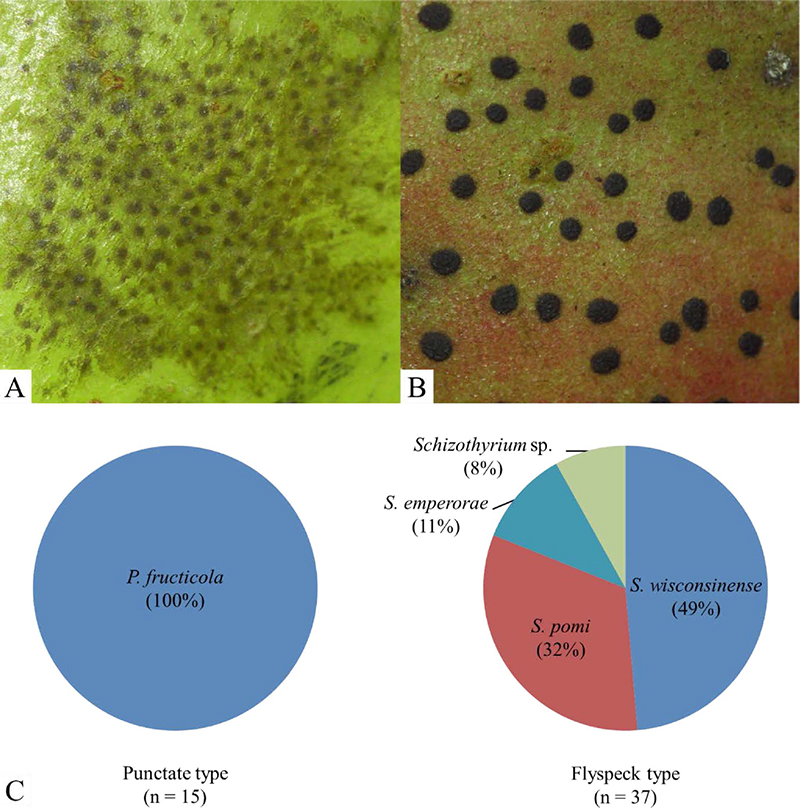
Symptoms of punctate and flyspeck type on apple fruits, and isolation frequency of sooty blotch and flyspeck strains. A: Symptom of punctate type on apple fruit; B: Symptom of flyspeck type on apple fruit; C: Pie charts showing isolation frequency of 52 strains from each mycelial type.
3종의 그을음점무늬병균에 대한 효과적인 살균제 선발
선발된 13개 균주에 대해서 다양한 작용기작을 가지는 살균제의 균사 생장 억제 효과를 검정하였다(Fig. 2). 나1 군 (FRAC code B1)의 benomyl WP는 P. fructicola, S. wisconsinense, S. pomi 3종의 균주들에 대해서 100%의 높은 균사 생장 억제율을 보였다. 다2 군 (FRAC code C2)의 fluxapyroxad SC는 S. wisconsinense SW05에 대해서 75%, pyraziflumid SC는 P. fructicola PF01에 대해서 62%의 균사 생장 억제율을 나타냈으나, 그 외 균주들에 대해서는 80% 이상의 높은 균사 생장 억제율이 확인되었다. Penthiopyrad SC의 경우, 검정한 모든 P. fructicola 및 S. pomi 균주에서는 80%의 높은 균사 생장 억제율을 보였으나, S. wisconsinense SW01균주를 제외한 SW02 및 SW03균주에 대해서는 60~80% 균사 생장 억제율이 확인되었다. 다3 군 (FRAC code C3) 살균제에서는 균주별로 살균제에 대한 감수성 차이가 명확하게 확인되었다. Azoxystrobin WP, kresoxim-methyl WG, pyraclostrobin WG는 S. wisconsinense SW02와 S. wisconsinense SW04 및 S. pomi SP01 등 일부 균주에서 60% 이상의 억제율이 확인되었으나, 대부분의 균주들에 대해서 60% 미만의 낮은 균사 생장 억제율이 확인되었다. Pyribencarb WG의 경우 P. fructicola PF02 및 PF03, S. wisconsinense SW01, SW02 및 SW04, S. pomi SP03균주를 제외하고, 모두 80% 미만의 균사 생장 억제율이 확인되었다. 다5 계통(FRAC code C5)의 fluazinam SC와 라1 군 (FRAC code D1)의 cyprodinil WG는 S. wisconsinense 균주들에 대해서 60% 이상의 억제율을 보였고, 사1 군 (FRAC code G1)의 tebuconazole WP, mefentrifluconazole WG, metconazole SC의 경우 모든 균주에 대해서 80~100%의 높은 균사 생장 억제율이 확인되었다. 카 군 (FRAC code M)의 captan WP는 검정한 모든 P. fructicola 균주와 S. pomi 균주에 대해서 각각 100% 및 80% 이상의 높은 균사 생장 억제율이 확인되었으나, 대조적으로 S. wisconsinense SW03, SW04, SW05 균주에서는 80%미만의 억제율이 확인되었다. 나머지 카 군의 chlorothalonil WP, dithianon WG의 경우 대부분의 균주에 대해서 낮은 억제 효과가 확인되었다. 이상의 결과에서, 3종의 사과그을음점무늬병균을 모두 효과적으로 억제할 수 있었던 살균제는 나1 군의 benomyl WP, 사1 군의 tebuconazole WP, mefentrifluconazole WG, metconazole SC, 카 계통의 mancozeb WP로 확인되었으며, 균주별/종별로 차이는 존재하지만 다 2군의 살균제도 대부분의 균주에서 높은 균사 생장 억제율이 확인되었다(Fig. 2).
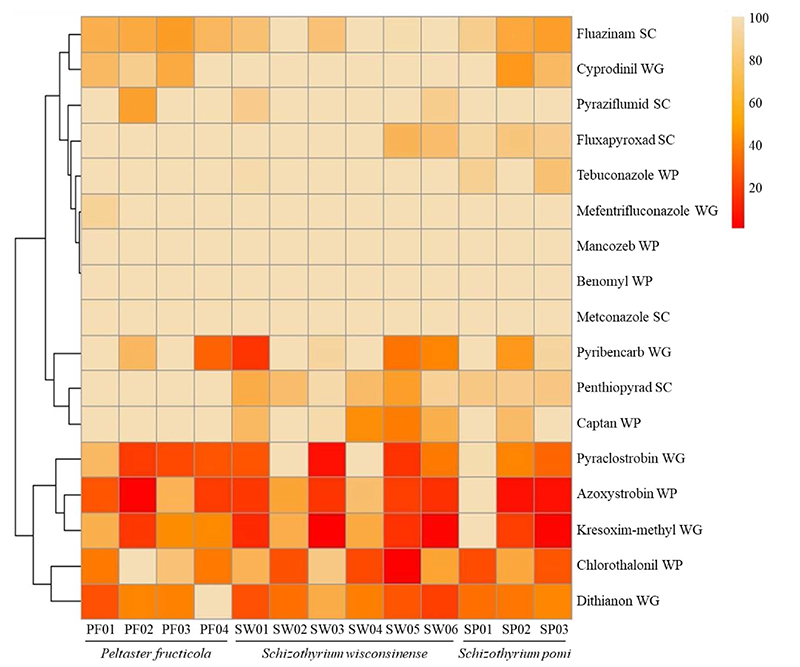
A heatmap showing the mycelial growth inhibition rates (%) of 17 fungicides against Peltaster fructicola, Schizothyrium wisconsinense, and S. pomi strains on fungicide amended potato dextrose agar for recommended dose.
사과에 발생하는 그을음점무늬병은 미국, 중국, 유럽 등 다양한 지역에서 그 발생이 보고되었으며, 특히 P. fructicola, S. wisconsinense, S. pomi는 전 세계적으로 다양한 기주에 그을음점무늬병을 일으키는 병원균으로 알려져 있다(Batzer et al., 2016; Gleason et al., 2019). 현재 국내에는 사과 그을음점무늬병에 대한 살균제가 등록되어 있지 않고, 그을음점무늬병균의 종 다양성 및 살균제 방제 효과 등에 대한 연구가 전무하다. 따라서, 본 연구에서는 사과에 등록된 다양한 계통의 살균제를 이용하여 그을음점무늬병균으로 보고된 P. fructicola, S. wisconsinense, S. pomi 3종에 대해서 균사 생장 억제율을 검정한 결과 나1, 사1 균 살균제와 카 군의 mancozeb WP가 효과적인 것으로 확인되었다. 하지만 다 3군 계통의 살균제의 경우, SHAM을 첨가하여 실험을 수행하였음에도 불구하고 azoxystrobin WP, kresoxim-methyl WG, pyraclostrobin WG 등의 strobilurin계 살균제에서는 일부 균주에 대해서 낮은 억제효과를 나타냈으며, 균주간의 균사 생장 억제율 차이가 확인되었다. 따라서, 국내 그을음점무늬병균 균주들 중 일부가 strobilurin계 계통 살균제에 대해 저감성을 나타낼 것으로 생각되나, 포자발아 억제 효과, 병 방제 효과, 점 돌연변이 등의 추가적인 검정이 필요할 것으로 판단된다.
현재 국내 사과 살균제 살포 프로그램에는 다2, 사1 계통 및 captan WP 등 그을음점무늬병균에 대해 효과적인 것으로 확인되었던 살균제들이 다수 포함되어 있으며 mancozeb와 동일한 EBDC계의 metiram, propineb 또한 우수한 방제 효과를 나타낼 것으로 예상된다(Uhm, 2022; Back et al., 2025). 하지만 일부 과수원에서 발생이 지속되는 원인으로는 살균제가 사과 과실에 고르게 살포되지 않았거나, 통기 불량, 전정 미흡 등 환경적 요인으로 인해서 발생하는 것으로 추정된다(Gleason et al., 2019).
본 연구에서는 2년간 채집된 사과 그을음점무늬병균에 대해 국내 사과에 등록된 살균제를 대상으로 균사 생장 억제율 검정을 통해 효과적인 살균제를 스크리닝하였다. 위 결과를 통해 향후 사과 살균제 살포 프로그램 설계의 기초 자료로 활용될 것으로 기대된다.
Acknowledgments
본 연구는 농촌진흥청 농업과학기술 연구개발사업(과제번호: RS-2025-02223499)의 지원에 의해 수행되었습니다.
이해상충관계
저자는 이해상충관계가 없음을 선언합니다.
References
-
Back CG, Lee SY, Keum JH, Jung HY, 2025. Development of fungicide spray programs for the efficient control for major apple diseases. Korean J. Pestic. Sci. 29(2):114-126.
[https://doi.org/10.7585/kjps.2025.29.2.114]

-
Batzer JC, Weber RWS, Mayfield DA, Gleason ML, 2016. Diversity of the sooty blotch and flyspeck complex on apple in Germany. Mycol. Progress. 15(1):2.
[https://doi.org/10.1007/s11557-015-1145-9]
-
Carbone I, Kohn LM, 1999. A method for designing primer sets for speciation studies in filamentous ascomycetes. Mycologia 91(3):553-556.
[https://doi.org/10.1080/00275514.1999.12061051]
- Choi JW, Lee SR, Lim GJ, Choi JS, Back CG, et al., 2024a. First report of Schizothyrium emperorae and S. wisconsinense associated with flyspeck on apple in Korea. Kor. J. Mycol. 52(4):371-380.
- Choi JW, Lim SK, Lee SR, Back CG, Kang IK, et al., 2024b. Peltaster fructicola: Undescribed sooty blotch and flyspeck species on apple fruit in Korea. Kor. J. Mycol. 52(2):145-153.
-
Gardes M, Bruns TD, 1993. ITS primers with enhanced specificity for basidiomycetes-application to the identification of mycorrhizae and rusts. Mol. Ecol. 2(2):113-118.
[https://doi.org/10.1111/j.1365-294X.1993.tb00005.x]
-
Glass NL, Donaldson GC, 1995. Development of primer sets designed for use with the PCR to amplify conserved genes from filamentous ascomycetes. Appl. Environ. Microbiol. 61:1323-1330.
[https://doi.org/10.1128/aem.61.4.1323-1330.1995]
-
Gleason ML, Batzer JC, Sun G, Zhang R, Arias MMD, et al., 2011. A new view of sooty blotch and flyspeck. Plant Dis. 95(4):368-383.
[https://doi.org/10.1094/PDIS-08-10-0590]
-
Gleason ML, Zhang R, Batzer JC, Sun G, 2019. Stealth pathogens: The sooty blotch and flyspeck fungal complex. Annu. Rev. Phytopathol. 57(1):135-164.
[https://doi.org/10.1146/annurev-phyto-082718-100237]
- KOSIS (Korean Statistical Information Service), 2025. Fruits production. http://www.kosis.kr, (Accessed Dec. 11. 2025).
- KSPP (The Korean Society of Plant Pathology), 2025. List of plant disease in Korea. https://genebank.rda.go.kr, (Accessed Dec. 11. 2025).
- Mirzwa-Mróz E, Dzięcioł R, Pitera E, Jurkowski A, 2012. Influence of sooty blotch and flyspeck (SBFS) fungi on apple fruits during storage. Acta Sci. Pol. Hortorum. Cultus. 11(1):39-46.
-
Patriarca A, 2019. Fungi and mycotoxin problems in the apple industry. Curr. Opin. Food Sci. 29:42-47.
[https://doi.org/10.1016/j.cofs.2019.08.002]
-
Rehner SA, Samuels GJ, 1994. Taxonomy and phylogeny of Gliocladium analyzed from nuclear large subunit ribosomal DNA sequences. Mycol. Res. 98(6):625-634.
[https://doi.org/10.1016/S0953-7562(09)80409-7]
- Rural Development Administration, 2025. Pesticide safety information system. https://psis.rda.go.kr, (Accessed Dec. 11. 2025).
- Tamura K, Nei M, 1993. Estimation of the number of nucleotide substitutions in the control region of mitochondrial DNA in humans and chimpanzees. Mol. Biol. Evol. 10(3):512-526.
-
Tamura K, Stecher G, Kumar S, 2011. MEGA11: Molecular evolutionary genetics analysis version 11. Mol. Biol. Evol. 38(7):3022-3027.
[https://doi.org/10.1093/molbev/msab120]
-
Tarnowski TL, Batzer JC, Gleason ML, Helland S, Dixon PM, 2003. Sensitivity of newly identified clades in the sooty blotch and flyspeck complex on apple to thiophanate-methyl and ziram. Plant Health Prog. 4(1).
[https://doi.org/10.1094/PHP-2003-1209-01-RS]
- Uhm J, 2021. 40 years of developing apple disease control systems: Changes in disease patterns and responses. Partsstudio. pp. 262.
- Uhm J, 2022. Development of apple disease control systems and issues of pesticide resistance in Korea. 2022 Spring conference of the Korean Society of Pesticide Science. p. 17-27.
-
Vilgalys R, Hester M, 1990. Rapid genetic identification and mapping of enzymatically amplified ribosomal DNA from several Cryptococcus species. J. Bacteriol. 172(8):4238-4246.
[https://doi.org/10.1128/jb.172.8.4238-4246.1990]
-
Xu C, Chen H, Gleason ML, Xu J-R, Liu H, et al., 2016. Peltaster fructicola genome reveals evolution from an invasive phytopathogen to an ectophytic parasite. Sci. Rep. 6:22926.
[https://doi.org/10.1038/srep22926]
-
White TJ, Bruns TD, Lee SB, Taylor JW, 1990. Amplification and direct sequencing of fungal ribosomal RNA genes for phylogenetics. pp. 315-322. In: eds. MA Innis MA, DH Gelfand DH, Sninsky JJ, White TJ (Eds.). PCR Protocols: A guide to methods and applications. Academic Press, San Diego, USA.
[https://doi.org/10.1016/B978-0-12-372180-8.50042-1]
-
Williamson SM, Sutton TB, 2000. Sooty blotch and flyspeck of apple: Etiology, biology, and control. Plant Dis. 84(7):714-720.
[https://doi.org/10.1094/PDIS.2000.84.7.714]
-
Zoller S, Scheidegger C, Sperisen C, 1999. PCR primers for the amplification of mitochondrial small subunit ribosomal DNA of lichen-forming ascomycetes. Lichenologist 31(5):511-516.
[https://doi.org/10.1006/lich.1999.0220]
Jun-Woo Choi, Department of Plant Medicine, Kyungpook National University, Master, data analysis, and first draft preparation, https://orcid.org/0009-0008-3395-806X
Hae-Dam Kim, Department of Plant Medicine, Kyungpook National University, Master course student, sample collection, isolation.
Seong-Keun Lim, Department of Plant Medicine, Kyungpook National University, Ph. D. student, species identification, https://orcid.org/0009-0006-7552-0838
Seung-Yeol Lee, Department of Plant Medicine, Kyungpook National University, Associate Professor, Supervision, draft review and editing, https://orcid.org/0000-0003-1676-0330
Hee-Young Jung, Department of Plant Medicine, Kyungpook National University, Professor, Manuscript review and editing, https://orcid.org/0000-0002-4254-3367