
귤가루깍지벌레(Planococcus citri (Risso))를 이용한 수입 오렌지 물리화학 복합처리 소독기술 개발

초록
메틸브로마이드의 단계적 사용 중단에 따라 식물검역 해충 방제를 위한 대체 훈증제 및 물리적 소독 기술의 개발이 추진되고 있다. 본 연구에서는 수입 오렌지의 메틸브로마이드 대체 소독기준 설정을 위해 귤가루깍지벌레(Planococcus citri (Risso))를 이용하여 에틸포메이트(EF)와 포스핀(PH3) 혼합처리 후 저온 병행처리 시 방제효과를 평가하고, 오렌지(Citrus × sinensis)에 미치는 약해를 평가하였다. 5 ± 1°C 조건에서 알, 약충, 그리고 성충을 대상으로 EF 및 PH3 단독 또는 혼합 처리 시 감수성을 확인한 결과 모든 처리조건에서 알에 대한 감수성이 가장 낮은 것으로 나타났다. 검증 시험을 위해 4 m3 훈증챔버에서 EF 20 g/m3 + PH3 0.2 g/m3 조건으로 4시간 처리 시 약충과 성충을 완전히 방제할 수 있었으며, 알은 EF 35 g/m3 + PH3 0.2 g/m3로 4시간 처리했을 때 완전히 방제되었다. 작업자안전성 평가를 위해 탈착 시험을 실시한 결과, PH3 농도는 19시간 이내에 안전 한계치 이하로 떨어졌고, EF 농도는 환기 후 1시간 내에 빠르게 감소했다. 오렌지에 대한 약해평가 결과, 5°C에서 4시간 동안 EF 10~40 g/m3 + PH3 0.1~0.4 g/m3로 훈증 처리 시 색상, 경도, 총 가용성 고형물, 산도, 중량 감소에서 유의미한 차이가 없었다. 이러한 결과는 EF와 PH3 훈증에 저온 처리를 병행하는 것이 수입 오렌지의 해충 방제를 위한 효과적이고 안전한 메틸브로마이드 대체 방법임을 입증한다.
Abstract
As methyl bromide is being phased out, alternative fumigation and physical disinfestation techniques have been developed to control quarantine pests. Our study evaluated the efficacy of combined ethyl formate (EF) and phosphine (PH3) fumigation with subsequent cold treatment for controlling the citrus mealybug, Planococcus citri (Risso), and assessed its phytotoxic effects on oranges (Citrus × sinensis) to develop methyl bromide alternative treatment method. When assessing the susceptibility of P. citri eggs, nymphs, and adults to fumigation with either EF or PH3 or a combination of both at 5°C, we noted the eggs were the least susceptible in all the treatments. Combined treatment of EF 20 g/m3 + PH3 0.2 g/m3 for 4 hours in a 4 m3 chamber at 5°C led to a complete control of nymphs and adults. Similarly, eggs were completely controlled with combined EF 35 g/m3 + PH3 0.2 g/m3 for 4 hours in a 4 m3 chamber at 5°C. Gas desorption tests were performed to estimate worker re-entry safety. The PH3 levels dropped below safety limits within 19 hours, while EF concentrations decreased rapidly within 1 hour after venting. Following fumigation with EF 10−40 g/m3 + PH3 0.1−0.4 g/m3 for 4 hours at 5°C, there were no significant differences in the phytotoxicity assessments of color, firmness, total soluble solids, acid ratio, or weight loss. Our results demonstrate that combined EF and PH3 fumigation with cold treatment is an effective and safe alternative to methyl bromide for postharvest disinfestation of imported oranges.
Keywords:
Cold treatment, Citrus mealybug Planococcus citri (Risso), Ethyl formate (EF), Phosphine (PH3), Postharvest oranges키워드:
에틸포메이트, 포스핀, 저온처리, 귤가루깍지벌레, 오렌지서 론
오렌지(Citrus × sinensis [Rosids: Sapindales])는 2025년 기준 국내에서 수입되는 신선과일 중 두 번째로 많은 수입량을 차지하는 주요 품목이다(Korea Agro-Fisheries & Food Trade Corporation, 2026). 오렌지와 같은 식물검역대상물품은 검역병해충의 유입 우려로 「식물방역법」 제12조에 따라 수입 시 검역 절차를 거쳐야 한다(APQA, 2024). 검역 과정에서 금지병해충이 발견될 경우 해당 물품은 폐기, 반송하게 되고, 관리병해충이 발견될 경우 소독(Treatment)을 통해 병해충을 사멸시킨 뒤 국내로 반입하고 있다(Kim 등, 2023). 소독은 검역병해충을 사멸시키는 절차로, 국제적으로 인정된 소독 방법으로는 크게 물리적 소독(열처리, 방사선 등)과 화학적 소독(훈증제)이 있다(Hennessey et al., 2013). 특히 국내에서는 최근까지 오렌지 소독 목적으로 메틸브로마이드(Methyl bromide)를 이용한 화학적 소독방법이 사용되고 있었다(Park et al., 2021).
메틸브로마이드는 과거 전 세계적으로 광범위하게 사용된 대표적인 훈증제이나, 오존층 파괴 물질로 분류되면서 2015년 이후 검역 외 목적으로의 사용이 중단되었으며, 검역 목적의 사용 또한 점차 감축되고 있다(UNEP, 2019). 이에 따라 국내외에서는 에틸포메이트(Ethyl formate, EF)와 포스핀(phosphine, PH3) 등을 대체 훈증제로 개발·활용하고 있다(Ducom, 2012). 에틸포메이트는 1927년부터 말린 과일에 사용되어 왔으며, 곡물, 콩류, 향신료, 건조 과일 등 다양한 농산물에 적용 가능성이 입증되었다(Simmons and Fisher, 1945). 또한 잔류량이 낮고 처리 후 빠르게 분해되어 안전성이 높은 것으로 알려져 있다(Muthu et al., 1984). 그러나 흡착량이 많고 침투력이 낮아 해충 방제를 위해 필요한 투약량이 높은 단점이 있다(Muthu et al. 1984). 포스핀은 전 세계적으로 곡물 및 저장농산물 훈증에 널리 사용되고 있으며, 잔류물이 남지 않는 장점이 있으나 충분한 방제 효과를 위해 장시간의 처리 기간이 요구된다는 제약이 있다(Chaudhry, 2000). 최근에는 훈증제의 이러한 단점을 극복하고 방제효과를 높이기 위해 훈증제 복합처리 기술이 많이 보고되고 있다(Lee et al., 2016; Jeon et al., 2022; Yoo et al., 2025; Ban et al. 2026).
가루깍지벌레류(mealybugs)는 다양한 과실류 및 관상식물을 가해하는 전세계적으로 중요한 농업해충 중 하나이다(Subramanian et al., 2021). 이 해충은 감로(honeydew)를 분비하여 그을음병을 유발하고, 잎의 시들음, 황변, 조기 낙엽 및 생장 저해를 초래하여 과실의 상품성과 수확량을 저하시킨다(Gill et al., 2012). 이러한 피해로 인해 유럽에서는 1813년, 미국에서는 1879년부터 주요 해충으로 인식되어 왔다(Gill et al., 2012). 가루깍지벌레류는 검역적으로도 중요한 해충인데, 가루깍지벌레류가 포함된 노린재목의 경우 수화물에서 가장 많이 검출되는 해충군으로 알려져 있다(Pace et al., 2022; Jenkins et al., 2014). 특히 국내 수입량이 많은 오렌지의 경우에도 국경검역에서 Aonidiella auranti, Planococcus lilacinus (Cockerell) 등의 깍지벌레류가 검출되고 있는 것으로 알려져 있다(Suh et al., 2013). 이에 따라 가루깍지벌레류에 대한 효과적인 소독기준 확보가 시급하나, 검역해충을 이용한 방제효과 시험은 특수한 밀폐시설이 반드시 갖추어져야 하는 제약이 있다. 국내에서는 이를 해소하고자 검역병해충 확보가 곤란한 경우 유사 해충을 공시충으로 선정할 수 있도록 규정하고 있다(APQA, 2024). 귤가루깍지벌레(Planococcus citri (Risso))는 훈증제에 대한 내성이 높은 해충으로 보고되고 있어, 한국에서는 비검역 해충이지만 검역 깍지벌레류 소독기준 마련을 위한 시험해충으로 활용하고 있다(Park et al., 2021; Plant Protection Act, 2025). 본 연구에서는 훈증제에 내성이 높은 귤가루깍지벌레를 이용하여, 오렌지에 대한 훈증제 복합 처리 효과를 평가하였다.
재료 및 방법
시험곤충 및 시험작물
시험곤충인 귤가루깍지벌레는 경북 김천에 위치한 농림축산검역본부 식물검역기술개발센터 내 실험해충사육동에서 누대 사육된 개체를 사용하였다. 사육 조건은 Gill et al. (2012) 및 Goldasteh et al. (2009)을 참고하여 온도 24 ± 3°C, 상대습도 40–60%, 광주기 16:8 (L:D) 조건에서 싹이 난 감자를 먹이로 제공하였다.
시험작물로는 호주에서 수입한 오렌지를 사용하였다. 구매한 오렌지는 시험 전까지 5 ± 1°C에서 보관하였으며 개당 평균 무게는 263 ± 15 g이었다.
훈증제 및 처리 시설
에틸포메이트는 순도 97% 시약(Sigma-Aldrich, St. Louis, USA)을 사용하였으며, 포스핀은 팜한농(서울, 한국)의 비바킬 훈증제(PH3 2%)를 사용하였고 처리는 20 ft 냉장컨테이너에서 수행되었다.
귤가루깍지벌레에 대한 훈증제 단독 및 복합처리 방제효과 실험
훈증 처리는 5 ± 1°C로 설정된 20 ft 리퍼 컨테이너 내부에 설치된 55 L 아크릴 훈증상(UNI·B&C, Gyeonggi-do, Korea)에서 수행하였다. 처리 농도는 다음 수식에 따라 산출하였다.
Vf: 처리량, T: 온도(oC), P: 기압(Pa), Mv: 1몰 부피(L), Mw: 1몰 질량(g), C: 처리 농도(g/m3), V: 훈증상 부피(L), Pg: 순도(%)
에틸포메이트는 gas-tight syringe(Trajan Scientific and Medical, Victoria, Australia)를 이용하여 아크릴 훈증상 내부에 미리 설치한 filter paper에 시약을 투약 후 기화시켜 처리하였다. 포스핀은 Tedlar gas sampling bag(SKC, Dorset, UK)을 이용해 실린더에서 가스를 채취 후, gas-tight syringe를 이용하여 아크릴 훈증상에 주입하였다. 시험곤충은 성충과 약충의 경우 감자 절편(1 cm 두께)과 함께, 알의 경우 티슈에 부착하여 5 × 3 cm breeding dish(SPL Lifescience, 포천, 한국)에 30마리 이상씩 넣은 후 시험에 사용하였다. 곤충을 접종한 breeding dish는 아크릴 훈증상 내 순환 팬 상단에 있는 중판 위에 배치하였다. 훈증제 처리 후 0.5, 1, 2, 4 h 경과 시점에 훈증상 내 가스를 100 mL씩 Tedlar gas sampling bag을 이용해 채취한 후 농도를 분석하였다. 훈증 종료 후 아크릴 훈증상을 개방하여 가스를 배기한 후, breeding dish를 사육실로 옮겨 사충률을 조사하였다. 성충 및 약충의 사충률은 처리종료 후 1일 경과 시 해부현미경 하에서 침으로 건드려 움직임 여부로 측정하였으며, 알은 처리 종료 후 3주간 부화율을 조사하였다. 모든 시험구는 3반복으로 수행되었다.
오렌지에 대한 약해 평가
55 L 데시케이터에 오렌지를 수용비 30%로 적재하고, 0.1+10 g/m3, 0.2+20 g/m3, 0.4+40 g/m3 농도의 포스핀과 에틸포메이트를 4 h 처리하였다. 처리 전, 2, 7, 14일차에 외부 색도, 내부 색도, 당도, 산도, 중량 감소율을 조사하였다.
색도는 CR-20(Konica Minolta, Tokyo, Japan)을 이용하여 과실당 3개 지점을 측정한 뒤 다음 식으로 색차(ΔE)를 계산하였다.
ΔE : 색차
L, a, b : CIE L*a*b* 색공간 값
L0, a0, b0 : 초기 조사값
i : 조사 순서
당도는 PAL-1(ATAGO, Tokyo, Japan), 산도는 GMK-835N(G-WON, Seoul, Korea), 중량은 K17(KAS, Gyeonggi-do, Korea)로 측정하였다. 각 처리구는 조사일마다 6과를 대상으로 조사하였다.
오렌지에 대한 훈증제 흡착률 평가
오렌지를 55 L 아크릴 훈증상에 수용비(w/v) 20% 및 30%로 채우고, 에틸포메이트와 포스핀을 각각 10 + 0.1, 20 + 0.2, 30 + 0.3 g/m3 농도로 병행 처리하였다. 처리 후 0.5, 1, 2, 3, 4 h 경과 시점에 훈증상 내 가스 농도를 측정하였다.
오렌지에 대한 훈증제 탈착량 평가
오렌지를 500 L 금속 훈증상(UNI·B&C, Gyeonggi-do, Korea)에 수용비 30%로 채우고, 5 ± 1°C 조건에서 에틸포메이트 20 g/m3와 포스핀 0.2 g/m3를 4 h 병행 처리하였다. 훈증상 개방 후 0, 0.5, 1, 2, 3, 4, 19, 21, 24, 43, 48 h에 오렌지를 채취하여 상온 조건의 12 L 아크릴 훈증상(유니비엔씨, 고양, 한국)에 수용비 25−30%로 적재하고, 24 h 후 탈착된 가스 농도를 측정하였다.
귤가루깍지벌레에 대한 복합처리 Scale-up 방제효과 실험
Scale-up을 통한 방제효과 확인를 위해 500 L 금속 훈증상에 오렌지를 수용비 30%로 채우고 귤가루깍지벌레 알, 약충 및 성충이 각각 담긴 breeding dish를 상단 오렌지 박스에 넣은 후 에틸포메이트 25 g/m3와 포스핀 0.2 g/m3를 4 h 병행 처리하였다. 훈증 종료 후 시험해충을 꺼내 상온 조건으로 옮긴 후 사충률을 조사하였다. Scale-up 시험 결과에 따른 현장조건 검증을 위해 4 m3 훈증상에 수용비 21%로 오렌지를 적재하고, 시험해충이 담긴 breeding dish를 하단, 중간, 상단에 위치한 오렌지 박스 내에 배치하였다. 훈증상을 밀폐한 후, 에틸포메이트 25, 35 g/m3와 포스핀 0.2 g/m3를 4 h 복합처리한 후 사충률을 조사하였다. 처리 중 가스 농도는 상, 중, 하 세 위치에서 각각 샘플링하였다.
가스 농도 분석
가스 농도는 Agilent 7890A 및 7890B GC 시스템(Agilent Technologies, Santa Clara, CA, USA)으로 분석하였다. 에틸포메이트(ethyl formate)는 Agilent 7890A에 Restek 5% diphenyl–95% dimethylpolysiloxane capillary 컬럼(15.0 m × 0.25 mm i.d. × 1.0 μm film thickness)을 장착하고, split 모드(split ratio 1:10)로 70 μL를 주입하여 분석하였다. Oven 온도는 등온 100°C로 설정하였고, injector 및 detector 온도는 각각 250°C와 300°C였다. 검출기로는 FID를 사용하였으며, FID 가스 조건은 air 300 mL/min, H2 30 mL/min, N2(메이크업) 25 mL/min이었다. 포스핀은 Agilent 7890B에 HP-PLOT/Q 컬럼(30.0 m × 0.53 mm i.d. × 40 μm film thickness)을 장착하고, split 모드(split ratio 1:10)로 20 μL를 주입하였다. Oven 온도는 등온 200°C로 설정하였고, injector 및 detector 온도는 각각 200°C와 250°C였다. 검출기로는 FPD를 사용하였으며, 가스 조건은 air 100 mL/min, H2 75 mL/min, N2(make up) 30 mL/min이었다.
탈착량 측정 시 주입량은 200 μL로 조정하였다. Ct (concentration × time)값은 아래 식에 따라 계산하였다(Ren et al., 2011).
C: 훈증제 농도, t: 경과시간, i: 측정 시점
통계 분석
모든 처리는 3반복으로 수행하였으며, 결과는 평균 ± 표준편차로 표시하였다. 자료 분석은 SPSS 25 (IBM, New York, USA)를 이용하였다. 귤가루깍지벌레의 사충률은 Abbott (1925)의 방법에 따라 보정 후 Probit 분석을 통해 LCt99 값을 산출하였다. 약해 데이터는 Kruskal–Wallis 검정을 수행하였으며, 유의수준 0.05에서 귀무가설을 검정하였다. 귀무가설이 기각될 경우, pairwise Wilcoxon rank sum test 및 Bonferroni 보정을 적용하여 사후 검정을 수행하였다.
결 과
귤가루깍지벌레에 대한 훈증제 단독 및 복합처리 시 방제효과
Probit 분석 결과, 5 ± 1°C에서 에틸포메이트 4시간 단독 처리 시 알의 LCt50 및 LCt99 값은 각각 10.93 및 80.38 g·h/m3였으며, 약충과 성충의 LCt99 값은 33.85 g·h/m3 이하로, 알에서 가장 높은 저항성을 보였다(Table 1). 포스핀 4시간 단독 처리 시 알의 LCt50 및 LCt99 값은 각각 0.00 및 1.12 g·h/m3, 약충은 0.07 및 1.09 g·h/m3, 성충은 0.10 및 0.75 g·h/m3로, 알, 약충 성충 순으로 높은 저항성을 나타냈다(Table 2).

Probit analysis of LCt50 and LCt99 values for Planococcus citri treated with ethyl formate for 4 hours in a 55 L fumigation chamber at 5°C, based on Ct values
Probit analysis of LCt50 and LCt99 values for Planococcus citri treated with phosphine for 4 h in a 55 L fumigation chamber at 5°C, based on Ct values
5 ± 1°C에서 포스핀 0.1 g/m3와 에틸포메이트 4시간 복합 처리 시 알의 LCt50 및 LCt99 값은 각각 8.52 및 40.12 g·h/m3, 약충은 0.95 및 5.88 g·h/m3, 성충은 0.79 및 10.33 g·h/m3로, 알 > 성충 > 약충 순으로 높은 저항성을 나타냈다(Table 3).
Probit analysis of LCt50 and LCt99 values for Planococcus citri treated with a combination of ethyl formate and phosphine for 4 h in a 55 L fumigation chamber at 5 ± 1°C, based on Ct values
오렌지에 대한 훈증제 흡착률 평가
5 ± 1°C에서 에틸포메이트와 포스핀을 4 h 복합 처리한 결과, 오렌지 20% 적재 시 4 h 후 에틸포메이트 잔존률은 처리 농도 10, 20, 30 g/m3에서 각각 69.80%, 67.83%, 66.94%로 고농도일수록 높은 흡착률을 보였으며, 포스핀 잔존률은 0.1, 0.2, 0.3 g/m3에서 각각 120.77%, 108.51%, 107.60%로 에틸포메이트와 마찬가지로 고농도일수록 높은 흡착률을 보였다. 오렌지 30% 적재 시 에틸포메이트 잔존률은 각각 52.81%, 53.34%, 57.21%로, 포스핀 잔존률은 각각 109.51%, 104.56%, 99.77%로 확인하였다(Fig. 1).
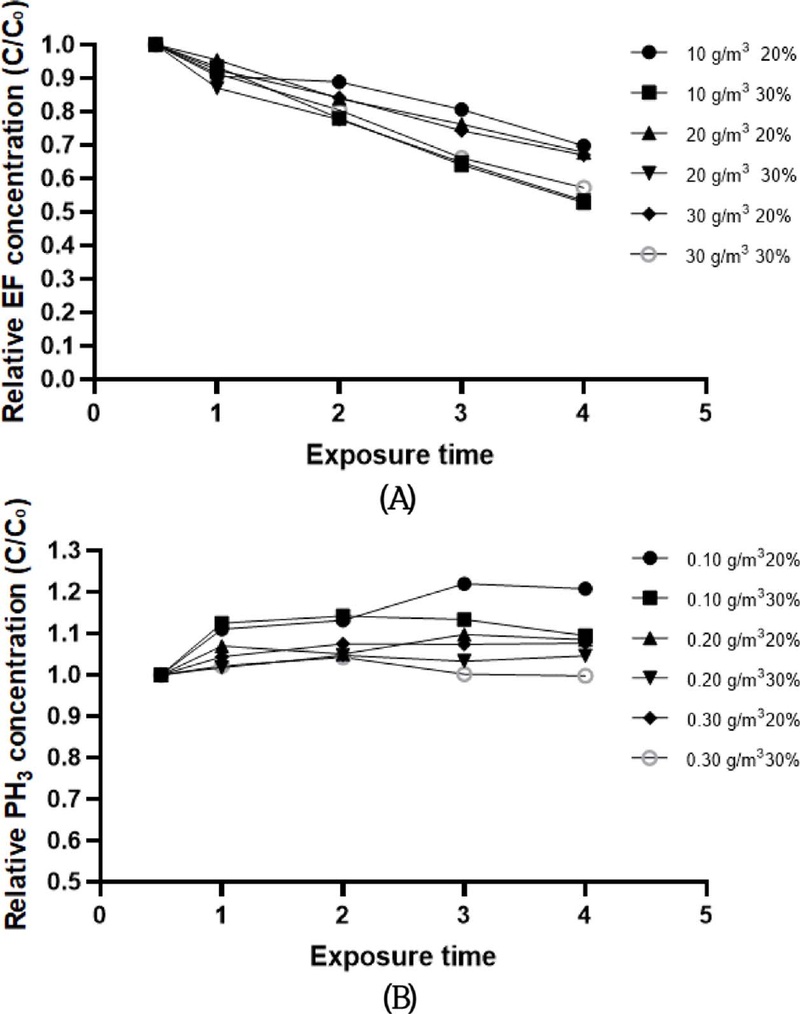
Sorption of ethyl formate (A) and phosphine (B) after 4 h combined treatment at 5 ± 1 °C in a 55 L chamber, with oranges loaded at 20% and 30% (w/v).
오렌지에 대한 훈증제 탈착량 평가
500 L 훈증상에서 에틸포메이트와 포스핀을 4 h 복합 처리 후 배기하여 경과 시간에 따른 잔류 가스를 측정하였다. 에틸포메이트의 시간가중평균 노출기준(TLV-TWA(Threshold Limit Value-Time Weighted Average))은 100 ppm으로, 배기 직 이하를 유지하였다. 포스핀의 TLV-TWA는 0.3 ppm으로, 4 h 시점에 1.13 ppm을 나타낸 후 19 h 이후 0.15 ppm까지 감소하였다(Fig. 2).
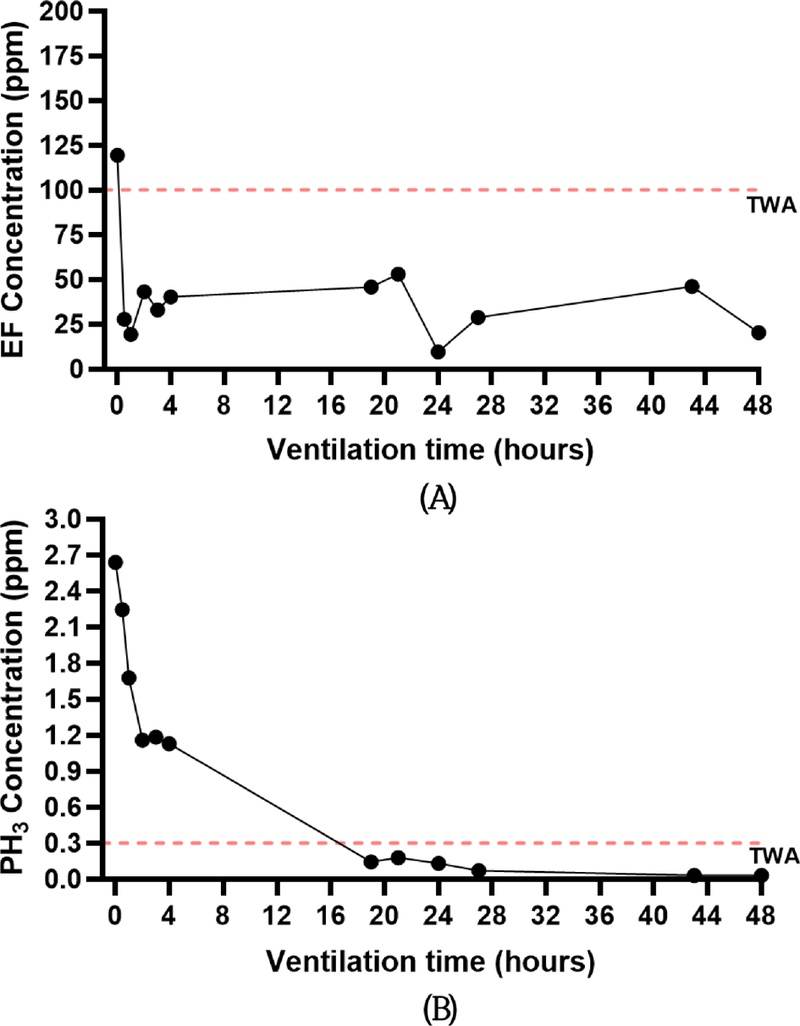
Results of ethyl formate (A) and phosphine (B) desorption measurement after sealing oranges for 24 h in a 12 L fumigation chamber following combined treatment with ethyl formate and phosphine for 4 h in a 500 L fumigation chamber at 5±1°C, according to venting time.
Scale-up 시험
현장 규모의 훈증 효과를 검증하기 위해 500 L 훈증상에서 오렌지 30%(w/v) 적재 조건으로 처리한 결과, 성충과 약충은 포스핀과 에틸포메이트 Ct 값이 각각 0.67 및 12.59 g·h/m3일 때 100% 치사율을 보였고, 알은 Ct 값 0.97 및 24.67 g·h/m3에서 100% 치사율을 나타냈다(Table 4).
Mortality of Planococcus citri adults, nymphs and eggs treated with a combination of ethyl formate and phosphine in a 0.5 ? fumigation chamber with a volume ratio of 30% after 4 h of exposure
500 L 훈증상에서 도출한 결과를 바탕으로, 현장 조건과 유사한 4 m3 규모 훈증상에서 21% 적재 조건으로 처리한 결과, 성충과 약충은 포스핀과 에틸포메이트 병행처리 시 Ct 값이 각각 0.36 및 8.94 g·h/m3에서 100% 방제되었다. 알은 포스핀과 에틸포메이트 병행처리 시 Ct 값이 각각 0.35 및 18.72 g·h/m3 이하에서 100% 방제됨을 확인하였다(Table 5).
Mortality of Planococcus citri adults, nymphs and eggs treated with a combination of ethyl formate and phosphine in a 4 m3 fumigation chamber with a volume ratio of 21% after 4 h of exposure
오렌지에 대한 약해 평가
포스핀 0.1−0.4 g/m3 및 에틸포메이트 10−40 g/m3를 처리한 조건에서 오렌지를 14일간 저장하며 약해를 조사하였다. 처리시 Ct값은 포스핀 + 에틸 포메이트가 각각 0.1 + 10 g/m3에서 0.52 + 25.63 g·h/m3, 0.2 + 20 g/m3에서 1.00 + 43.91 g·h/m3, 0.4 + 40 g/m3에서 2.25 + 76.64 g·h/m3의 농도를 보였다. Kruskal–Wallis 검정 및 Bonferroni 보정이 적용된 pairwise Wilcoxon rank sum test 결과, 모든 처리구에서 대조구와 비교하여 유의한 차이가 나타나지 않았다(p > 0.05). EF 10 + PH3 0.1 g/m3 처리구에서는 3일차 외부 색도에서 유의차가 관찰되었으나, 대조구의 색 변이가 높게 나타난 결과로 품질에는 영향이 없을 것으로 판단되었다(Fig. 3, Table 6).
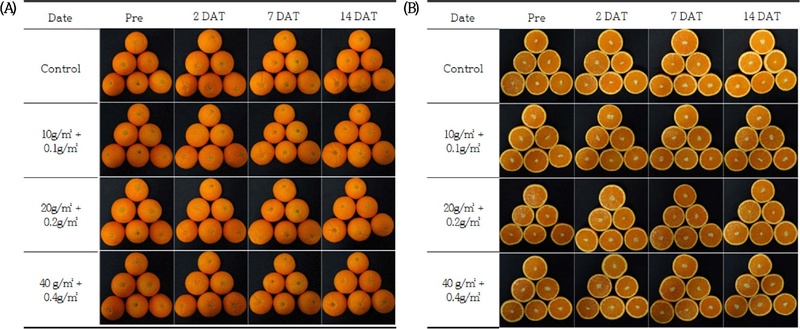
External (A) and internal (B) appearance of oranges stored at 5 ± 1°C after 4 h combined treatment with ethyl formate and phosphine in a 55 L fumigation chamber (DAT: days after treatment).
Phytotoxicity of oranges evaluated after combined treatment with ethyl formate and phosphine for 4 h in a 55 L fumigation chamber at 5 ± 1°C and subsequent storage at 5 ± 1°C.
고 찰
메틸브로마이드는 오존층 파괴 물질로 분류되면서 몬트리올 의정서에 따라 사용이 제한되었으며(UNEP, 2019), 이를 대체하기 위한 다양한 방제 기술이 연구되고 있다. 이러한 연구에는 대체 훈증제 개발뿐 아니라 열처리(Monzon et al., 2006), 저온처리(Sharp, 1993), 방사선 조사(Follett et al., 2013; Lee et al., 2014), 저산소 처리(Oh and Choi, 2014), 복합처리(Lee et al., 2016; Jeon et al., 2022; Cho et al., 2020) 등이 포함된다. 농림축산검역본부에서는 수입 농산물에 대한 소독처리기준 설정을 위해 수출입식물검역소독처리규정에서 훈증소독 시험 방법에 대해 규정하고 있으며, 메틸브로마이드 대체 소독기술 또한 시험 방법에 따라 수행되어야 현장 적용이 가능하다(APQA, 2024). 이 시험 방법은 시험 해충에 대한 방제효과 검정, 대상 작물에 대한 약해 평가, 흡착탈 평가 및 scale-up을 통한 현장조건 검정의 4가지 단계로 구성된다. 본 연구는 오렌지에 대한 훈증제 단독 처리 및 복합 처리 시 귤가루깍지벌레에 대한 방제효과 및 오렌지에 대한 약해, 흡탈착 검정을 통해 소독처리기준 설정 목적으로 수행되었다.
귤가루깍지벌레에 대한 방제효과 검정 결과, 5°C에서 훈증제 단독 처리 시 성충, 약충, 알 순으로 높은 방제 효과가 나타났다. 일반적으로 저온 조건에서는 해충의 호흡량 감소로 훈증제의 방제효과가 낮아지는 것으로 알려져 있으나, 귤가루깍지벌레의 경우 반대 결과가 나왔는데, 이는 저온조건에서 귤가루깍지벌레의 생존율이 낮아지기 때문으로 판단된다(Tanka et al. 2026). Kim et al. (2021)은 점박이응애와 복숭아혹진딧물에 대해 2시간의 저온 복합 처리를 수행한 결과 낮은 방제 효과를 보고하였다. 이는 해충의 종류에 따른 저온 저항성의 차이에 기인한 것으로 해석되며, 저온 조건이 해충의 생리적 특성에 따라 훈증제에 대한 감수성 차이를 나타낼 수 있음을 시사한다. 또한 Kim et al. (2021)은 동일한 해충이라도 훈증제 종류에 따라 5°C와 20°C에서 상승효과가 반대로 나타날 수 있음을 보고하였다.
또한 훈증제를 단독 처리했을 때보다 복합 처리에서 LCt99 값이 감소하는 것으로 확인되었는데, 이는 Zou et al. (2025)가 수행한 Paracoccus marginatus에서의 복합처리에서도 동일한 양상을 보이며, 본 연구에서도 에틸포메이트와 포스핀이 상호보완적으로 작용하여 발육 단계 간 약효 차이를 줄이고 전체 약량을 감소시켰음을 보여준다.
오렌지에 대한 에틸포메이트+포스핀 복합처리 시 흡탈착 평가 결과, 용적율 30% 조건에서 포스핀의 4 h 잔존률은 평균 104.61%로 확인되었는데, 이는 포스핀이 공기보다 밀도가 높아 하부에 축적되는 특성에 기인한 것으로 보인다. 반면 에틸포메이트 잔존률은 54.45%로 낮게 나타나 중·대규모 실험에서는 대상 해충이 사멸하는 Ct값 확보를 위해 훈증제 초기 처리량을 증가시켰다(Ahmed et al., 2018). 한편, 탈착 경향은 에틸포메이트의 경우 30분이내, 포스핀의 경우 19시간 이내에 TLV-TWA기준치인 100 ppm, 0.3 pppm 이하로 유지되어, 과일 취급 시점인 처리 후 약 24시간에는 안전하게 취급이 가능함을 보였다(Park et al., 2021).
기초 시험 결과를 토대로 수행한 중규모 실험(500 L)에서는 포스핀과 에틸포메이트의 Ct 값이 각각 0.97 및 24.67 g·h/m3일 때 귤가루깍지벌레 모든 태가 100% 방제되었고, 현장과 유사한 조건에서 수행한 대규모 실험(4 m3)에서는 Ct 값이 각각 0.36 및 8.94 g·h/m3일 때 약충과 성충이 100% 방제되었고, Ct 값이 각각 0.35 및 18.72 g·h/m3일 때 알이 100% 방제되었다. 본 연구에서 처리된 5oC에서의 에틸포메이트와 포스핀 복합처리는 Yang 등(2016)이 연구한 8oC에서의 에틸포메이트 포스핀 복합처리보다 낮은 처리 농도에서 내성태인 알을 100% 방제하여서 더 낮은 온도에서의 복합처리가 귤가루깍지벌레에 더 효과적임을 보여주었다. 오렌지에 대한 약해 평가 결과, 포스핀과 에틸포메이트를 각각 2.25 및 76.64 g·h/m3 농도로 처리 후 14일 경과 시 까지 대조구와 품질지표에서 유의한 차이가 나타나지 않았다.
결론적으로 포스핀, 에틸포메이트의 복합 처리는 귤가루깍지벌레 전 발육 단계에 대해 높은 살충력을 보였으며, 단독 처리 보다 복합 처리가 높은 약효를 나타내었다. 또한 24시간 이내에 작업자에 안전한 수준으로 탈착농도가 유지되었으며 오렌지에서 약해가 관찰되지 않아 오렌지의 유통온도에서의 적은 처리량은 에틸포메이트-포스핀 복합처리가 오렌지 소독처리기준으로 실용화 가능성이 높을 것으로 기대된다. 그러나 Kim et al. (2021) 및 Lee et al. (2018)의 보고처럼 상승효과는 해충 및 처리 조건에 따라 달라질 수 있으므로, 향후 다양한 검역 해충을 대상으로 한 추가 연구가 필요하다. 특히 Kim et al. (2015)이 제안한 저온·고산소·훈증제 복합 처리와 같은 물리적 병행 기술은 메틸브로마이드 대체 방안으로 유용할 것으로 기대된다.
Acknowledgments
본 연구는 농림축산검역본부 농림축산검역검사기술개발사업의 지원을 받아 수행되었습니다(과제번호: B-1543086-2024-26-01).
This paper was written based on the first author’s master’s thesis
이해상충관계
저자는 이해상충관계가 없음을 선언합니다.
REFERENCES
-
Abbott WS, 1925. A method of computing the effectiveness of an insecticide. J. Econ. Entomol. 18(2):265-267.
[https://doi.org/10.1093/jee/18.2.265a]

-
Ahmed Q, Ren Y, Emery R, Newman J, Agarwal M, 2018. Evaluation of ethyl Formate, phosphine, and their combination to disinfest harvested celery against purple scum springtails. Horttechnology 28(4):492-501.
[https://doi.org/10.21273/HORTTECH04030-18]
- APQA, 2024. Regulation on the disinfection and treatment for import and export plants. Animal and Plant Quarantine Agency Notification No. 2024-54. (In Korean)
-
Ban J-H, Yoo J-S, Choi J-E, Kim J-R, Kim B-S, 2026. Synergistic toxicity assessment of ethyl formate combined with low-oxygen and cold treatments against the red flour beetle, Tribolium castaneum Herbst. J. Stored Prod. Res. 115: 102802.
[https://doi.org/10.1016/j.jspr.2025.102802]
-
Chaudhry MQ, 2000. Phosphine resistance. Pestic. Outlook 11(3):88-91.
[https://doi.org/10.1039/b006348g]
-
Cho SW, Kim HK, Kim B-S, Yang J-O, Kim G-H, 2020. Combinatory effect of ethyl formate and phosphine fumigation on Pseudococcus longispinus and P. orchidicola (Hemiptera: Pseudococcidae) mortality and phytotoxicity to 13 foliage nursery plants. J. Asia-Pac. Entomol. 23(1):152-158.
[https://doi.org/10.1016/j.aspen.2019.11.005]
- Ducom P, 2012. Methyl bromide alternatives. Proceedings of the 9th International Conference on Controlled Atmosphere and Fumigation in Stored Product, Antalya, Turkey. p. 19.
-
Follett PA, Snook K, Janson A, Antonio B, Haruki A, et al., 2013. Irradiation quarantine treatment for control of Sitophilus oryzae (Coleoptera: Curculionidae) in rice. J. Stored Prod. Res. 52:63-67.
[https://doi.org/10.1016/j.jspr.2012.09.004]
-
Gill HK, Goyal G, Gillett-Kaufman J, 2012. Citrus mealybug Planococcus citri (Risso)(Insecta: Hemiptera: Pseudococcidae): EENY-537/IN947, 9/2012. EDIS 2012.
[https://doi.org/10.32473/edis-in947-2012]
-
Goldasteh S, Talebi A, Fathipour Y, Ostovan H, Zamani A, et al., 2009. Effect of temperature on life history and population growth parameters of Planococcus citri (Homoptera, Pseudococcidae) on coleus [Solenostemon scutellarioides (L.) Codd.]. Arch. Biol. Sci. 61(2):329-336.
[https://doi.org/10.2298/ABS0902329G]
-
Hennessey MK, Jeffers L, Nendick D, Glassy K, Floyd L, et al., 2013. Phytosanitary treatments, in: Gordh, G., McKirdy, S. (Eds), The handbook of plant biosecurity: Principles and practices for the identification, containment and control of organisms that threaten agriculture and the environment globally. Springer Netherlands, Dordrecht. pp. 269-308.
[https://doi.org/10.1007/978-94-007-7365-3_10]
-
Jenkins DA, Mizell RF, Van Bloem S, Whitmire S, Wiscovitch L, et al., 2014. An analysis of arthropod interceptions by APHIS-PPQ and customs and border protection in Puerto Rico. Am. Entomol. 60(1):44-57.
[https://doi.org/10.1093/ae/60.1.44]
-
Jeon J-C, Kim H-K, Koo H-N, Kim B-S, Yang J-O, et al., 2022. Synergistic effect of cold treatment combined with ethyl formate fumigation against Drosophila suzukii (Diptera: Drosophilidae). Insects 13(8):664.
[https://doi.org/10.3390/insects13080664]
- Kim B, Kim J, Lee B, Kim G, 2023. Development of methyl bromide alternative fumigants and fumigation technologies for plant quarantine purpose. Proceedings of the Korean Society of Pesticide Science Conference. p. 75-77.
-
Kim B-S, Yang J-O, Roh GH, Ren Y, Lee B-H, et al., 2021. Reciprocal effect of ethyl formate and phosphine gas on two quarantine pests, Tetranychus urticae(Acari: Tetranychidae) and Myzus persicae (Hemiptera: Aphididae). Korean J. Environ. Biol. 39(3):336-343.
[https://doi.org/10.11626/KJEB.2021.39.3.336]
-
Kim HK, Lee S-W, Kim J-I, Yang J-O, Koo H-N, et al., 2015. Synergistic effects of oxygen on phosphine and ethyl formate for the control of Phthorimaea operculella (Lepidoptera: Gelechiidae). J. Econ. Entomol. 108(5):2572-2580.
[https://doi.org/10.1093/jee/tov244]
- Korea agro-fisheries & food trade corporation, 2026. 2025 Agriculture and forestry export & import statistics. KATI Agricultural & Food Export Information. Naju, Korea. (In Korean)
-
Lee BH, Kim HM, Kim BS, Yang JO, Moon YM, et al., 2016. Evaluation of the synergistic effect between ethyl formate and phospine for control of Aphis gossypii (Homoptera: Aphididae). J. Econ. Entomol. 109(1):143-147.
[https://doi.org/10.1093/jee/tov289]
-
Lee G-A, Park M-G, Cho J-Y, 2014. Application of electron beam irradiation for insect pest control in agricultural products quarantine [Case study: Myzus persicae and Planococcus citri (Risso)]. J. Appl. Biol. Chem. 57(2):141-144.
[https://doi.org/10.3839/jabc.2014.021]
-
Lee JS, Kim HK, Kyung Y, Park G-H, Lee B-H, et al., 2018. Fumigation activity of ethyl formate and phosphine against Tetranychus urticae (Acari: Tetranychidae) on imported sweet pumpkin. J. Econ. Entomol. 111(4):1625-1632.
[https://doi.org/10.1093/jee/toy090]
-
Monzon ME, Biasi B, Simpson TL, Johnson J, Feng X, et al., 2006. Effect of radio frequency heating as a potential quarantine treatment on the quality of ‘Bing’ sweet cherry fruit and mortality of codling moth larvae. Postharvest Biol. Technol. 40(2):197-203.
[https://doi.org/10.1016/j.postharvbio.2005.12.011]
-
Muthu M, Rajendran S, Krishnamurthy TS, Narasimhan KS, Rangaswamy JR, et al., 1984. Ethyl formate as a safe general fumigant. Dev. Agric. Eng. 5:369-393.
[https://doi.org/10.1016/B978-0-444-42417-4.50037-2]
-
Oh JS, Choi JE, 2014. The evaluation of disinfection and operation of large scale anoxic chamber system for museum insects. J. Conserv. Sci. 30(2):137-148.
[https://doi.org/10.12654/JCS.2014.30.2.03]
-
Park M-G, Lee B-H, Yang J-O, Kim B-S, Roh GH, et al., 2021. Ethyl formate as a methyl bromide alternative for fumigation of citrus: Efficacy, fruit quality, and workplace safety. J. Econ. Entomol. 114(6):2290-2296.
[https://doi.org/10.1093/jee/toab175]
-
Pace R, Ascolese R, Miele F, Russo E, Griffo RV, et al., 2022. The bugs in the bags: The risk associated with the introduction of small quantities of fruit and plants by airline passengers. Insects 13(7):617.
[https://doi.org/10.3390/insects13070617]
- Plant protection act, 2025. Law No. 20751. (In Korean)
-
Ren YL, Lee BH, Padovan B. 2011. Penetration of methyl bromide, sulfuryl fluoride, ethanedinitrile and phosphine into timber blocks and the sorption rate of the fumigants. J. Stored Prod. Res. 47(2):63-68.
[https://doi.org/10.1016/j.jspr.2010.04.006]
-
Sharp JL, 1993. Heat and cold treatments for postharvest quarantine disinfestation of fruit flies (Diptera: Tephritidae) and other quarantine pests. Fla. Entomol. 76(2):212-218.
[https://doi.org/10.2307/3495716]
-
Simmons P, Fisher CK, 1945. Ethyl formate and isopropyl formate as fumigants for packages of dried fruits. J. Econ. Entomol. 38(6):715-716.
[https://doi.org/10.1093/jee/38.6.715a]
-
Subramanian S, Boopathi T, Nebapure SM, Yele Y, Shankarganesh K, 2021. Mealybugs, in: Omkar (Ed.), Polyphagous pests of crops. Springer Singapore, Singapore, pp. 231-272.
[https://doi.org/10.1007/978-981-15-8075-8_5]
-
Suh, S-J, Yu, HM, Hong, K-J, 2013. List of intercepted scale insects at Korean ports of entry and potential invasive species of scale insects to Korea (Hemiptera: Coccoidea). Korean J. Appl. Entomol. 52(2):141-160.
[https://doi.org/10.5656/KSAE.2013.03.0.007]
-
Tanka DV, Mutamiswa R, Coombes CA, Moore SD, Hill MP, 2026. Cold hardiness and chill coma recovery dynamics in mealybugs species of citrus, and implication for pest management. Entomologia 14(1):107929.
[https://doi.org/10.1127/entomologia/3973]
- UNEP (Ed.), 2019. Handbook for the Montreal Protocol on substances that deplete the ozone layer, 13th ed. United Nations Environment Programme, Nairobi.
-
Yang J, Park Y, Hyun I-H, Kim G-H, Kim B-S, et al., 2016. A combination treatment using ethyl formate and phosphine to control Planococcus citri (Hemiptera: Pseudococcidae) on pineapples. J. Econ. Entomol. 109(6):2355-2363.
[https://doi.org/10.1093/jee/tow222]
-
Yoo J-S, Ban J-H, Choi J-E, Kim B-S, Kim J-R, 2025. Primary investigation on the synergistic effects of methyl bromide and 1°C cold treatment for two-spotted spider mite (Tetranychus urticae) and the citrus mealybug (Planococcus citri). Insects 16(4):377.
[https://doi.org/10.3390/insects16040377]
-
Zou H, Li L, Li B, Ren Y, Liu T, 2025. Phosphine and phosphine plus ethyl formate for controlling papaya mealybug (Hemiptera: Pseudococcidae) on succulents. J. Econ. Entomol. 118(1):152-159.
[https://doi.org/10.1093/jee/toae270]
Jae-Ho Ban, Animal and Plant Quarantine Agency, Researcher, https://orcid.org/0000-0001-8112-4707, Investigation, Data analysis, Writing original draft preparation
Young Ho Kim, Research Institute of Invertebrate Vector, Kyungpook National University, Professor, https://orcid.org/0000-0003-0003-6604, Writing-review and Editing
Bong-Su Kim, Animal and Plant Quarantine Agency, Ph.D, https://orcid.org/0000-0003-4316-4315, Writing-review and Editing