
Analyzing the Duration of Efficacy of Pine Tree Trunk-Injected Abamectin and Emamectin Benzoate to Control Pine Wood Nematode Infections

Abstract
The pine wood nematode (PWN) affects pine trees worldwide with the most devastating nematode disease. Due to the dearth of effective methods to control the infection, injecting nematicides into the trunk is the most commonly used preventive measure. Under existing pesticide registration standards, abamectin and emamectin benzoate are the most commonly used trunk-injected nematicides in Korea and are currently recognized as having an efficacy period of one year. However, previous research indicated the persistence of disease-inhibiting effects of these two nematicides for three years in natural habitats. Therefore, we investigated whether their preventive efficacy persists into the fourth year at the same test site used in the previous studies. We observed that for both standard and double dose treatments, emamectin benzoate 2.15% demonstrated a control efficacy of over 90% up to the fourth year. However, abamectin 1.8% maintained over 90% efficacy into the fourth year, only when the dose was doubled. In the case of treatment with a mixed formulation of acetamiprid and emamectin benzoate, the mixture with an emamectin benzoate content of 2% showed a control effect of 78.7% in the fourth year. There was an annual increase in dead trees infected with PWNs in the untreated control group over four years, with the proportion of dead trees reaching 39.6% by the fourth year. Our results suggest that when standard doses of emamectin benzoate are used in low-value natural forests, such as landscape trees, practical control effects could persist into the fourth year.
Keywords:
Abamectin, Emamectin benzoate, Persistence, Pine wood nematode (PWN), Trunk injectionIntroduction
Pine wilt disease, caused by the pine wood nematode (PWN), Bursaphelenchus xylophilus, is causing fatal damage to native Korean pine species, including Pinus densiflora, P. thunbergii, and P. koraiensis. PWNs, which are transmitted by vectors and invade the tree trunk, multiply rapidly; as a result, the trees' water movement is blocked, causing them to die quickly. In the early stages of pine wilt disease, symptoms are difficult to distinguish. By the time yellowing, drooping needles, and branch dieback occur, the disease has already multiplied and spread within the tree. Therefore, control measures implemented after infection involve felling dead trees for incineration, burial, or fumigation (Lee et al., 2024). However, to prevent pine wilt disease in living trees, preventive trunk injections of nematicides or insecticide mixtures are commonly administered before infection (Shin et al., 2015).
The activity of avermectin-class nematicides, such as emamectin benzoate, ivermectin, and abamectin, for the control of PWNs has been reported (Takai et al., 2000). In Korea, various field bioassay studies using nematicides like abamectin, emamectin benzoate, fosthiazate, and morantel tartrate have also been conducted (Lee et al., 2009; 2021; 2023; 2024). Currently, 183 products of single and combination formulations of abamectin, emamectin benzoate, and milbemectin are registered in Korea as tree trunk injection agents for PWN control (RDA, 2026).
Currently, testing standards for trunk injection agents used to control PWN in Korea evaluate efficacy for only one year by assessing the damage rate 3 to 6 months after PWN inoculation in the year of treatment (RDA, 2017). However, studies regarding the duration of efficacy for tree-injected nematicides report that emamectin benzoate prevents PWN for up to three years post-injection (Takai et al., 2004). Similarly, prior field bioassays in Korea indicate that the efficacy of both abamectin and emamectin benzoate is maintained for two to three years. (Lee et al., 2009; 2023; 2024). In particular, Lee et al. (2024) investigated the persistence of nematicide tree injection efficacy and the increase in infected trees in untreated groups over a three-year period on islands where the natural spread of pine wilt disease from surrounding forests is limited. They reported that treatments with double doses of abamectin and emamectin benzoate, both individually and as a mixture, showed an average control efficacy of over 90% over three years. While the long-term efficacy of trunk-injected nematicides is important in natural forests, it is equally crucial for urban forestry and residential landscaping. High persistence reduces overall injection costs and minimizes the number of perforation wounds inflicted on the trees. Therefore, based on the prior study by Lee et al. (2024), this study was conducted to determine whether the control efficacy of trunk-injected nematicides persists into the fourth year after the initial injection.
Materials and Methods
The study was conducted in a 14-hectare Japanese black pine (P. thunbergii) forest on Gonri Island, located in Gonri, Sanyang-eup, Tongyeong-si, Gyeongnam, the same site used in the prior study by Lee et al. (2024). The treatment area was divided into seven 2-hectare plots (Fig. 1). Prior to trunk injection treatment, a total count was conducted to determine the total number of P. thunbergii, the number of dead trees, and the number of trees infected with PWNs within each experimental plot. The number of trunk-injected P. thunbergii in each experimental plot ranged from 896 to 1,804, with an average of 1,437 trees. Prior to trunk injection, the PWN infection rate in each treatment plot ranged from 34.3% to 58.6%, with an average of 47.5%. The breast height diameter of the P. thunbergii in each treatment plot ranged from 17.3 to 24.3 cm, with an average of 19.7 cm across all experimental plots (Lee et al., 2024).The research methodology followed that of the previous study by Lee et al. (2024). Briefly, abamectin micro-emulsion (recommended and double doses), emamectin benzoate micro-emulsion (recommended and double doses), acetamiprid·emamectin benzoate (8+2%) dispersible concentrate, and acetamiprid·emamectin benzoate (10+6%) soluble concentrate were purchased from commercial pesticide retailers for trunk injection. The injections were administered over five days, from February 18 to February 23, 2021. Trunk injection holes were created using a mechanical backpack drill equipped with a 10 mm diameter, 10 cm long drill bit. The nematicides were then injected directly into the holes using a pipette.
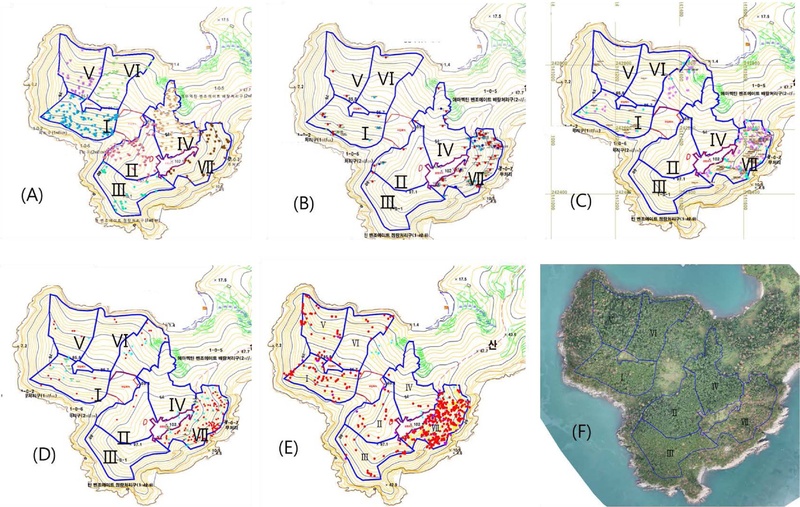
Status of dead trees infected by pine wood nematode before (A) and after 1 (B), 2 (C), 3 (D), and 4 years (E and F) after trunk injection of nematicide in Gonri Island. Areas Ⅰ through Ⅶ are trunk injection treatment zones; refer to Table 1 for treatment details. The red-filled circle dots in the figure indicate the locations of dead trees. Each point indicates the location of a dead tree (E) confirmed as a pine wilt nematode-infected tree by ground surveying a dead tree (F) captured in drone footage. Figures (a), (b), (c), and (d) are from Lee et al. (2023).
For each zone, the number of dead trees in the entire test plot prior to trunk injection was initially surveyed using a drone; the final count was then determined by conducting a secondary ground survey of the points identified in the images. The drone used to investigate pine wilt disease (PWD)-infected trees in the trunk injection treatment plots was a Phantom 4 RTK equipped with a dedicated 20 MP camera. Images were captured for each treatment plot, and damaged trees were identified using orthophotos. The flight altitude was set to 100−120 m, the flight speed to 8-10 m/s, and both the longitudinal and lateral overlap rates to 80%. An automatic flight program (Mission Planner) was used for image acquisition. After capturing the images, the final number of dead trees was confirmed through an in-forest ground survey at the corresponding coordinates.
The effectiveness of the control treatment in the fourth year following trunk injection was investigated on March 29 and November 22, 2025. After the drone survey, only trees with red leaves and drooping leaves—symptoms of pine wilt disease—were considered as affected trees through visual inspection within the forest (Choi et al., 2022). The isolation of PWNs from infected trees was determined by the confirmation of PWN infection symptoms, as there was variability in the presence or absence of detection depending on the sampling site and the time of infection. Because this was a single-plot study, the annual control rate was calculated relative to the control group. To compare treatment efficacy, an analysis of variance (ANOVA) was performed using the average control rate for each year, followed by Tukey's test for mean separation (SAS/STAT® 9.3 User’s Guide, 2011).
Results and Discussion
The preventive effect against PWN in the fourth year after trunk injection varied according to nematicide type and dosage (Table 1). Emamectin benzoate treatment demonstrated a control efficacy exceeding 90% at both standard and double doses; conversely, abamectin treatment exhibited over 90% efficacy only at the double dose. In the case of the mixture treatments, the treatment group with a 2% emamectin benzoate content showed a control efficacy of 78.7%, while the mixture containing 6% showed a control efficacy of 95.4%. The average annual control efficacy over the entire four years was consistent with the results of the fourth-year results. The standard dose of 1.8% abamectin showed the lowest efficacy, while the combination of acetamiprid and emamectin benzoate (8+2%) showed a control efficacy of less than 90%.

Control efficacy of various trunk-injected nematicides against pine wood nematode in Pinus thunbergii forests on Gonri Island
In addition to control efficacy, the number of dead trees infected with PWNs increased significantly in the fourth year after trunk injection compared to the third year, representing a high increase in the proportion of damaged trees (Table 1 and Fig. 1). In the untreated group, 300 dead trees were recorded, representing a 1.72-fold increase from the 175 trees the previous year. In the trunk injection group, 60 dead trees were recorded at the standard dose of 1.8% abamectin, reflecting a 2-fold increase over the prior year. In the treatment plots using standard and double doses of emamectin benzoate 2.15%, no tree mortality occurred in the previous year. However, in the fourth year, 21 and 6 dead trees were recorded, respectively, indicating a high decline in efficacy. For the combination treatment plots, 40 dead trees occurred in the acetamiprid + emamectin benzoate (8+2%) plot, representing a 4-fold increase from the previous year. Meanwhile, 11 dead trees occurred in the acetamiprid + emamectin benzoate (10+6%) plot, marking a 5.5-fold increase.
Overall, the number of dead trees damaged by PWN increased significantly in the fourth year compared to the third year. however, regarding control efficacy compared to the control group, emamectin benzoate treatment achieved 94.4% in the standard-dose treatment group and 98.1% in the double-dose treatment group, while the abamectin 1.8% double-dose treatment group showed an efficacy of 93.5%. Therefore, based on the control efficacy relative to the control group and the average efficacy over four years, the emamectin benzoate 2.15% treatment consistently exceeded 90%, suggesting it is suitable for practical use. Conversely, practical control efficacy cannot be guaranteed by the fourth year for abamectin 1.8% or combination formulations with a 2% emamectin benzoate ratio.
Because the study was conducted as a large-scale demonstration trial without replication, its statistical analysis has limitations. Furthermore, the island's isolation prevents the free movement of pine wilt nematode vectors, creating conditions that differ from general mainland forests. Despite these differences, emamectin benzoate overall demonstrated a longer-lasting preventive effect against pine wilt nematodes than abamectin. Additionally, the results suggest that emamectin benzoate content is a more critical factor in determining control efficacy than whether it is administered as a single or mixed treatment. Meanwhile, the residual amount of emamectin benzoate in the treatment groups with the standard amount of emamectin benzoate, the 10+6% combination of acetamiprid and emamectin benzoate, and the 8+6% combination of acetamiprid and emamectinbenzoate did not show a statistical difference in the 3rd and 4th years (Unpublished data).
Overall, it is estimated that the efficacy of emamectin benzoate can be sustained for four years with trunk injection at the standard dose of 2.15% in areas where PWNs naturally occur; however, since this study was conducted in island regions where the additional influx of vectors is limited, it is considered that further research is needed regarding the impact according to the degree of damage in inland areas. Given that the rate of dead trees infected with PWN is relatively higher than in the previous three years, it is judged that additional tree injections every three years will be necessary for pine trees of high economic importance or those requiring special management. Conversely, since the overall forest mortality rate is only 1.3% over four years, administering follow-up injections after this period is deemed economically practical, provided that stand density and the conservation value of the trees are taken into account. Therefore, tree injection schedules should be tailored to the unique characteristics and environmental conditions of each individual stand. In addition, further research on nematicides with long residual effects or the duration of efficacy of new nematicides is considered necessary for the practical management of PWNs.
Acknowledgments
This study was conducted with funding from the Korea Forest Service’s ‘Research and development projects for solving current issues in forestry disasters and calamities,’ specifically the project titled ‘Evaluation of the control effect of pine wilt disease by a single mixed injection method’ (Project No. “2021333A00-2123-CD02”).
Conflict of Interest
The author declares that there is no conflict of interest.
REFERENCES
-
Choi J, Lee J, Lee H, Jang C, Kim YS, et al., 2022. Time-dependent change of host by nematicide tree injection and pine wood nematode, Bursaphlenchus xylophilus inoculation in two pine species, Pinus densiflora and P. thunbergii. Korean J. Pestic. Sci. 26(1):43-54.
[https://doi.org/10.7585/kjps.2022.26.1.43]

-
Lee SM, Jeong YH, Kim DS, Lee DW, 2023. Efficacy and persistence of trunk injection nematicides against pine wood nematode, Bursaphlenchus xylophilus in pine tree, Pinus densiflora. Korean J. Pestic. Sci. 27(3):221-231.
[https://doi.org/10.7585/kjps.2023.27.3.221]
-
Lee SM, Jeong YH, Lee DW, 2024. Effectiveness and sustainability of nematicides used against the pine wood nematode, Bursaphelenchus xylophilus, in the black pine (Pinus thunbergii) forest in Gonrido, Korea. Korean J. Pestic. Sci. 28(2):171-182.
[https://doi.org/10.7585/kjps.2024.28.2.171]
-
Lee SM, Jung YH, Seo S, Kim DS, Lee DW, 2021. Residual amounts of trunk-injected abamectin and emamectin benzoate and their control efficacy on pine wood nematode, Bursaphlenchus xylophilus according to the injection time to Korean red pine (Pinus densiflora). Korean J. Pestic. Sci. 25(4):255-262.
[https://doi.org/10.7585/kjps.2021.25.4.255]
- Lee SM, Kim DS, Lee SG, Park NC, Lee DW, 2009. Selection of trunk injection pesticides for preventive of pine wilt disease by Bursaphelenchus xylophilus on Japanese black pine (Pinus thunbergii). Korean J. Pestic. Sci. 13(4):267-274.
- Rural Development Administration (RDA), 2017. Detailed guidelines for the field of efficacy and phytotoxicity in the pesticide registration test (insecticides). National Institute of Agricultural Sciences. Wanju, Korea.
- Rural Development Administration (RDA), 2026. Pesticide Safety Information System. https://psis.rda.go.kr/psis/
- SAS/STAT® 9.3 user’s guide, 2011. SAS Institute Inc., Cary, NC, USA.
-
Shin WS, Jung YH, Lee SM, Lee CM, Lee CJ, et al., 2015. Development of effective screening method for efficacy test of trunk injection against pine wood nematode, Bursaphelenchus xylophilus in Japanese black pine, Pinus thunbergii. Korean J. Pestic. Sci. 19(4):440-449.
[https://doi.org/10.7585/kjps.2015.19.4.440]
-
Takai K, Soejima T, Suzuki T, Kawazu K, 2000. Emamectin benzoate as a candidate for a trunk-injection agent against the pine wood nematode, Bursaphelenchus xylophilus. Pest Manag. Sci. 56(10):937-941.
[https://doi.org/10.1002/1526-4998(200010)56:10<937::AID-PS213>3.0.CO;2-B]
-
Takai K, Suzuki T, Kawazu K., 2004. Distribution and persistence of emamectin benzoate at efficacious concentrations in pine tissues after injection of a liquid formulation. Pest Manag. Sci. 60(1):42-48.
[https://doi.org/10.1002/ps.777]
Sang Myeong Lee (ORCID http://orcid.org/0000-0001-7346-9430), and Young Hak Jung, SM Biovision Co., PhD.
Ki Bo Sim, Gyeongsangnamdo Forest Environmental Research Institute, Researcher.
Mwamula Abraham Okki, Kyungpook National University, PhD.
DongWoon Lee, Kyungpook National University, Professor. ORCID http://orcid.org/0000-0001-9751-5390.
Research design; Lee SM, Jung YH, Lee DW, Investigation; Lee SM, Jung YH, Sim KB, Data analysis; Jung YH, Lee DW, Writing – original draft preparation; Lee DW, Mwamula AO, Writing – review and editing; Lee SM, Jung YH, Sim KB, Mwamula AO, Lee DW.