
The Korean Society of Pesticide Science
[ ORIGINAL ARTICLES ]
The Korean Journal of Pesticide Science - Vol. 29, No. 2, pp.97-113
ISSN: 1226-6183 (Print) 2287-2051 (Online)
Print publication date 30 Jun 2025
Received 11 Jun 2025 Revised 23 Jun 2025 Accepted 23 Jun 2025
DOI: https://doi.org/10.7585/kjps.2025.29.2.97

신물질 작물보호제의 수출 확대를 위한 개발도상국 등록 체계 조사

홍수명1 ; 김택겸2 ; 김수연3 ; 김보열4 ; 김진효1, *
1경상국립대학교 농업생명과학연구원 환경생명화학과
2농촌진흥청 국립농업과학원 잔류화학평가과
3한국농업기술진흥원
4브릭특허사무소
Investigation of Registration Frameworks in Developing Countries to Promote the Export of Novel Crop Protection Products
Su-Myeong Hong1 ; Taek-Gyum Kim2 ; Su-Yeon Kim3 ; Bo-Yul Kim4 ; Jin-Hyo Kim1, *
1Department of Applied Life Chemistry, Institute of Agriculture and Life Science (IALS), Gyeongsang National University, Jinju 52828, Republic of Korea
2Residual Agrochemical Assessment Division, National Institute of Agricultural Sciences, Wanju 55365, Republic of Korea
3The Korea Agriculture Technology Promotion Agency, Iksan 54667, Republic of Korea
4Brick Patent Law Firm, Gwanak-gu, Seoul 08793, Republic of Korea

Correspondence to: *E-mail: jhkim75@gnu.ac.kr

초록

본 연구에서는 우리나라에서 개발을 진행하고 있는 신물질 작물보호제의 효율적인 해외 등록 방법을 모색하여 해외 등록을 촉진하고 수출을 확대하고자 세계 각국의 작물보호제 등록 체계와 등록을 위한 시험보고서 그리고 등록 진행 과정을 분석하였다. FAO가 제공하는 세계 각국의 등록체계는 (1) 시험보고서의 유추성(Analogy) 평가 등록 (2) 원제 및 제품의 동등성(Equivalence) 평가 등록 (3) 시험보고서의 합리성(Rationalization) 평가 등록 (4) 자국의 시험방법 및 평가 기준에 의해 생산한(Local Evaluation) 시험보고서 평가 등록 등 크게 4단계의 수준으로 등록체계를 구분할 수 있었으며, 세계 각국의 작물보호제 등록을 위해 요구하는 시험연구 보고서는 15개 분야 218개의 항목으로 조사되었다. 우리나라에서 개발을 진행하고 있는 신물질 작물보호제의 동록 및 수출 대상국을 개발도상국 한정을 하면 대부분의 개발도상국은 지역 경제 공동체의 선진국에서 등록이 된 작물보호제 원제 및 제품의 경우, 동등성 평가만으로 그 나라에서 등록을 진행하는 체계를 가지고 있는 것으로 조사되었다. 농약 등록 관리 선진국에 개별적 농약 등록 후에 이 국가들의 등록을 Reference로 하여 농약 원제 및 제품의 동등성 인정으로 주변 개발도상국들에 대한 농약 등록을 촉진이 가능할 것으로 판단된다.

Abstract

This study investigates the crop protection product registration systems of developing countries to identify effective strategies for promoting the overseas registration of novel crop protection products developed in Korea. Global crop protection product registration systems were categorized into four levels by analyzing the classification framework provided by the FAO. These are (1) analogy-based data evaluation, (2) equivalence assessment of active ingredients and formulations, (3) rationalization of existing data, and (4) evaluation based on local test data. Many developing countries recognise the equivalence of pesticides that have been approved for use in developed countries or regional economic communities. This allows for a simplified registration process. Accordingly, obtaining initial approval in advanced regulatory jurisdictions can serve as a critical benchmark. Therefore, the approval process in neighboring developing countries is accelerated and global market access is enhanced for Korean innovations.

Keywords:

Developing countries, Equivalence, Novel crop protection product, Registration authority, Test report

키워드:

신물질 작물보호제, 등록 기관, 시험 보고서, 개발도상국, 동등성

서 론

작물보호제는 농산물 생산의 가치사슬에서 매우 중요한 후방산업으로 작물보호제의 안정적 공급은 인구 증가, 고령화, 환경 및 안전 등의 이슈가 대두되고 있는 국내외 환경에서 지속적으로 식량을 생산하고 공급하여 농산업의 핵심 요소로써 작용하고 있다(Tudi et al., 2021). 특히 글로벌 화학기업들은 작물보호제 시장으로의 활발한 진출을 위해 공격적인 인수합병을 추진하고 노동 절감형 제품, 생력화 제품 등 차별화된 기술을 확보하여 경쟁력 있는 사업 확장을 위한 노력을 매우 적극적으로 추진 중이다(Mansfield et al., 2024). 이러한 글로벌 환경에도 우리나라의 신물질 작물보호제 원제 개발은 높은 R&D 비용으로 인해 연구 개발에 대한 투자 여력이 제한적이었으며 열악한 연구 개발 환경으로 인해 수출용 신물질 원제 개발에 필수적인 해외시장조사 또는 특허 기술, 그리고 수출 대상국에 대한 작물보호제 원제 등록에 관한 정보가 부족하고 이를 해결하기 위한 노력이 매우 부족한 실정이다.

전 세계 작물보호제 사용량은 2000년에서 2021년 62%가 증가하여 2021년에는 350만 톤으로 증가하였고, 2000년에서 2016년까지 지속 성장 후 2018년까지 감소하는 양상을 보이다가 이후 계속 성장하였으며 아메리카가 가장 많은 작물보호제를 사용하였으며 아시아, 유럽, 아프리카 및 오세아니아가 그 뒤를 차지하고 있다. 대륙별 작물보호제 소비량을 보면, 아메리카의 경우 41%에서 50%로 증가하였으며 아시아와 유럽은 28%와 14%로 각각 5~6% 감소, 아프리카는 작물보호제 적용 증가율이 176%로 상승하여 가장 높은 성장세를 보이고 있다(MarketandMarkets, 2024). 작물보호제 시장은 기후 변화로 인한 병충해 증가, 나노 및 생물 작물보호제 도입, 지속 가능한 농업 실천 확산 등으로 성장하고 있으나 화학 작물보호제에 대한 규제 강화, 잔류성 작물보호제에 따른 환경영향 우려, 작물보호제 내성 증가 등에 대한 우려는 시장 성장을 억제하고 있지만 정밀 농업, IPM 도입, 신흥 시장 확장은 새로운 기회를 제공함과 동시에 대체 기술 확산과 식량 생산 증가에 도움이 되고 있다는 소비자 인식 변화는 도전적 요인으로 작용하고 있다(Abubakar et al., 2020). 남미 지역, 특히 브라질과 아르헨티나는 대규모 농업 지역을 보유하고 있으며, 대두 및 옥수수와 같은 수출을 위한 곡물을 재배하는 데 있어 광범위한 병해충관리가 필수적이고(Wesselinga et al., 2005) 아시아 지역에서는 중국과 인도가 높은 시장 점유율을 차지하고 있으며 아시아 태평양 지역 및 아프리카 지역은 다양한 농작물 재배와 병해충 압력으로 인해 큰 시장 점유율을 차지할 것으로 예상되고 있다(FAO, 2023).

2024년 전 세계 농약시장은 약 1,810억 달러로 추정이 되며 2031년까지 연평균 성장률(CAGR) 5.6%에 이를 것이며, 시장 규모는 약 1,812억 달러로 확대될 것으로 전망된다. 이중 개발도상국 시장 수요 증가율은 연간 3.3% 성장하여 2025년 기준 약 798억 달러 규모에 이를 것으로 예상이 된다. 특히 인도, 아프리카, 중남미 등의 지역이 시장 성장을 주도하고 있다(Persistencemarket research, 2024). 2024년 '작물보호 화학물질' 시장에서 아시아·태평양 지역이 약 29% 점유하고 있으며, 대부분 개발도상국에 속한 중국·인도·베트남·인도네시아 등이 큰 비중을 차지하고 있습니다. 개발도상국은 전 세계 농약 시장의 약 3/4를 차지하며, 특히 아시아·아프리카·남미 중심으로 빠르게 확대되고 있다(Freedoniagroup, 2022).

세계은행(World Bank)의 국가 경제 분류 원칙에 의하면 고소득(high-income) 국가 제외한 중저소득 국가(low, lower-middle, upper-middle income)를 개발도상국으로 분류하며, 2022년 기준, 고소득 국가가 80개이고, 나머지 137개 국가와 경제권이 개발도상국으로 분류한다(World population review, 2025).

작물보호제 등록은 등록 주체(국가)가 작물보호제 개발자가 제시한 해당 물질의 목적에 효과적이며 사람이나 동물의 건강 또는 환경에 허용할 수 없는 위험을 초래하지 않음을 입증하는 종합적인 과학적 시험 결과를 평가한 후 작물보호제의 판매 및 사용을 승인하는 절차로서 작물보호제 등록의 기본 원리는 사람(소비자, 작업자), 동물, 환경에 대한 유해성을 평가하는 안전성(Safety) 항목과 작물보호 효과가 충분한지 실험 자료를 통해 검증하는 유효성(Efficacy) 항목, 제조된 제품이 규격에 맞고, 유효성분이 일정하게 존재하는지 확인하는 품질(Quality & Formulation Stability) 평가 항목, 안전 사용을 위한 정확한 사용법, 농작물, 희석배수, 공시사항 등을 라벨에 표기를 규정 Labelling 항목, 식품 내 잔류허용기준(MRL)을 설정하여 소비자 노출량 평가하는 잔류물평가(Residue Assessment) 항목, 유해 가능성과 작물 보호 효과를 비교 평가하여 등록 여부 결정하는 위험성-이익 균형(Risk-Benefit Analysis)항목으로 구분된다(Tiel, 1982). 우리나라가 개발을 진행하고 있는 신물질 작물보호제의 성공을 위해서는 다가오는 미래의 주요 시장이 될 수 있는 개발도상국에 대한 작물보호제 등록 전략을 수립하기 위해서는 해당 국가의 등록 기관이 작물보호제를 평가하고 승인하기 위해 적용하는 등록 제도를 이해하고 활용하여야 한다. 선택한 등록 전략은 무엇보다도 해당 국가의 국가 작물보호제 등록 법률 및 정책, 작물보호제 등록에 사용할 수 있는 인적 자원(예: 기술 전문성, 경험), 재정 자원(예: 직원 수, 운영 자금 수준)에 따라 대응해야 하는 방법이 달라질 수 있다.

따라서 우리나라 신물질 작물보호제 원제 개발 기술 경쟁력을 강화하고 개발된 신물질 원제의 신속한 수출 대상국이 될 수 있는 개발도상국에 대한 작물보호제 등록을 이루어내기 위하여 개발도상국에 대한 신물질 작물보호제 등록 관리 제도 및 규정을 조사하고 국가별 작물보호제 등록 관리에 투여하는 다양한 자원의 수준을 평가하여 분류한 후에 우리나라가 개발하는 신물질 작물보호제의 대외 수출 활동을 통해 경제적 성과의 마중물이 될 수 있는 개발도상국에 대한 등록 활성화 방안을 제시하기 위하여 본 연구를 추진하였다.


방 법

개발도상국들의 작물보호제 등록 체계를 조사하기 위하여 UN 산하 FAO 및 WHO에 회원국으로 가입하여 작물보호제 등록 관리 정보를 제공한 국가들의 작물보호제 등록관리 기관 현황을 조사하였고 이들 나라들이 작물보호제 등록 시에 요구하는 시험 보고서 항목을 조사하여 분류하였다(FAO, 2025). 작물보호제 등록 시에 적용하는 안전성 평가 및 품질 관리, 약효 약해 등 등록을 위한 다양한 자료 요구 정도 및 평가 수준의 자원 활용도에 따라 등록 관리 정책을 4단계로 분류하여 작물보호제의 등록 관리 제도에 대한 체계적 분류를 진행하였다.

개발도상국에 대한 등록을 확산하기 위해서 FAO가 국가별 작물보호제 등록 관리 제도의 효율적인 운영을 위하여 지역적 유대가 가능한 인접 국가간의 작물보호제 등록 운영 및 평가 결과에 대한 상호 협력 방안을 제시하고 개발도상국들에게 등록 평가 시스템에 투자 가능한 다양한 자원의 준비가 이루어 지기 전에는 지역 경제 공동체 국가 중 작물보호제 등록관리 선진국의 등록 평가 결과를 해당 국가에 적용하여 운영하기를 권장함으로서(WHO, 2014) 개발도상국 대상 신물질 작물보호제의 등록 기준 중에서 지역 경제 공동체 국가의 동일 작물보호제 등록 시에 해당 작물보호제의 등록을 용이하게 하기 위한 작물보호제 동등성(Equivalence) 인정을 위한 시험 항목 및 평가 기준 조사하고, 국제적으로 결성되어 운영되고 있는 지역 경제공동체 국가의 구성과 경제 협의 블록 국가 내의 작물보호제 등록 관리 선진국 현황을 파악하였다. 이러한 조사 결과를 바탕으로 우리나라가 개발하는 신물질 작물보호제의 원활한 수출을 위해서 수출 대상국으로 선정된 개발도상국의 신속한 작물보호제 등록 방안으로 지역 경제공동체 권역 내의 작물보호제 등록관리 선진국에 대한 등록을 거친 후 등록 평가 기준을 인근 선진국의 등록 결과를 벤치마킹하는 개발도상국의 등록관리 정책의 특성을 파악하여 제시하고자 하였다.


결과 및 고찰

UN 산하 195개국의 회원국 중 작물보호제 등록 관리를 진행하지 않거나 자국 중심의 선진화된 관리체계 운영으로 FAO 주관하의 작물보호제 등록 관리 기술에 관한 협력에 참여하지 않는 국가(유럽연합, 미국 등)를 제외한 115개국의 작물보호제 등록관리 기관 현황과 정보를 조사하였다(Table 1). FAO 작물보호제 협력프로그램에 참여하는 국가들의 대부분은 개발도상국들이고 해당 국가들의 작물보호제 등록 기관, 등록시 요청하는 시험 보고서, 등록을 위한 평가 방법 등을 파악하였다. 조사 대상 국가들이 작물보호제 등록을 위하여 제출하여야 할 내용과 시험 보고서 항목을 조사한 결과를 보면 다양한 국가들의 작물보호제 등록의 위해성 판단을 위한 결정 방침에 따라 15개 분야 218개의 항목을 작물보호제 등록을 위하여 요구하는 것으로 조사되었다(FAO & WHO, 2016). 이에 대한 조사 결과는 Table 2에 나타내었다.

Authorities responsible for the registration of crop protection products in FAO toolkit member countries

Data requirements and status of test reports for the registration of crop protection products

이러한 조사 결과를 바탕으로 개발도상국들이 채택하여 운영 중인 작물보호제 등록 관리 제도를 분류하여 보면 (1) 시험보고서의 유추성(Analogy) 평가 등록 (2) 원제 및 제품의 동등성(Equivalence) 평가 등록 (3) 시험보고서의 합리성(Rationalization) 평가 등록 (4) 자국의 시험방법 및 평가 기준에 의해 생산한(Local Evaluation) 시험보고서 평가 등록 등 4가지의 큰 체계로 분류할 수 있는 것으로 나타났다(Fig. 1). 개발도상국들의 작물보호제 등록 관리 체계를 분석하여 분류하여 보면 작물보호제 등록은 기본 체계부터 종합적인 판단을 하는 체계까지 다양하며, 기본 체계는 복잡하지 않는 소수의 필수적인 시험 데이터를 사용하므로 최소한의 리소스가 필요한 상태이고 점점 더 포괄적인 등록 체계를 사용하면 일반적으로 작물보호제 등록 평가에 더 많은 시험 데이터가 사용되며, 이에 따라 더 복잡해질 뿐만 아니라 등록 국가의 시험 보고서도 해당국가의 지역별로도 더 세분화되며, 이를 위해서는 등록 기관에 추가적인 리소스가 필요하게 된다. 대부분의 개발도상국들이 유추성과 동등성 평가로 작물보호제의 등록 평가를 완성하는 것으로 조사되었으며 이에 대한 설명은 Table 3에 서술하였다.
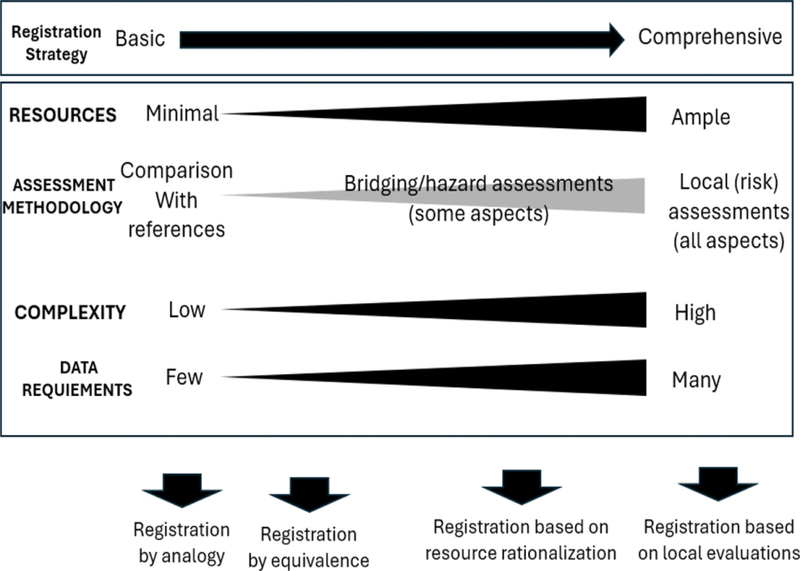
Fig. 1.

Comparative analysis of regulatory management levels for crop protection products based on evaluation criteria and data submission requirements

Classification of crop protection product registration systems

유추성 평가에 의한 작물보호제 등록은 등록 관리 인프라가 부족한 국가에서 등록을 위해 제출된 작물보호제와 1개국 이상의 다른 나라에서 등록된 유사 작물보호제를 제한적으로 비교하는 기본적인 등록 방식이다. 작물보호제가 인근 국가에 등록되었으므로 자국에서 사용하더라도 작물보호제의 품질, 효능 및 위험이 허용 가능한 것으로 가정하는 방식이다. 이후 등록 기관은 동일한 작물보호제의 효능과 위험이 자국에서도 허용 가능한 지 여부를 평가한다. 이 접근 방식은 작물보호제의 효능과 위험을 평가하기 위해 가교 방법을 적용하며, 완전한 평가보다 상대적으로 덜 복잡하고 데이터 사용량이 적으며 인적 자원이 덜 필요한 등록 방법이다. 그러나 유추에 의한 등록은 보다 포괄적인 평가보다 정확도가 떨어지고 현지 사용 조건에서 효능과 위험에 대한 상당한 불확실성을 남길 수 있다.

동등성 평가 등록은 등록 요청 작물보호제가 해당 국가에 이미 등록된 유사 작물보호제와 동등하다는 것을 입증할 수 있는 경우 동등성에 근거한 등록을 진행할 수 있다. 다른 나라에서 등록되어 생산되는 작물보호제의 불순물 및 독성학적 프로필과 물리적, 화학적 특성이 유사하여 비슷한 수준의 위험성을 나타낼 것으로 예상할 수 있는 경우 두 작물보호제는 동등한 것으로 간주된다는 개념이다. 동등성 판단의 목적은 후발 등록 작물보호제가 "참조" 사양의 기반이 되는 이미 등록된 작물보호제보다 품질 및 유해성이 더 나쁘지 않은지 여부를 판단하는 것으로 이를 입증할 수 있는 경우 후발 작물보호제도 등록할 수 있다.

동등성에 의한 등록은 해당되는 경우 완전한 현지 평가보다 신청자가 제출해야 하는 자료가 매우 적을 수 있다(FAO & WHO, 2022). 동등성은 간단한 개념이지만 그 결정은 다소 복잡하며 특히 작물보호제의 화학적 조성에 대한 전문 지식이 필요하다. 작물보호제 신규 등록을 위해서 제출한 자료를 기반으로 신물질 작물보호제의 동등성 평가를 획득하기 위하여 제출하는 자료와 평가기준은 Table 4와 같다(FAO & WHO, 2022).

A two-step assessment approach for determining technical equivalence during the registration of novel crop protection product active ingredients

데이터 요구 사항은 등록 기관에 특정 유형의 작물보호제가 특정 사용 상황에 적합한지 평가하는 데 필요할 수 있는 데이터에 대한 지침을 제공하는 것으로, 이러한 데이터를 생성하는 데 사용할 수 있는 널리 인정된 테스트 지침에 대한 조언도 포함이 된다. 등록 기관은 이러한 데이터들을 평가하여 등록 신청자로부터 필요한 모든 데이터를 확보했는지 또는 잘 알려진 테스트 방법을 사용했는지 확인할 수 있는 것이다. 이러한 데이터 요구 항목은 작물보호제 등록을 위한 국가별 데이터 요건이 없거나 업데이트가 필요한 경우 이를 정의하는 데 사용할 수 있다. 데이터 요건은 모든 유형의 작물보호제에 대해 동일하지는 않지만 작물보호제 그룹, 작물보호제 유형(예: 살충제, 제초제 또는 쥐약), 용도(예: 식용, 공중보건용 또는 임업용), 등록 유형(예: 해당 국가의 새로운 활성성분을 사용한 신제품 또는 기존 등록의 연장)에 따라 달라질 수 있다.

FAO의 작물보호제 등록 평가 효율화 방안에 제시된 방법에 의하면(WHO, 2014) 작물보호제 등록에 가용할 수 있는 제한된 국가 자원을 최적화하는 또 다른 방법은 작물보호제 등록을 위한 지역 협력을 촉진하는 것이다. 이러한 국가 간 협력은 데이터의 상호 수용(예: 효능 또는 잔류 시험), 업무 공유(예: 신규 등록 작물보호제의 시험 결과에 대한 과학적 평가), 데이터 요구 사항 및 평가 방법의 조화, 지역 유대 권역별 작물보호제 등록 계획 공유에 이르기까지 다양한 형태로 이루어질 수 있다. FAO는 자원이 부족한 국가/지역에서 작물보호제 등록 체계를 개선하기 위한 효과적인 수단으로 지역 협력을 적극 권장하고 UN 주관의 국가 협력 프로젝트의 일환으로 적극적으로 추진하고 있다.

작물보호제의 등록에 관한 지역 국가간의 협력과 정보 교류가 이루어지는 국가 경제협의체는 Table 5와 같으며 대부분의 지역 경제 협의체들이 경제 활성화와 시장 개방 그리고 경제 정보 교류를 주요 목적으로 하고 있으며 우리나라가 진행중인 신물질 작물보호제의 수출 대상이 될 수 있는 개발도상국들이다.

Overview of economic and interest-based regional alliances among countries for the harmonization of crop protection products registration

UN 산하 FAO가 조사한 115개국의 농약 등록을 위한 시험 및 자료 현황을 살펴보고, 다양한 국가들의 농약 등록관리 실태를 분석한 결과 신물질 작물보호제의 주요 시장이 될 것으로 예상되는 개발도상국에서는 동등성 평가에 의한 등록 제도를 폭넓게 운영하고 있다. 자국에 등록을 희망하는 원제 및 제품이 타 국가에 이미 등록되어 있고 동등성 평가에 필요한 화학, 독성 시험보고서가 국제 가이드라인에 준해 생산된 보고서라면 이를 수용하여 인정하고 나아가 타 국가에서 수행한 위해성 평가를 자국의 상황에 맞게 사용하고 해석하는 브리징(Bridging)을 적용하고 있다. 더불어 개발도상국간 등록 평가에 투입되는 인적 및 재정적 자원의 부족을 극복하기 위하여 인근 국가간의 경제적 협의체 기구를 바탕으로 한 국가간 협력이 빈번하게 이루어지므로 FAO/WHO 가이드라인(FAO & WHO, 2022)이 규정한 동등성 인정을 위한 화학 및 독성 자료를 준비하여 지역별 선도 국가에 우선적으로 등록을 추진하면 효율적인 신물질 농약의 등록 확대를 이룰 수 있을 것이다(Fig. 2).
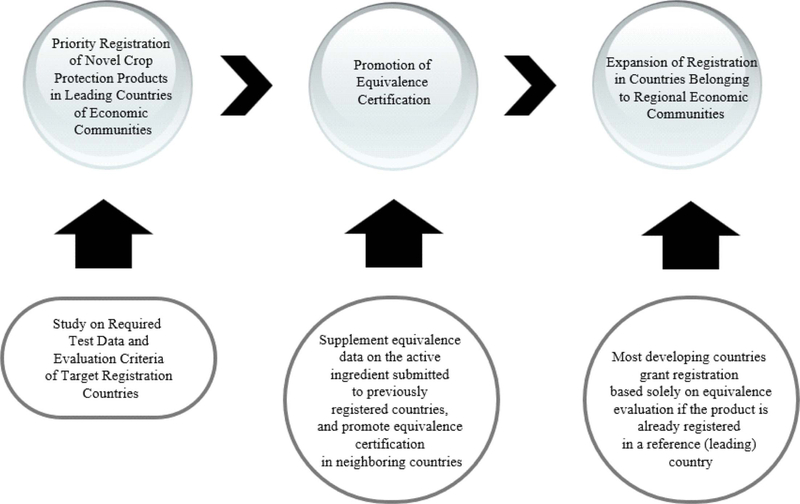
Fig. 2.

Approaches to facilitating the registration of novel crop protection products in developing country regulatory systems.

지금 추진 중인 신물질 작물보호제의 수출 확대를 위해서는 개발도상국을 타겟으로 하여 등록 및 수출 전략을 추진하는 것이 효율적인 것으로 판단되며, 이를 위해 해당 개발도상국들은 대부분 작물보호제 등록 평가 선진국에서 등록이 되어있는 동등한 원제 및 제품이 자국에 등록을 희망하면 동등성 평가를 위한 자료를 요구하고 이의 적합성을 판단하여 등록시켜 주고 있는 제도를 운영하고 있으므로, 동등성 인정에 필요한 자료를 사전에 준비하여 지역경제 공동체에 해당하는 국가들에 대한 등록을 이룰 수 있을 것으로 판단된다.

Acknowledgments

본 연구는 2024년 농촌진흥청 농업연구개발사업 연구개발비(RS-2024-00398439) 지원에 의해 수행되었으며 이에 감사드립니다.

이해상충관계

저자는 이해상충관계가 없음을 선언합니다.

References

  • Abubakar Y, Tijjani H, Egbuna C, Adetunji C, Kara S, et al., 2020. Natural Remedies for Pest, Disease and Weed Control, Academic Press, USA, pp 29-42. [https://doi.org/10.1016/b978-0-12-819304-4.00003-8]
  • FAO, 2023. Statistical Yearbook, https://openknowledge.fao.org/handle/20.500.14283/cc8166en, (Accessed November. 08. 2024).
  • FAO & WHO, 2013. International Code of Conduct on the Distribution and Use of Pesticides: Guidelines on data requirements for the registration of pesticides, United Nations, E-ISBN 978-92-5-107455-8 (PDF), pp 10-27.
  • FAO & WHO, 2016. Manual on development and use of FAO and WHO Specifications for pesticides, United Nations, Rome, pp 18-36. [https://doi.org/10.4060/cc9840en]
  • FAO & WHO, 2022. Manual on the development and use of FAO and WHO specifications for chemical pesticides, United Nations, Rome and Geneva, pp 21-42.
  • FAO, 2025. Pesticide Registration Toolkit, https://www.fao.org/pesticide-registration-toolkit/en/, (Accessed May. 12. 2025).
  • Freedoniagroup, 2022. Global Agricultural Pesticides, https://www.freedoniagroup.com/industry-study/global-agricultural-pesticides-4243.htm, (Accessed March. 01. 2024).
  • Persistencemarket research, 2024. Pesticides market size, share and growth forecast for 2024-2031. https://www.persistencemarketresearch.com/market-research/pesticides-market.asp?utm_source, (Accessed May. 10. 2025)
  • Mansfield B, Werner M, Berndt C, Shattuck A, Galt R, Williams B, et al. 2024. A new critical social science research agenda on pesticides, Agriculture and Human Values 41:395-412.
  • MarketsandMarkets, 2024. Crop Protection Chemicals Market, https://www.marketsandmarkets.com/Market-Reports/crop-protection-380.html, (Accessed March. 08. 2024).
  • Sarkar S, Dias Bernardes Gil J, Keeley J, Jamsen K. 2021. The use of pesticides in developing countries and their impact on health and the right to food, European Union, Brussels, Belgium, pp 2-142.
  • Tiel NV, 1982. Principles and Procedures of Pesticide Registration in The Netherlands. EPPO Bulletin, 12(3):255-261. [https://doi.org/10.1111/j.1365-2338.1982.tb01796.x]
  • Tudi M, Ruan HD, Wang L, Lyu J, Sadler R et al. 2021. Agriculture Development, Pesticide Application and Its Impact on the Environment, Int. J. Environ. Res. Public Health, 18(3):1112. [https://doi.org/10.3390/ijerph18031112]
  • Wesselinga C, Corriols M, Bravoa V, 2005. Acute pesticide poisoning and pesticide registration in Central America, Toxicology and Applied Pharmacology 207:S697-S705. [https://doi.org/10.1016/j.taap.2005.03.033]
  • WHO, 2014. Report on 8th FAO/WHO Joint meeting on Pesticide Management and 10th Session of the FAO Panel of Experts on Pesticide Management, United Nations, pp 8-14.
  • World Population Review, 2025. Developing Countries 2025, https://worldpopulationreview.com/country-rankings/developing-countries?utm_source, (Accessed May. 10. 2025).
Author Information and Contribution

Su-Myeong Hong, Department of Applied Life Chemistry, Gyeongsang National University, Visiting Professor, https://orcid.org/0000-0003-2035-5039

Taek-Gyum, Residual Agrochemical Assessment Division, National Institute of Agricultural Sciences, Senior Researcher, https://orcid.org/0009-0007-4441-0553

Su-Yeon Kim, The Korea Agriculture Technology Promotion Agency, Researcher, https://orcid.org/0009-0009-2165-8833

Bo-Yul Kim, Brick Patent Law Firm, Patent Attorney, https://orcid.org/0009-0006-8824-5265

Jin-Hyo Kim, Department of Applied Life Chemistry, Gyeongsang National University, Professor, https://orcid.org/0000-0002-0341-7085

Fig. 1.

Fig. 1.
Comparative analysis of regulatory management levels for crop protection products based on evaluation criteria and data submission requirements

Fig. 2.

Fig. 2.
Approaches to facilitating the registration of novel crop protection products in developing country regulatory systems.

Table 1.

Authorities responsible for the registration of crop protection products in FAO toolkit member countries

No. Countries Registration Authorities Address Web sites
1 Algeria Direction de la Protection des Végétaux et des Contrôles
Techniques. Sous-Direction des Homologations et des
Agréments.
12, Bd Colonel Amirouche, Algiers www.minagri.dz
2 Angola Ministry of Agriculture Av. Ce Gika, Largo Dos Ministerios,
Luanda
3 Antigua & Barbuda Pesticides and Toxic Chemicals Control Board, Ministry
of Agriculture, Lands, Fisheries and Barbuda Affairs
Angola
4 Argentina Servicio Nacional de Sanidad y Calidad Agroalimentaria
(SENASA), Dirección de Agroquímicos y Biológicos
Avda. Paseo Colón 439 Piso 1;
ACD1063 - Buenos Aires
https://www.argentina.gob.ar/senasa/
5 Barbados Pesticides Control Board, Ministry of Agriculture and
Food Security
Graeme Hall, Christ Church www.minagriculture.gov.bb
6 Belize Pesticides Control Board, Ministry of Agriculture, Fisheries,
Forestry, Environment and Sustainable Development
PO Box 217, San Ignacio Town, Cayo
District, Belize
www.pcbbelize.com
7 Benin Ministry of Agriculture Pesticide Control Committee
8 Bolivia SENASAG SENASAG www.senasag.gob.bo
9 Botswana Plant Protection Division, Ministry of Agriculture Private Bag 0091, Gaborone, Botswana
10 British Virgin
Islands
Plant Protection Division British Virgin Islands
11 Burkina Faso Comité Sahélien des Pesticides (CSP) s/c Institut du Sahel. Quartier Hamdallaye
ACI 2000, Rue 453, porte 538, Bamako,
Mali
http://www.insah.org
12 Burundi Pesticide Control and Registration Service Ministry of Agriculture and Livestock,
P.O. Box 114, Bujumbura
13 Cambodia Agriculture Material Standard Office, Department of
Agricultural Legislation, Ministry of Agriculture, Forestry
and Fisheries
14 Cameroon Direction de la Réglementation et du Controle de qualité
des intrants et produits agricoles
BP 2082 Messa, Yaoundé
15 Canada Pest Management Regulatory Agency Sir Charles Tupper Build., 2720 Riverside
Drive, Ottawa-Ontario K1A 0K9 Canada
16 Cape Verde Comité Sahélien des Pesticides (CSP) s/c Institut du Sahel. Quartier Hamdallaye
ACI 2000, Rue 453, porte 538, Bamako,
Mali
http://www.insah.org
17 Communauté économique
et monétaire de l'Afrique
centrale (CEMAC)-
Regional
Comité Inter états de Pesticides d'Afrique Centrale
(CPAC)
Direction Générale du CPAC, BP 16344
Yaoundé, Cameroon
www.cpac-cemac.org
18 Central African Republic Ministry of agriculture & Rural development BP 786 Bangui, Central African Republic
19 Chad Comité Sahélien des Pesticides (CSP) s/c Institut du Sahel. Quartier Hamdallaye
ACI 2000, Rue 453, porte 538,
Bamako, Mali
http://www.insah.org
20 Chile National Pesticide Registry
21 China, People's Republic of Institute for the Control of Agrochemicals, Ministry of
Agriculture and Rural Affairs (ICAMA)
No. 22 Maizidian Street, Chaoyang
District; P.R. China 100026
www.chinapesticide.gov.cn/en/
22 Colombia Directora de licencias, Permisos y trámite ambientales
- Ministerio de Ambiente, Vivienda y Desarrollo Territorial.
Secretaria
Gloria Portela. Calle 37 No. 8-40 Bogotá www.minambiente.gov.co
23 Colombia Instituto Colombiano Agropecuario - ICA Carrera 68A N° 24B-10 Edificio Plaza
Claro - Torre 3 Piso 6, Bogotá D.C
https://www.ica.gov.co/areas/agricola/servicios/regulacion-y-control-deplaguicidas-quimicos.aspx
24 Congo D.R. Bureau d'Homologation des Pesticides Ministry of Agriculture, Direction de la
Production et Protection des Végetaux
25 Congo, Republic of Service de la Protection des Végétaux. Direction de la
Production Agricole et de la Protection des Végétaux
26 Cook Islands Cook Islands Ministry of Agriculture, Research Division P.O. Box 96, Rarotonga
27 Costa Rica Servicio Fito Sanitario del Estado del Ministerio de
Agricultura y Ganaderia. Encargado Unidad de Registro
del S.F.E
Sabana Sur, 400 metros Sur del Estadio
Nacional, edificio anexo al Ministerio
de Agricultura y Ganadería. San José
28 Cuba Registro Central de Plaguicidas, Direccion de Sanidad
Vegetal, Ministerio de Agricultura
Ayuntamiento No. 231, entre Lombillo y
San Pedro, Municipio Plaza de la Revolucion,
la Habana, CP 10600
29 Dominica Pesticide Control Board, Ministry of Agriculture and
Fisheries/Division of Agriculture
Botanic Gardens, Roseau http://www.agriculture.gov.dm/index.php/servicescentral/49-registered-pesticides
30 Dominican Republic Unidad Agronomica, Registro de Plaguicidas, Ministerio
de Agricultura
Avenida John F. Kennedy km 6 ½, Los
Jardines del Norte, Santo Domingo
31 El Salvador Ministerio de Agricultura y Ganadería (MAG)
32 Eritrea Regulatory Services Department, Ministry of Agriculture P.O.Box 1162, Asmara, Eritrea
33 Ethiopia Plant Health Regulatory Directorate (PHRD) Ministry of Agroculture, P.O. Box
62347, Addis Ababa
34 SPC Secretariat of the Pacific Community (SPC). Plant
Health-Land Resources Division
Entomology Technician Secretariat of the
Pacific Community (SPC). Plant Health-
Land Resources Division. Private Mail
Bag, Suva, Fiji Islands
http://www.spc.int
35 Fiji Ministry of Agriculture P.O. Box 77, Koronivia Research Station,
Nausori
http://www.agriculture.govnet.gov.fj
36 Gambia Comité Sahélien des Pesticides (CSP) s/c Institut du Sahel. Quartier Hamdallaye
ACI 2000, Rue 453, porte 538,
Bamako, Mali
http://www.insah.org
37 Gambia National Environment Agency. 5 Fitzgerald street,
PMB 48 Banjul
5 Fitzgerald street, PMB 48 Banjul
38 Ghana Chemical Control and Management Centre, Environmental
Protection Agency
P.O Box M326, Accra
39 Grenada Grenada Pesticides Control Board, Ministry of Agriculture Ministerial Complex, Botanical Gardens,
Tanteen, St George
40 Guatemala Unidad de Normas y Regulaciones, Ministerio de
Agricultura, Ganadería y Alimentaciòn
7a.Avenida 12-90, Zona 13
41 Guinea Ministère de l'Agriculture. Service National de la Protection
des Végétaux et des Denrées Stockées
BP: 1098 Conakry
42 Guinea-Bissau Comité Sahélien des Pesticides (CSP) s/c Institut du Sahel. Quartier Hamdallaye
ACI 2000, Rue 453, porte 538,
Bamako, Mali
http://www.insah.org
43 Guyana Pesticides and Toxic Chemicals Control Board, Ministry
of Agriculture
Mon repos, NAREI compound, East
Coast Demerara
www.ptccb.org.gy
44 Haiti Ministère de l'Agriculture, des Ressources Naturelles
et du Développement Rural (MARNDR)
Route National No. 1, Damien www.agriculture.gouv.ht
45 Honduras Secretaría de Agricultura y Ganadería (SAG); Pest Control
46 India Registration Committee, Directorate of Plant Protection,
Quarantine and Storage. Department of Agriculture
& Cooperation - Ministry of Agriculture
N.H.IV, CGO Complex, Faridabad
121001 (Haryana, India
http://www.cibrc.nic.in
47 Indonesia Directorate of Pesticides and Fertilizer, Ministry of
Agriculture
48 Ivory Coast Service des semences et plants, Ministère de l'agriculture
et du développement rural. Direction de la Protection
des Végétaux, du Contrôle et de la Qualité du
Ministère de l'Agriculture
B.P. 505. ABIDJAN 04, Côte d'Ivoire
49 Kiribati Department of Agriculture and Livestock P.O. Box 267, Bikenibeu, Tarawa
50 Jamaica Pesticides Control Authority, Ministry of Health Kingston Nursing School Complex,
3rd floor, 50 Half Way Tree Road,
Kingston 5
https://www.caribpesticides.net/index1.asp
51 Japan Plant Products Safety Division, Food Safety and Consumer
Affairs Bureau. Ministry of Agriculture, Forestry
and Fisheries
1-2-1 Kasumigaseki, Chiyoda-ku, Tokyo,
100-8950. Japan
52 Jordan Plant Protection & Phytosanitary Directorate, Ministry
of Agriculture
Queen Rania Al Abdullah St.39 Queen Rania Al Abdullah
St.39
53 Kenya Pest Control Products Board (PCPB) P.O. Box 13794-00800
Loresho,OffWaiyakiWay
Nairobi
www.pcpb.or.ke
54 Lao PDR Regulatory and Agri-input Registration Division, Department
of Agriculture. Ministry of Agriculture and Forestry
P.O. Box 811 Vientiane, Laos
55 Lebanon Plant Protection Department; Ministry of Agriculture
56 Lesotho Department of Agricultural Research P.O. Box 829, Maseru 100
57 Liberia Ministry of Agriculture
58 Madagascar Service du Phytosanitaire et de l'Inspection des Végétaux.
Ministère de l'Agriculture, de l'Elevage et de la Pêche
(MAEP)
BP 1042 Nanisana, Antananarivo 101
59 Malawi Pesticides Control Board Pesticides Control Board. P.O. Box
51300, Limbe, Malawi
60 Malaysia Department of Agriculture, Pesticides & Fertilizer
Control Division
Wisma Tani, Level 5-7, Jalan Sultan
Salahuddin, 50632 Kuala Lumpur
www.doa.gov.my
61 Mali Comité Sahélien des Pesticides (CSP) s/c Institut du Sahel. Quartier Hamdallaye
ACI 2000, Rue 453, porte 538,
Bamako, Mali
http://www.insah.org
62 Marshall Islands Environmental Protection Agency Delap Rd. Majuro MH 96960
63 Mauritania Comité Sahélien des Pesticides (CSP) s/c Institut du Sahel. Quartier Hamdallaye
ACI 2000, Rue 453, porte 538,
Bamako, Mali
http://www.insah.org
64 Mauritius Dangerous Chemicals Control Board. Ministry Health and Quality Dangerous Chemicals Control Board.
Atchia Building Suffren St Port Louis,
Mauritius
65 Micronesia
(Federal States of)
Department of Resources and Development P.O. Box 12, Palikir, Pohnpei, FM
96941
66 Mongolia Crop Production Policy Implementation and Coordination
Department, Ministry of Food, Agriculture and
Light Industry
Government building #9, Enkhtaivan
Avenue 16A, Ulaanbaatar-210349, Mongolia
67 Montserrat Department of Agriculture. Ministry of Agriculture of
Montserrat
Montserrat
68 Morocco Office National de Sécurité Sanitaire des Produits Alimentaires
(ONSSA). Division des Intrants Chimiques
Av. Hadj Ahmed Cherkaoui, Agdal,
Rabat
www.onssa.gov.ma
69 Mozambique Agrochemical Registration and Control Section.
Department of Plant Protection. National Directorate
of Agriculture and Forestry. Ministry of Agriculture
and Food Security.
Maputo, FPLM Avenue, IIAM Location,
Pavilhão Novo, 1st floor, right.
70 Myanmar Plant Protection Division. Ministry of Agriculture and
Irrigation (MOAI)
Bayint Naung Road, Insein PO 11011,
Yangon
http://www.ppdmyanmar.org/prb.html
71 Namibia Service des Protections des végétaux et Contrôles Phytosanitaires
72 Namibia Ministry of Agriculture, Water & Rural Development
73 Nepal Pesticide Registration and Management Division Harihar Bhawan, Lalitpur, Nepal
74 New Zealand Ministry for Primary Industries (MPI)
Environmental Protection Authority (EPA)
P.O. Box 2835 Wellington, New Zealand http://www.nzfsa.govt.nz
75 Nicaragua Plant Protection Directorate
76 Niger Comité Sahélien des Pesticides (CSP) s/c Institut du Sahel. Quartier Hamdallaye
ACI 2000, Rue 453, porte 538,
Bamako, Mali
http://www.insah.org
77 Nigeria Ministry of Agricultural Development 7th & 9th Floor, Federal Secretariat,
Shehu Shagari Way. Garki - Abuja
78 Niue Department of Agriculture, Forestry and Fisheries;
Ministry of Natural Resoures
Fonuakula, Alofi, Niue Island
79 Pakistan Ministry of National Food Security and Research
(MNFSR), Department of Plant Protection
Jinnah Avenue, Malir Halt, Karachi https://plantprotection.gov.pk/services/pesticide-registration/
80 Palestine Pesticides Deptartment. Ministry of Agriculture - Plant
Protection & Inspection Services
81 Palau Environmental Quality Protection Board P.O. Box 8086, Koror PW 96940
82 Panamá Ministrerio de Desarrollo Agropecuario, Dirección
Nacional de Sanidad Vegetal, Departamento de Agroquímicos
83 Philippines Fertilizer and Pesticide Authority FPA Building, Bureau of Animal Industry
Compound, Brgy. Vasra, Diliman,
Quezon City
https://fpa.da.gov.ph/NW/index.php
84 Rwanda Directorate of Inspection and Certification, Ministry of
Agriculture and Animal Resources
P.O. Box 661, Kigali www.minagri.gov.rw
85 Saint Lucia Pesticides and Toxic Chemicals Control Board, Ministry
of Agriculture, Fisheries, Physical Planning, Natural
Resources and Coopertives
Stanisclas James Building, Waterfront,
Castries
86 Samoa Ministry of Agriculture and Fisheries, Quarantine Division P.O. Box 1874, Apia https://www.maf.gov.ws/quarantine/
87 Senegal Comité Sahélien des Pesticides (CSP) s/c Institut du Sahel. Quartier Hamdallaye
ACI 2000, Rue 453, porte 538,
Bamako, Mali
http://www.insah.org
88 Seychelles Pesticide Board. Ministry of Health
89 Seychelles Plant Protection Services Section
90 Sierra Leone Ministry of Agriculture, Forestry & Food Security.
Crop Protection Services, MAFFS
MAFFS, Youyi Building, Freetown,
Sierra Leone
91 Singapore Pesticide Registration, Agri-Food and Veterinary
Authority of Singapore
5 Maxwell Road #18-00 Tower Block,
MND Complex, Singapore 069110
92 Solomon Islands Minister responsible for Agriculture Maclean Vaqalo, Director of Research,
Agriculture Research & Development.
Ministry of Agriculture & Livestock
93 South Africa Department of Agriculture, Land Reform and Rural
Development
Jonathan Mudzunga, Registrar: Act
No. 36 of 1947. Department of Agriculture,
Directorate Food Safety and
Quality Assurance. Private Bag X343,
Pretoria 0001 (www.nda.agric.za)
www.nda.agric.za
94 Sri Lanka Office of the Registrar. Pesticides Department of Agriculture 1056 Gatembe, Peradeniya 20400 https://doa.gov.lk/rophome-3/
95 St. Kitts & Nevis PTCCB-MoA & Toxic Chemicals Control Board, Pesticides
Board, Department of Agriculture
Pesticides Board, Department of Agriculture
96 St. Kitts & Nevis Pesticides & Toxic Chemicals Control Board. Ministry
of Agriculture, Lands, Housing and Development.
Plant Quarantine Division
P.O. Box 186 Basseterre, Saint Kitts
and Nevis
97 St. Vincent & the
Grenadines
Ministry of Agriculture, Rural Transformation, Forestry
and Fisheries
Richmond Hill, Kingstown P.O.
98 Sudan Plant Protection Dirccctorate P.O Box 14. Kliartoun North, Sudan
99 Suriname Pesticides Division, Ministry of Agriculture, Animal
Husbandry and Fisheries
Letitia Vriesdelaan 8-10, Paramaribo
100 Swaziland ?Registrar of Pesticides of minister of agricultures Mr. Boniface Dumisa Makhubu, Plant
Protection Officer, Ministry of Agriculture,
P.O. Box 501, Manzini. M200.
Swaziland
101 Syria Registration Department. Ministry of Agricultural &
Agrarian Reform. Directorate of Plant Protection
102 Tanzania Tanzania Plant Health and Pesticides Authority (TPHPA) P.O.Box 3024 Arusha, Tanzania https://www.tpri.go.tz/
103 Thailand Office of Agricultural Regulation (OAR). License and
Registration Division. Department of Agriculture.
Ministry of Agriculture and Cooperatives
50 Phaholyothin Rd., Chatuchak, Bangkok
10900, Thailand
104 Togo Division Contrôle Phytosanitaire. Direction de l'Agriculture.
Ministère de l'Agriculture, de l'Elevage et de la
Pêche
BP 1263 Lomé, Togo
105 Tonga Ministry of Agriculture, Food and Forestry P.O. Box 14, Vuna Road, Nuku'alofa www.mafff.gov.to
106 Trinidad and Tobago Pesticides and Toxic Chemicals Control Board, Chemistry,
Food and Drugs Division, Ministry of Health
92 Frederick Street, Port of Spain
107 Tunisia Direction Générale de la Protection et du Contrôle de
la Qualité des Produits Agricoles. Ministère de l'Agriculture,
des Ressources Hydrauliques et de la Pêche.
30, Rue Alain Savary, 1002 Tunis,
Tunisia
www.ancsep.rns.tn
108 Uganda Ministry of Agriculture, Animal Industry and Fisheries P.O Box 102, Entebbe www.agriculture.go.ug
109 United Arab Emirates Ministry of Climate Change and Environment  
110 Vanuatu Department of Environmental Protection and Conservation PMB 9063, Port Vila https://environment.gov.vu
111 Venezuela Instituto Nacional de Salud Agricola Integral (INSAI) Av. Francisco Solano cruce con calle
Pascua Navarro. Edificio Banvenez.
Piso 12, 13, 14 Sabana Grande, Municipio
Libertador, Caracas
112 Vietnam Pesticide Management Division, Plant Protection
Department, Ministry of Agriculture and Rural Development
(MARD)
MARD. 149, Ho Dac Di Street. Dong
Da District. Hanoi, Vietnam
http://www.ppd.gov.vn
113 Zambia Environmental Management Agency (ZEMA)
114 Zimbabwe Pesticides Registration Office – Department of Research
and Specialist Services, Ministry of Agriculture
P.O. Box CY550, Causeway, Harare http://www.drss.gov.zw/index.php/2013-02-12-13-51-55/fertilizer-farmfeeds-and-remedies
115 Yemen Ministry of Agriculture and Irrigation, General Directorate
of Plant Protection
P.O. Box 26, Zaid Street. Sana'a, R.o.
Yemen

Table 2.

Data requirements and status of test reports for the registration of crop protection products

Categories Test Items and Contents
Abstracts 1. Specification of purity of the active substance
2. Identity, content, structural formula of isomers, impurities, and additives cc
3. Identity, content, structural formula of impurities and additives
4. Batch analysis data
5. Manufacturer(s) of the preparation and of the active substance(s) (name and contact information)
6. Trade name
7. Detailed quantitative and qualitative information on the composition of the preparation (chemical pesticides)
8. Detailed quantitative and qualitative information on the composition of the preparation (biochemical pesticides)
9. Type of formulation and code
10. Function (herbicide, insecticide, etc.)
11. Test procedures and criteria to characterize the strain or serotype
12. For mutant or genetically-modified strains, indicate all known differences between the modified microorganism and the parent wild strain(s)
13. Trade names, common names, developmental code name
14. Indigenous or non-indigenous at the species level to the intended area of application.
15. Composition of MPCP
16. Composition of microbial material used for manufacture of end use products in terms of g/kg or g/L for each active ingredient including microbial and non-microbial impurities.
17. Methods of production and quality criteria for the production and storage of the active microorganism; including quality control measures and information on human/mammalian pathogens.
18. Quality control data (measures of quality criteria) from 3 - 5 production batches, including storage stability data.
19. The formation, presence and/or impact of unintentional ingredients (theoretical discussion)
20. International regulatory status of microorganism.
Analytical
Methods
1. Analytical standards and samples
2. Description of analytical methods for the analysis of the active substance as manufactured
3. Description of analytical methods for the determination of residues to enable compliance with MRLs to be determined or to determine dislogeable residues
4. Description of methods for analysis of soil for parent compound and metabolites of toxicological, ecotoxicological or environmental concern
5. Description of methods for analysis of water (drinking water, ground water and surface water) for parent compound and metabolites of toxicological, ecotoxicological or environmental concern
6. Method for determining pesticides in sediment
7. Description of methods for analysis of air for active substance and metabolites, formed during or shortly after application, of toxicological concern
8. Analytical methods for parent compound and toxicologically, ecotoxicologically or environmentally significant metabolites in body fluids and tissues
9. Samples of the preparation
10. Methods for analysis of the formulated product
11. Methods for analysis of impurities of toxicological or ecotoxicological or environmental concern
Application 1. Field of use
2. Nature of effects on harmful organisms
3. Details of intended use
4. Rate of application per unit treated
5. Concentration of active ingredient in material used
6. Description of method of application, type of equipment used and type and volume of diluent per unit of area or volume
7. Number and timing of applications
8. Necessary waiting periods or other precautions to avoid phytotoxic effects on succeeding crops
9. GAP table
10. Proposed instructions for use as printed, or to be printed, on the label
Classification,
Label, Packing
1. Information on authorizations in other countries
2. Proposals (including justification) for the classification of the product and its related label elements, including hazard symbol(s), signal word, hazard statement(s),
3. Proposal for precautionary statement(s)
4. Proposed label
5. Specimen of proposed packaging
Ecotoxicology 1. Bioaccumulation in fish
2. Avian toxicity - acute oral toxicity
3. Avian toxicity - reproduction
4. Fish toxicity - acute toxicity
5. Fish toxicity - early life stage (freshwater)
6. Fish toxicity - early life stage (saltwater)
7. Fish toxicity - life cycle
8. Toxicity to aquatic species other than fish - acute toxicity to aquatic invertebrates
9. Toxicity to aquatic species other than fish - aquatic invertebrate life cycle (saltwater)
10. Effects of sediment-dwelling organisms - whole sediment - acute toxicity – freshwater invertebrates
11. Effects of sediment-dwelling organisms - whole sediment - acute toxicity – marine invertebrates
12. Effects of sediment-dwelling organisms - whole sediment - chronic toxicity - freshwater &marine invertebrates
13. Effects on bees - honeybee - acute oral toxicity
14. Effects on bees - honeybee - acute contact toxicity
15. Effects on bees - honeybee - toxicity of residues on foliage
16. Effects on bees - honeybee - brood toxicity
17. Effects on non-target terrestrial arthropods
18. Effects on earthworms – Reproduction test
19. Effects on soil microbial activity
20. Algal toxicity – growth inhibition
21. Effects on marine and estuarine organisms - oyster acute toxicity
22. Effects on marine and estuarine organisms - mysid acute toxicity
23. Effects on marine and estuarine organisms - penaeid acute toxicity
24. Effects on marine and estuarine organisms - bivalve acute toxicity (embryo-larval)
25. Effects on algae - algal toxicity (tier II)
26. Effects on aquatic plants - Lemna toxicity test (tier I)
27. Effects on aquatic plants - Lemna toxicity test (tier II)
28. Effects on terrestrial vascular plants - seedling emergence (tier I)
29. Effects on terrestrial vascular plants - vegetative vigour (tier I)
30. Effects on terrestrial vascular plants - seedling emergence (tier II)
31. Ecotoxicology of MPCA
32. Effects on terrestrial vascular plants - vegetative vigour (tier II)
33. Other aquatic toxicity tests
34. Effects on bees
34. Effects on terrestrial vascular plants
36. Effects on bees - honeybee - chronic toxicity
37. Effects on bees - honeybee - semi-field and field studies
38. Effects on Collembola in soil – Reproduction test
39. Effects on earthworms – Acute toxicity
40. Effects on earthworms – Field test
Efficacy 1. Efficacy data - efficacy tests
2. Efficacy data – Preliminary range finding tests
3. Efficacy data – Minimum effective dose tests
4. Efficacy data - effects on yield and quality
5. Adverse effects - phytotoxicity to host crop
6. Adverse effects on health of host animals
7. Adverse effects on site of application (discoloration, corrosion, etc.)
8. Adverse effects on beneficial organisms
9. Adverse effects on parts of plants used for propagation (e.g. seeds, cuttings, runners)
10. Adverse effects on succeeding crops
11. Adverse effects on other plants including adjacent crops
12. Adverse effects - information on the possible occurence of development of resistance or cross-resistance
13. Economics
14. Benefits - survey of alternative pest control measures (chemical and non-chemical)
15. Benefits - compatibility with current management practices, including IPM
16. Benefits - contribution to risk reduction
17. Other/special studies
Exposure 1. Operator exposure
2. Bystander exposure
3. Worker exposure
4. Dislodgeable residues
5. Epidemiology
6. Data on formulants
7. Domestic animal/livestock safety
Fate & Behavior in
Environment
1. Ready biodegradability
2. Field studies - aquatic (sediment)
3. Field studies - forestry
4. Combination & tank mixes
5. Mobility studies - adsorption and desorption
6. Mobility studies - leaching
7. Mobility studies - volatility - laboratory
8. Mobility studies - volatility - field
9. Hydrolysis rate
10. Direct phototransformation in water
11. Degradation in aquatic systems - aerobic aquatic metabolism
12. Degradation in aquatic systems - anaerobic aquatic metabolism
13. Rate and route of degradation in air
14. Monitoring data on fate and behaviour
15. Environmental Fate of MPCA/Active Substance
16. Route and rate of degradation in soil – aerobic and anaerobic soil metabolism
17. Field studies - terrestrial
Futher information 1. Packaging and compatibility with the formulation
2. Procedures for cleaning application equipment and protective clothing
3. Re-entry periods, necessary waiting periods, pre-harvest intervals or other precautions to protect people, livestock and the environment
4. Statements of risks arising from the recommended methods, and precautions and handling procedures to minimize those risks
5. Detailed procedures in the event of an accodent during transport, storage or use
6. Neutralization procedures for use in the event of accidental spillage
7. Pyrolytic behaviour of the active substance and the content of polyhalogenated dibenzo-p-dioxins in the prodyuct of pyrolysis
8. Disposal procedures for the pesticide
Identity &
Composition
1. Specification of purity of the active substance
2. Identity, content, structural formula of isomers, impurities, and additives cc
3. Identity, content, structural formula of impurities and additives
4. Batch analysis data
5. Manufacturer(s) of the preparation and of the active substance(s) (name and contact information)
6. Trade name
7. Detailed quantitative and qualitative information on the composition of the preparation (chemical pesticides)
8. Detailed quantitative and qualitative information on the composition of the preparation (biochemical pesticides)
9. Type of formulation and code
10. Function (herbicide, insecticide, etc.)
11. Composition of MPCP
12. Manufacturer name and contact information
13. Composition/specification of Technical Grade of MPCA/Active Substance
14. Applicant name and contact information
15. Scientific Information
16. ISO common name and synonyms
17. Chemical name
18. Manufacturer's codes, trade name(s) and patent status
19. Existing CAS and CIPAC number
20. Molecular formula, molecular mass, and molecular structure
21. Method of manufacture (starting materials, pathways, by-products and impurities)
Physico chemical
property
1. Melting point, freezing point or solification point
2. Boiling point
3. Temperature at which decomposition occurs
4. Flammability
5. Relative density
6. Vapour pressure
7. Henry's Law constant
8. Appearance: Description of the physical state, colour and odour
9. Spectra, a table of signal characteristics and molecular extinction at relevant wavelengths
10. Spectra for impurities
11. Solubility in water
12. Solubility in organic solvents
13. Partition coefficient octanol/water
14. Stability in water: Hydrolysis rate
15. Stability in water: Direct phototransformation
16. Stability in water: Dissociation constant
17. Photochemical oxidative degradation
18. Flash point
19. Explosivity
20. Surface tension
21. Oxidizing properties
22. pH
23. Stability: storage stability
24. Stability: temperature, metals
25. Acidity or alkalinity and if necessary pH
26. Viscosity and surface tension
27. Relative density and bulk density
28. Storage stability and shelf-life
29. Technical characteristics of the formulatyed product: Wettability
30. Technical characteristics of the formulatyed product: Persistent foaming
31. Technical characteristics of the formulatyed product: Suspensibility and suspension stability
32. Technical characteristics of the formulatyed product: Dilution stability
33. Technical characteristics of the formulatyed product: Sieve test
34. Technical characteristics of the formulated product: Particle size distribution
35. Technical characteristics of the formulatyed product: Emulsion characteristics
36. Technical characteristics of the formulatyed product: Flowability, pourability and dustability
37. Physical and chemical compatibility with other products
38. Distribution and adherence to seeds
39. Miscibility
40. Dielectric breakdown voltage
41. Corrosion characteristics
42. Container material
Residue 1. Metabolism and Residues Data of MPCA
2. Storage stability of residues
3. Metabolism, distribution and expression of residues – Nature of the residue in plants
4. Metabolism, distribution and expression of residues – Nature of the residue in meat, milk, poultry or eggs
5. Metabolism, distribution and expression of residues – Nature of the residue in fish
6. Residue trials for crops or plant products used as food or feed
7. Livestock feeding studies
8. Effects of industrial processing and/or household preparation on the nature, distribution and levels of the residue
9. Residues in rotational crops
10. Proposed residue definition and maximum residue limits
11. Information on established maximum residue levels (MRL) in other countries
Toxicology &
Metabolism
1. Toxicological and Exposure Data of MPCA
2. Absorption, distribution, excretion and metabolism in mammals
3. Acute oral toxicity
4. Acute dermal toxicity
5. Acute inhalation toxicity
6. Skin (dermal) irritation
7. Eye irritation
8. Short-term toxicity – 90-day oral (rodent)
9. Short-term toxicity – 90-day oral (non-rodent)
10. Short-term toxicity – 90-day inhalation
11. Short-term toxicity – 21 or 28-day dermal
12. Short-term toxicity – 90-day dermal
13. In vitro genotoxicity testing – bacterial reverse mutation assay
14. In-vitro genotoxicity testing – mammalian cell assay
15. In-vivo cytogenetics
16. Long-term oral toxicity
17. Carcinogenicity (two rodent species)
18. Reproductive toxicity – two-generation study
19. Reproductive toxicity – developmental studies (teratogenicity) (two species)
20. Acute neurotoxicity (rat)
21. Delayed neurotoxicity following acute exposure (hen)
22. 28-day delayed neurotoxicity (hen)
23. Subchronic neurotoxicity 90-day (rat)
24. Developmental neurotoxicity
25. Toxicity studies on metabolites
26. Medical data
27. Immunotoxicity
28. Dermal penetration
29. Dermal sensitization

Table 3.

Classification of crop protection product registration systems

Categories Remarks
Registration
by Analogy
A system applied when registration resources are highly limited.
− Registration decisions are made by comparing the submitted product with those already registered in
other countries.
Registration
by Equivalence
A system that requires moderate resources for efficient safety evaluation.
− Based on the determination of similarity between the submitted product and an already registered,
highly similar product.
Registration based on
Resource Rationalization
A system that relies on moderate or example-based resources.
− Utilizes existing data and evaluations conducted in other jurisdictions to the fullest extent possible.
Registration based on
Local Evaluation
A strategy requiring substantial national resources.
− Primarily based on test reports produced within the country and country-specific evaluation methodologies.

Table 4.

A two-step assessment approach for determining technical equivalence during the registration of novel crop protection product active ingredients

Tier 1 determination Tier 2 determination
1. Technical grade active ingredients from different manufacturers or manufacturing processes are deemed to be equivalent if:
 a. the materials meet the requirements of the existing FAO/WHO specifications; and
 b. assessments of the manufacturing process used, the impurity profile and results of mutagenicity (bacteria, in vitro) testing have been carried out with the result that the profiles meet the requirements of paragraph 3 (below).
 2. Where a producer changes the manufacturing process for a technical grade active ingredient which has previously been evaluated and incorporated into a specification, equivalence may be determined on the basis of paragraphs 1.a and 1.b above.
 3. Equivalence of the impurity profiles of technical grade active ingredients, determined by comparison of the manufacturing specification limits.
 a. Where (i) the maximum level (manufacturing limit) of non-relevant impurity is not increased by more than 50% (relative to the maximum level in the reference profile), or the maximum absolute level (manufacturing limit) is not increased by more than 3g/kg (whichever represents the greater increase); (ii) there are no new relevant impurities; and (iii) the maximum level of the relevant impurities is not increased; the technical grade active ingredients will normally be considered equivalent.
 b.Where these limits for differences in maximum non-relevant impurity concentration are exceeded, the proposer will be asked to provide a reasoned case, with supporting data as required, as to why the particular impurities remain “non-relevant”. The JMPS will evaluate the case to decide whether or not the technical active ingredient is considered to be equivalent.
 c. Where new impurities are present at ≥ 1 g/kg, the proposer will be asked to provide a reasoned case, with supporting data if available, as to why these impurities are “non-relevant”. The JMPS will evaluate the case to decide whether or not the technical active ingredient is equivalent.
 d. The mutagenicity (bacteria, in vitro) profile is considered equivalent to that of the reference material if the assessment compares endpoint to endpoint and the outcome is not worse for the material under consideration.
 e. Information about the assessment of the proposed material by a competent registration authority is taken into account in Tier-1.
 f. Where relevant impurities are increased in maximum concentration and/or where new relevant impurities are present, appropriate toxicological, eco-toxicological or other information on the technical grade active ingredient or the impurities in question should be submitted, if available, for evaluation in Tier-2.
 4. Where the Tier-1 information is insufficient to decide on equivalence or is insufficient to decide on non-equivalence, further evaluation should proceed with information and data available under Tier-2.
 Technical grade active ingredients from different manufacturers or manufacturing processes are deemed to be equivalent if Tier-1 nonequivalence is uncertain and the Tier-2 assessments of the toxicological/eco-toxicological profiles have been carried out with the result that the profiles meet the requirements of paragraph 1 and 2 of TIER 2, below.
1. Equivalence of the toxicological profiles of a technical grade active ingredient
 a. The toxicological profile will be considered equivalent to that of the reference profile, where the data required by pure and technical grade active ingredients. do not differ by more than a factor of 2 compared to the reference profile (or by a factor greater than that of the appropriate dosage increments, if more than 2). There should be no change in the assessment in those studies which produce categorical results (e.g. Category 1, 2, or 3 skin irritant, not a skin irritant).
 (i) Studies which produce categorical results (e.g. Category 1, 2, or 3 skin irritant, not a skin irritant) do not lead to a more serious classification than the reference product.
 (ii) No qualitatively new adverse effect is observed in the repeated dose studies (28 or 90 days repeated dose studies in rodents).
 (iii) The NOAEL or bench-mark dose for any toxicity endpoint is not more than a factor of 10-0.5 lower than that for the reference product.
 b. Where necessary, additional toxicological data will be assessed by the criterion applied in paragraph 1.a, provided that, where appropriate, the organs affected are the same. The bench-mark dose should not differ by more than a factor of two, or the “no observable effect levels” (NOELs) or NOAELs should not differ by more than the differences in the dose levels used.
 2. Equivalence of the ecotoxicological profiles for the technical active ingredient (as appropriate to the intended use of the active ingredient).
Where required, the ecotoxicological profile will be considered equivalent to that of the reference profile if the data do not differ by more than a factor of 5 compared to the reference profile (or by a factor more than that of the appropriate dosage increments, if greater than 5), when determined using the same species.
 3. Where a technical active ingredient proposed for inclusion in an existing specification does not comply strictly with the tests for equivalence given in minimum data requirements for extension of an existing TC/TK specification to an additional manufacturer or a new manufacturing route, but it is otherwise considered by the JMPS to be of acceptable or improved quality, a modification of the existing specification will be considered. .

Table 5.

Overview of economic and interest-based regional alliances among countries for the harmonization of crop protection products registration

Regional Economic
Communities (RECs)
Contents
CAN
(COMUNINADO
ANDINA)
− Andean Community of Nations
− Member countries: Peru, Bolivia, Colombia, and Ecuador.
− The member states are cooperating on the exchange of regulatory data and the joint assessment of crop protection product dossiers.
SAPReF
(Southern African
Pesticide
Regulators Forum)
− Crop protection product Registration Forum of the Southern African Development Community (SADC)
− Member countries: South Africa, Angola, Botswana, Comoros Democratic Republic of the Congo, Eswatini (formerly Swaziland), Lesotho, Madagascar, Malawi, Mauritius, Mozambique, Namibia, Seychelles, Tanzania (United Republic of Tanzania), Zambia, Zimbabwe
− Mutual cooperation and recognition of evaluation outcomes in crop protection product registration.
CILSS
(Permanent Interstate
Committee for Drought
Control in the Sahel)
− West African Platform for Food Security and Regional Response to Drought and Desertification
− Member countries (13 countries): Senegal, Benin, Côte d’Ivoire (Ivory Coast) The Gambia, Guinea, Guinea-Bissau, Mauritania, Togo, Burkina Faso, Mali, Niger, Chad, Cape Verde (also: Cabo Verde)
− Mutual cooperation and recognition of evaluation outcomes in crop protection product registration.
CARICOM
(Caribbean Community)
− Caribbean Community and Common Market
− Member countries: Jamaica, Bermuda,The Bahamas, Barbados, Belize, Dominica, Grenada, Guyana, Haiti, Montserrat, Saint Lucia, Saint Kitts and Nevis, Saint Vincent and the Grenadines, Suriname, Trinidad and Tobago
− Mutual cooperation and recognition of evaluation outcomes in crop protection product registration.
ASEAN
(Association of Southeast
Asian Nations)
− Association of Southeast Asian Nations
− Member countries (10 countries): Thailand, Brunei Darussalam, Cambodia, Indonesia, Laos, Malaysia, Myanmar, Philippines, Singapore, Vietnam
− Aims to promotes regional cooperation in trade, agriculture, and pesticide regulation harmonization ASEAN Guidelines on the Regulation of Crop protection product
SPC
(Pacific Community)
− An intergovernmental scientific organization focused on cooperation in health, agriculture, and science and technology
− Member countries (27 countries): Australia, Samoa, Palau etc
− Mutual cooperation and recognition of evaluation outcomes in crop protection product registration.