
Fluxametamide의 시설 딸기 재배지 점박이응애에 대한 년도별 약효 변동 및 저항성 발달
 ; Geon Woo Koh1 ; Eun Young Yang1 ; Yul Kyun Ahn1 ; June Sun Yoon2 ; Deok Ho Kwon1, *
초록
국내 딸기 온실에서 발생한 점박이응애의 fluxametamide에 대한 약효 변동 양상을 다배열생물검정방법을 기반으로 한 가중평균사충율을 토대로 조사하였다. 2021년부터 2025년 채집 점박이응애의 평균 사충율은 각각 79.6%, 83.1%, 50.6%, 49.1%, 그리고 32.3%로 통계적으로 유의하게 감소하였다(F4,74, P < 0.001). 채집한 개체군 중 24TU028과 24TU032 계통의 감수성 계통 대비 저항성비는 각각 약 724배와 108배였으며, 제조사의 추천농도 대비 방제효과지수는 약 38배와 4배로 나타나 fluxametamide에 대한 점박이응애 저항성 개체군이 출현한 것으로 확인되었다. 딸기 육묘 및 재배 농가의 체계적인 방제 전략 수립을 위하여 정기적인 약효 모니터링과 저항성 진단 시스템의 도입이 필요할 것이다.
Abstract
We investigated annual changes in the efficacy of fluxametamide to control the two-spotted spider mite (Tetranychus urticae) population in strawberry greenhouses in Korea. Using multi-array leaf-dipping bioassays, we analyzed the weighted mean mortality. The annual mean mortality of field-collected populations was 79.6% (2021), 83.1% (2022), 50.6% (2023), 49.1% (2024), and 32.3% (2025), which was a statistically significant decline over time (F4,74 = 23.868, P < 0.001). In comparison to a susceptible strain, strains 24TU028 and 24TU032 had approximately 724-fold and 108-fold resistance ratios, respectively. The control efficacy indices were approximately 38-fold (24TU028) and 4-fold (24TU032) higher than the manufacturer’s recommended concentration. The results of our study indicate the emergence of fluxametamide-resistant two-spotted spider mite populations. To establish sustainable control strategies for strawberry nurseries and production systems, it is pivotal to regularly monitor insecticide efficacy and implement resistance diagnostic systems.
Keywords:
Fluxametamide, Resistance, Strawberry, Tetranychus urticae, Weighted mean mortality키워드:
저항성, 가중평균사충율, 점박이응애, 딸기서 론
Fluxametamide는 곤충의 GABA-gated chloride ion-channel (GABACl)의 신경전달물질인 γ-aminobutyric acid (GABA)의 길항제로 작용하여 대상 해충을 급속히 마비시켜 치사를 유도하는 특징이 있다(Asahi et al., 2018). 흡즙성 해충인 애멸구와 점박이응애 등에 대한 약효가 우수하고 포유동물 대비 절지동물의 신경계에 대한 약효 특이성이 높은 것으로 보고되었다. 현재 살충제 작용기작그룹 30에 포함되어 있다 (IRAC, 2025).
국내에서는 fluxametamide를 유효성분으로 한 제품이 2018년부터 판매되었으며(PSIS, 2025), 다양한 작물에 피해를 주는 해충의 관리에 활용되고 있다. 해당 약제가 등록된 작물로는 50종의 채소, 25종의 과수, 11종의 식량작물, 9종의 화훼와 특용작물이 있으며, 방제 대상 해충으로는 거미강에서 7종(점박이응애, 차먼지응애, 귤녹응애, 뿌리응애 등)과 해충 강에서 75종(나비목 27종, 노린재목 24종, 딱정벌레목 7종, 파리목 7종, 총채벌레목 6종, 벌목 4종)이 등록되어 있다 (PSIS, 2025). 국내에서 fluxametamide의 유제 기준 출하량 변화는 2018년 958 kg에서 2024년 9,911 kg으로 1,034% 증가한 상황이다(KCPA, 2025).
2021년도에 국내 딸기 재배지에서 채집한 점박이응애 야외 개체군을 대상으로 다배열생물검정방법을 이용하여 생물검정을 수행한 결과, fluxametamide는 26종의 화학합성살충제 중 4번째로 높은 약효를 나타내었다(Kwon et al., 2022). 다만, 시험 대상 7개 계통 중 3개 계통(TU003, TU005, TU008)은 21−60%의 가중평균사충율로 낮은 약효를 보여 야외 개체군의 저항성 발달이 의심되었다.
본 연구에서는 2021년부터 2025년까지 5년간 국내 딸기 재배 온실에서 채집한 점박이응애 27개 개체군을 대상으로 fluxametamide에 대한 약효 변동 양상을 평가하였다. 또한 24TU028와 24TU032 계통을 대상으로 반수치사농도와 방제효과지수(control efficacy index, CEI)를 산출함으로써 fluxametamide에 대한 저항성 개체군의 출현 여부를 판별 하였다.
재료 및 방법
점박이응애 야외 개체군의 사육
약효 평가에 사용한 점박이응애는 총 27개 계통으로, 2021년부터 2025년까지 국내 딸기재배 온실에서 채집하였다(Table 1). 저항성 발달 수준 평가에 사용한 감수성 계통(SL_YS)은 2012년 11월 부터 살비제의 노출 없이 누대 사육하였다. 점박이응애의 누대 사육은 파종 후 14일이 지난 강낭콩을 기주식물로 공급하였으며, 아크릴케이지(400 × 400 × 500 mm) 내에서 외부 해충 및 살충제의 유입을 차단 하며 유지하였다. 사육 환경 조건은 온도 25 ± 2oC, 상대습도 60 ± 20%로 하였다.

Laboratory strain (SL_YS) and populations of Tetranychus urticae collected from strawberry farms between 2021-2025.
가중평균사충율 기반 약효 평가
약효 평가를 위한 생물검정은 다배열생물검정방법을 사용하였고, 약효 변동은 가중평균사충율을 기준으로 평가하였다(Kwon et al., 2022). 생물검정에 사용한 성충은 산란시기가 일정(약 6시간)한 알에서 부화한 성충을 사용하였다(Yu et al., 2025). 생물검정 수행 시기는 2 02 4년과 2 02 5년에 각각 21개(21TU002-24TU034)와 6개(25TU035-25TU040) 개체군을 대상으로 이뤄졌다(Table 1). 다배열생물검정법은 다음과 같은 과정으로 수행되었다. 먼저, 물 200 mL로 적신 탈지면(410 × 150 mm, 동아위생재료, 광주)에 필터페이퍼(195 × 145 mm, 아리랑과학, 대구) 2매를 올린 플라스틱 트레이(440 × 150 × 400 mm, 청운, 경산)를 준비하였다. 대상 약제인 fluxametamide 4.5% 유탁제는 제조사 추천 농도인 45 ppm으로 희석한 후, 강낭콩 엽절편(Ø 30 mm)을 10초간 침지하여 후드(동재산업, 김포)에서 30분간 음건하였다. 음건한 엽절편을 트레이에 치상한 후, 점박이응애 암컷 성충을 15마리씩 3반복으로 접종하였다. 사충 판별 기준은 세필붓(0.8 mm, 5/0호, Babara, Usui Brush Inc., Kobe, Japan)으로 자극하였을 때 충체 길이만큼 이동하지 못하면 죽은 개체로 간주하여 3일 동안 24시간 간격으로 사충수를 관찰하여 약제별 가중평균 사충율을 구하였다. 가중평균사충율은 사충율의 24시간 간격으로 한 차이값을 가중치로 하고 해당 일자의 사충율과 곱하였다. 그리고 전체 관찰 기간 내 곱한 값의 합계를 가중치의 합계로 나누어 계통 별 대상 약제에 대한 값을 산출하였다(Kwon et al., 2022).
저항성비와 방제효과지수 산출
가중평균사충율 기반 약효 평가에서 각각 40.9%와 63%의 약효를 나타내는 24TU028과 24TU032 계통을 선정하여 저항성비와 방제효과지수를 산출하였다(Fig. 1). 생물검정은 다배열생물검정방법을 기반으로 5개 농도 구배액(SL_YS, 0.2−1 ppm; 24TU028 & 24TU032, 28−450 ppm)을 준비 후 암컷 성충 15마리를 대상으로 3반복 처리하였다. 사충율은 처리 후 24시간에 관찰하였으며, Abbott (1925)의 공식에 따라 보정하고, 프로빗 분석(SPSS 13.0 SPSS 13.0, IBM, Illinois, United States) (Finney, 1971)을 통하여 LC50와 LC90을 산출하였다. 저항성비는 24TU028, 24TU032 계통의 LC50을 SL_YS의 LC50으로 나누었으며, 제조사의 추천농도(45 ppm)에 대한 방제효과지수(Control efficacy index, CEI) (Kang et al., 2023) 혹은 약제효력지수(Pesticide efficacy index, PEI) (Jeong et al., 2017)는 계통 별 LC90을 기준으로 비교하였다.
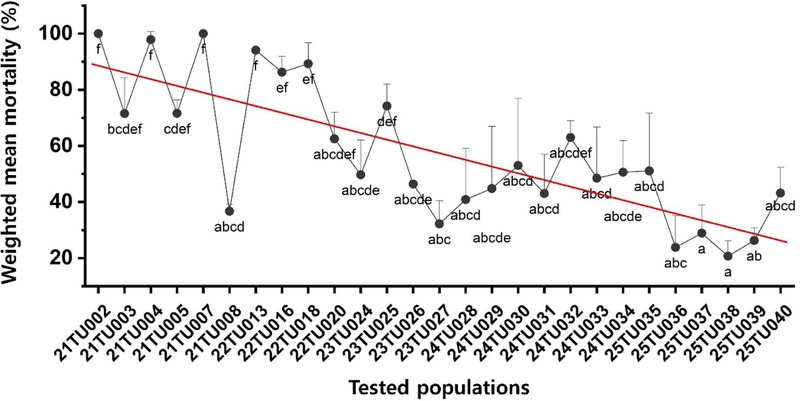
Acaricidal efficacy of fluxametamide evaluated by weighted mean mortality in Tetranychus urticae populations from domestic strawberry farms between 2021-2025. Weighted mean mortality values of each population were shown as black symbols with error bars indicating standard deviation. Different lowercase letters below each symbol mean statistically significances according to Tukey’s HSD. The linear fitted red line shows trend of acaricidal efficacy according to populations collected over time.
통계분석
통계분석은 R software (R core team, 2025)를 활용하여 일원분산분석을 수행하고, 사후 검정으로 Tukey’s HSD test를 실시하였다. 연도 별로 채집 계통의 관찰 기간 내 사충율과 가중평균사충율의 유의성 차이는 사후 검정 결과를 바탕으로 cld 함수를 이용하여 통계적으로 유의한 차이가 있는 경우 서로 다른 알파벳 소문자로 표시하였다.
결 과
딸기 재배지 내 점박이응애에 대한 fluxametamide 성분 약제의 약효 평가
2021년부터 2025년까지 국내 딸기 재배지에서 채집한 27개 점박이응애 개체군의 fluxametamide 성분 약제에 대한 약효를 평가하였다. 무처리구 사충율은 24, 48, 72시간에서 평균 2.0%, 6.8%, 9.4%였으며, 약제 처리구는 평균 28.8%, 47.3%, 그리고 63.5%로 시간이 경과함에 따라 유의하게 증가하였다(F27,168 = 53.7068, P < 0.001) (Supplementary Fig. 1). 각 계통 별 가중평균사충율은 20.7%에서 100%까지 통계적으로 유의하게 차이를 보였으며(F26,52 = 11.535, P < 0.001), 채집한 개체군의 가중평균사충율은 시간이 흐름에 따라 감소하는 경향을 나타내었다(Fig. 1). 채집 년도 별 가중평균사충율의 평균값을 기준으로 살펴보면, 2021년도와 2022년도 야외 개체군의 약효 반응은 통계적으로 유의한 차이가 없었으나, 2023년, 2024년, 그리고 2025년 채집 개체군의 평균값은 각각 50.6%, 49.1%, 그리고 32.3%로서 통계적으로 유의한 약효 감소 현상이 나타나는 것을 확인하였다(F4,74 = 23.868, P < 0.001)(Fig. 2).
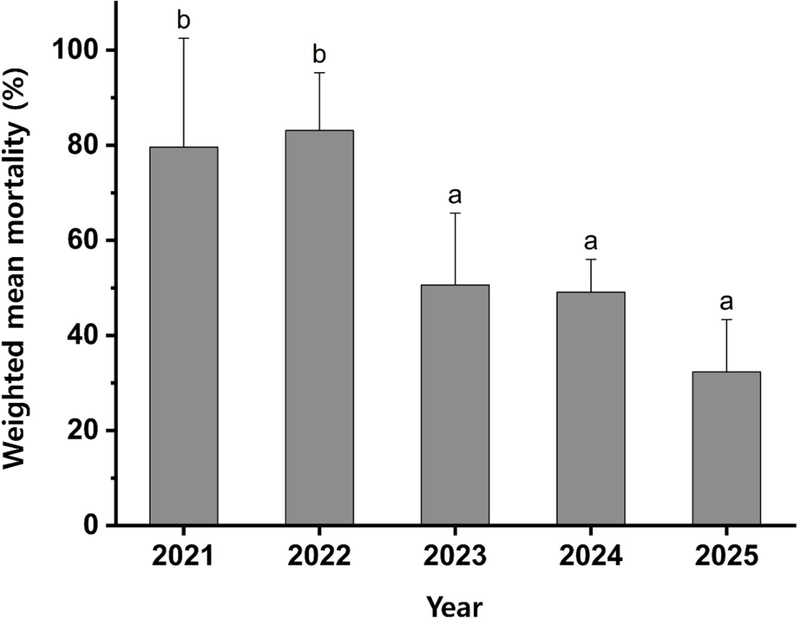
Fluctuation of acaricidal efficacy of fluxametamide based on average weighted mean mortality in Tetranychus urticae populations by each collected year. Error bars indicate the standard deviations. Small alphabetical character means the statistical difference by Tukey’s HSD.
감수성 계통에 대한 저항성 발달 수준 평가
24TU028과 24TU032 계통을 대상으로 fluxametamide에 대한 감수성 계통(SL_YS)의 반수치사농도(LC50) 기준 저항성비와 시험 대상 제품의 추천농도(45 ppm) 대비 방제효과지수(control efficacy index, CEI)를 산출하였다(Table 2). 두 계통의 LC50은 362와 54 ppm으로, SL_YS 계통과 비교하면 약 724와 108배의 저항성비를 각각 나타내었다. 또한, 24TU028과 24TU032 계통의 방제효과지수는 추천농도인 45 ppm 대비 약 38배와 4배로 각각 나타나 점박이응애 야외 채집 계통에서 fluxametamide 성분 약제에 대하여 약효 감소 현상이 나타났음을 확인할 수 있었다.
Evaluation of resistance level to fluxametamide of 24TU028 and 24TU032 compared to SL_YS
고 찰
국내 딸기 재배지에서 년도 별로 채집한 점박이응애 개체군을 대상으로 fluxametamide에 대한 저항성비와 약효 감소 수준을 평가한 결과 저항성 개체군이 발달한 것을 확인하였다. 24TU028과 24TU032 계통은 가중평균사충율이 각각 40.9%와 63%로 감수성 계통 대비 각각 724배와 108배의 저항성 발달 수준을 보였다(Table 2). 방제효과지수도 추천농도 대비 38배와 4배로 약효가 감소한 것을 확인하였다(Table 2).
2021년 점박이응애 야외 개체군을 대상으로 한 약효 평가에서 fluxametamide는 성충에 대하여 7개 개체군 모두 100%의 사충율을 나타내었다(Shin et al., 2021). 다배열생물검정법을 이용한 결과에서도 마찬가지로 fluxametamide는 2021년 야외 채집 개체군에 전반적으로 우수한 약효를 보였다(Kwon et al., 2022). 하지만, 본 연구를 통하여 2023년부터 야외 개체군에 대한 약효가 통계적으로 유의하게 감소하기 시작하였음을 알 수 있었다. 저항성 발달은 대상 약제에 대한 노출빈도와 연관성이 있다. Fluxametamide는 2018년부터 2024년까지 국내에서 해충 방제를 위하여 매년 약 47.8%의 출하량 증가를 나타내었다(KCPA, 2025). 향후, 점박이응애 채집 농가의 fluxametamide 성분 약제 사용량과 살포 빈도를 토대로 저항성 발달 간의 연관성을 규명할 필요가 있다.
딸기는 영양번식체이므로 육묘단계에서 점박이응애가 감염되면 정식 후 시설 내에서 급격하게 증가하여 생산량 감소에 직접적인 영향을 줄 수 있다(Butcher et al., 2012). 특히, 살비제 저항성 점박이응애 개체군에 감염될 경우 우수 약제를 통한 방제가 요구되므로 면밀한 주의가 요구된다. 국가수준에서 정기적인 모니터링을 통해 효과적인 방제 약제를 선발하고 공유하는 시스템 구축이 필요하다. 또한 약제 저항성의 생리적 기작으로 작용점 상의 돌연변이 발생과 과발현 해독효소가 관여하는데, 분자생리학적 측면에서 저항성 기작 연구를 병행하는 것이 필요하다. 기작 연구를 통해 밝혀진 살비제 저항성 관련 유전자 마커는 저항성 수준을 신속하게 모니터링할 수 있는 근거를 제시할 것이다.
Fluxametamide의 농업 해충을 대상으로 한 저항성 평가 연구는 인도와 중국에서 각각 열대거세미나방(Roy et al., 2023)과 이화명나방(Amponsah et al., 2025)을 대상으로 수행된 바 있다. 실내 인위 도태를 통하여 수행되어 각각 2.63배, 2.01배의 저항성이 발달되었고, 야외 개체군의 저항성 발달은 일어나지 않은 것으로 보고되었다. 국내에서는 배추좀나방을 대상으로 6개 지역 개체군을 대상으로 한 저항성 모니터링 연구에서는 여주, 용인, 김해, 상주 지역의 개체군이 감수성 계통 대비 64−303.3배의 저항성이 발달한 것으로 확인되었다(Kim et al., 2023). 이는 국내 배추좀나방 개체군에서 감수성 계통 대비 약제 저항성 개체군이 발달하였음을 의미한다. 그러나 추천 농도(45 ppm)에 대한 CEI 지수는 1 미만(0.04−0.36)의 값을 나타내며 포장에서 배추좀나방의 약효 감소 현상은 나타나지 않은 것으로 판단된다(data not shown). 지속적인 모니터링을 통해 야외에서 저항성 발달 여부를 추적하는 것이 필요하다.
영농 현장에서는 다양한 약제들이 복합적으로 사용되며, 새로운 작용기작의 살충제가 출시될 경우 농업인은 해당 약제를 편중되게 사용하는 경향이 있다. 단일 품목 살충제의 연용은 약제 저항성 개체군 발달을 촉진시키는데, 정기적인 년도별 모니터링 체계를 수립하여 약효 및 저항성 변동 양상을 국가수준에서 관리하는 것이 필요하다. 저항성 모니터링 연구는 농약판매업자와 농업인에게 약제 선발 근거를 제시하여 저항성 개체군 발달 지연 및 해당 약제의 가용수명 증대에 기여할 것이다.
Acknowledgments
본 연구는 농촌진흥청의 재원으로 국립원예특작과학원의 농업정책지원기술개발사업(PJ017011)의 지원을 받아 수행되었습니다.
이해상충관계
저자는 이해상충관계가 없음을 선언합니다.
REFERENCES
-
Abbott WS, 1925. A method of computing the effectiveness of an insecticide. J. Econ. Entomol. 18(2):265-267.
[https://doi.org/10.1093/jee/18.2.265a]

-
Amponsah P, Hasnain A, Wang Y, Zhan E, Luo G, et al., 2025. Resistance risk assessment and associated fitness cost of fluxametamide in the rice stem borer, Chilo suppressalis Walker (Lepidoptera: Pyralidae). Crop Protection. 197: 107297.
[https://doi.org/10.1016/j.cropro.2025.107297]
-
Asahi M, Kobayashi M, Kagami T, Nakahira K, Furukawa Y, et al., 2018. Fluxametamide: a novel isoxazoline insecticide that acts via distinctive antagonism of insect ligand-gated chloride channels. Pestic. Biochem. Physiol. 151: 67-72.
[https://doi.org/10.1016/j.pestbp.2018.02.002]
-
Butcher MR, Penman DR, Scott RR, 2012. The relationship between two‐spotted spider mite and strawberry yield in Canterbury. New Zealand Journal of Crop and Horticultural Science, 15(3):367-370.
[https://doi.org/10.1080/03015521.1987.10425583]
-
Finney, DJ, 1971. Probit analysis, 3rd ed. Cambridge University Press. J. Pharm. Sci. 60: 1432-1432.
[https://doi.org/10.1002/jps.2600600940]
- Insecticide Resistance Action Committee, IRAC, 2025. The IRAC mode of action classification online. Retrived on https://irac-online.org/mode-of-action/classification-online/
-
Jeong IH, Lee SK, Gao Y, Jeon SW, Park BY, et al., 2017. Assessment of resistance levels of Plutella xylostella field populations to 11 pesticides and concept establishment for pesticide efficacy index. The Korean J. Pestic. Sci., 21(2): 214-223. (In Korean)
[https://doi.org/10.7585/kjps.2017.21.2.214]
-
Kang DH, Lee YO, Kim SE, Moon HH, Kim SY, et al., 2023. Susceptibility assessment of cotton aphid, Aphis gossypii (Hemiptera: Aphididae) field populations in Korea to 11 insecticides. The Korean J. of Pestici. Sci. 27(3): 259-271. (In Korean)
[https://doi.org/10.7585/kjps.2023.27.3.259]
-
Kim HJ, Ko H, Youn YN, 2023. Insecticide resistance monitoring in Korean local populations of diamondback moth (Plutella xylostella) (I), Korean Journal of Agricultural Science. 50: 829-840. (In Korean)
[https://doi.org/10.7744/kjoas.500420]
- Korea Crop Protection Association (KCPA), 2025. Annual agricultural pesticide.
-
Kwon DH, Gwak GY, Kim IH, Ahn YG, Hong KH, 2022. Selection techniques of agrochemical materials by multi array leaf dipping bioassay method for the precision management of two-spotted spider mite (Tetranychus urticae) in fruit vegetables. Korean J. Pestic. Sci. 26(4): 258-272. (In Korean)
[https://doi.org/10.7585/kjps.2022.26.4.258]
- Pesticide Safety Information System, PSIS. 2025. Retrieved on https://psis.rda.go.kr/psis/index.ps
- R Core Team. (2025). R: A language and environment for statistical computing. R Foundation for Statistical Computing, Vienna, Austria. Retrieved from https://www.R-project.org/
-
Roy D, Biswas S, Sarkar S, Adhikary S, Chakraborty G, et al., 2023. Risk assessment of fluxametamide resistance and fitness costs in fall armyworm (Spodoptera frugiperda). Toxics, 11(4): 307.
[https://doi.org/10.3390/toxics11040307]
-
Shin EG, Cho SR, Kang YG, Kim HK, Koo HN, et al., 2021. Analysis of point mutations associated with resistance and acaricides selection for control of field-collected populations in two-spotted mites, Tetranychus urticae (Acari: Tetranychidae). The Korean J. Pestic. Sci. 25(3): 177-187. (In Korean)
[https://doi.org/10.7585/kjps.2021.25.3.177]
-
Yu GR, Koh GW, Yang EY, Ahn YK, Yoon JS, et al., 2025. Changes in acaricidal efficacy and resistance development to acynonapyr in field populations of two-spotted spider mite (Tetranychus urticae) in South Korea. The Korean J. Pestic. Sci., 29(4): 419-424. (In Korean)
[https://doi.org/10.7585/kjps.2025.29.4.419]
Appendix
Appendix
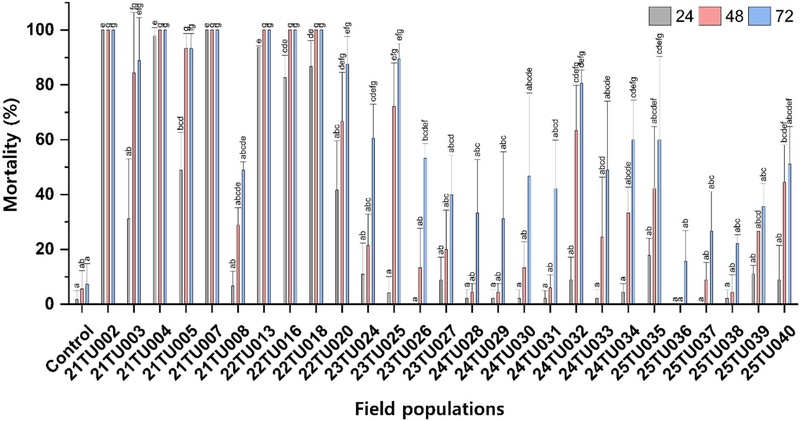
Average mortality against fluxametamide at 24, 48, and 72 h in Tetranychus urticae populations collected from strawberry farms during 2021 to 2025. Error bars above each symbol indicate the standard deviations and small alphabet letters below mean the statistical difference determined by Tukey’s HSD.
Gi Ryeol Yu: Rearing, Bioassay, Data analysis, Writing, https://orcid.org/0009-0008-6423-6019
Geon Woo Koh: Rearing, Bioassay
Yul Gyun Ahn: Draft review, Information collection, Writing
Eun Young Yang: Draft review, Information collection, Writing
June Sun Yoon: Draft review, Information collection, Writing
Deok Ho Kwon: Experiment design, Data analysis, Draft review & editing, https://orcid.org/0000-0003-2162-4771